










Indian Startup Tests Rotating Detonation Engine (RDE), Eyes Smaller Supersonic Missiles

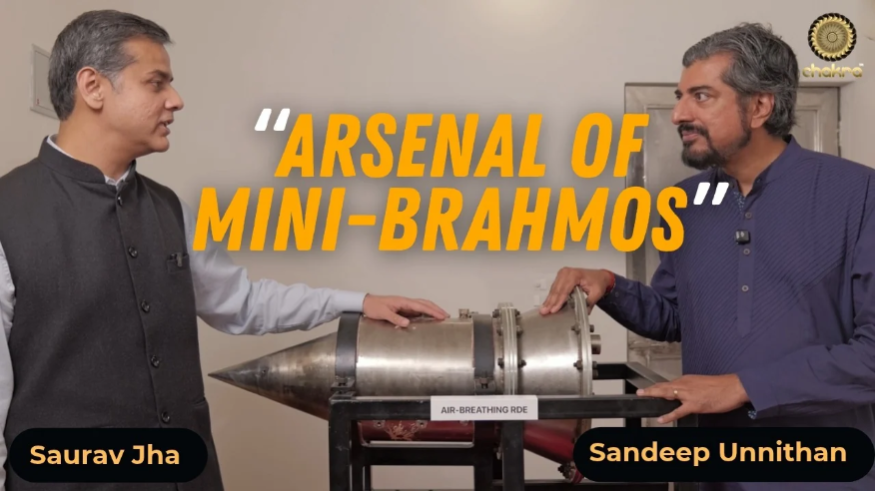
Indian aerospace startup Deep Propulse Aerospace successfully tested an air-breathing Rotating Detonation Engine (RDE), a new propulsion system that could pave the way for smaller and lighter supersonic missiles. The engine was tested at a DRDO facility in Hyderabad this July. It belongs to the 5 to 10 kilonewton (kN) class and is designed to offer a more compact alternative to conventional ramjet propulsion.
Speaking on The Sandeep Unnithan Show, Deep Propulse co-founder and CEO Saurav Jha said the engine could generate up to 8 kN of thrust under higher air-flow conditions. “If you push in 5 kg per second of air into this, which was not what was actually pushed in at the test, it can go up to 8 kilonewtons,” he said.
Saurav Jha described the technology as a potential game-changer for India's missile capabilities. “The flight-capable design could basically democratize a lot of things such as supersonic strike in the future,” he said.
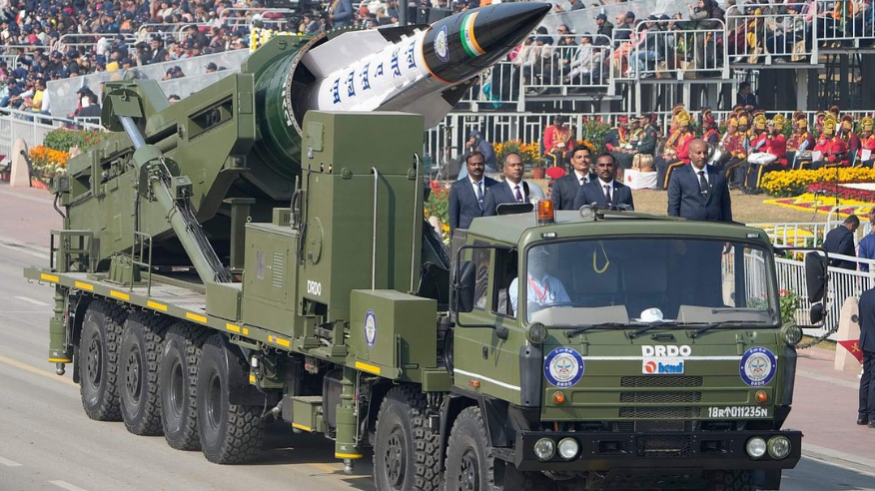
According to open-source defense estimates, the BrahMos missile’s two-stage propulsion system has a first-stage booster thrust of around 150–250 kN and the second-stage ramjet sustainer thrust of around 30–50 kN.
The key difference between an RDE and conventional jet propulsion lies in how fuel is burnt. In conventional gas turbines and ramjets, combustion takes place at subsonic speeds. An RDE uses a supersonic rotating detonation wave to compress the fuel-air mixture and ignite it.
Explaining the difference, Jha said, “Deflagration is basically a shock wave with a flame propagating at subsonic speeds, less than the speed of sound basically, less than Mach 1. Whereas detonation is a shock wave propagating at supersonic speeds.”
The rotating detonation wave sustains the combustion process as long as the engine receives the required fuel-air mixture. Unlike conventional turbine engines, the system does not require a compressor or moving parts. The detonation wave itself compresses the mixture. This also allows the engine to have a much smaller combustion chamber than a ramjet. Jha said the technology could be 15 to 25% more efficient in its use of air as an oxidiser.
The compact design could have direct implications for missile development. Jha said the flight-rated version would weigh around 40 kg, considerably less than conventional systems producing comparable thrust. For comparison, the Manik small turbofan engine used in Nirbhay-class cruise missiles produces around 4.41 kN of thrust.
The startup believes the technology could support the development of smaller and cheaper missiles that can be deployed in larger numbers. Jha described the concept as a ‘Mini BrahMos’. He said, “A Mini BrahMos would be a good way to put it.” However, he stressed that the new system would complement rather than replace the existing missile. “The BrahMos is a great system. You'll need that in your inventory. It's a mature system. But you can have many more of these.”
He said such missiles could be used to “completely overwhelm the enemy's air defense system”. Jha said a missile powered by the technology could carry a payload of around 200 kg and have a range of 300 to 600 km. A larger 20 kN system could potentially exceed 1,000 km. “Our agenda is to ultimately move towards that 1,500 km plus kind of mark,” he said.
The current engine remains a ground-test prototype. It has been tested for up to 15 seconds and does not yet have the regenerative cooling required for sustained flight. The company is developing a cooling jacket that will use liquid fuel to manage the engine's high temperatures.
Jha said prototypes with regenerative cooling are expected to be tested by early 2027. The company plans to extend ground testing beyond 30 seconds before moving towards flight testing. It is targeting early 2030 to offer an all-up supersonic cruise missile for user trials, though Jha said the timeline could be brought forward.
Deep Propulse is also developing a rotating detonation rocket engine for a smaller surface-to-air missile. Jha said the system could be around one metre long and serve as consumable ammunition for the armed forces. It could also be used in place of existing 70 mm Hydra rockets and 2.75-inch rockets carried by helicopters.
The company expects this system to enter production by 2028. CEO Saurav Jha said it could help counter jet-powered drones such as the Shahed-238 and Geran-4 and Geran-5.
He also pointed to a larger gap in India's propulsion capabilities. “Only two air-breathing propulsion systems in India have been operationally deployed,” he said. These are the PTAE-7 engine used on the Lakshya pilotless target aircraft and the integral rocket ramjet used on the Akash surface-to-air missile.
Jha identified the lack of indigenous propulsion technology as a major strategic weakness. “Our strategic Achilles heel is aero propulsion. Everything propulsion,” he said. He also pointed to India's dependence on imported propulsion technology for systems such as BrahMos.
Deep Propulse has collaborated with DRDO for the testing. The organisation provided the instrumentation used to collect test data. Jha said the engine has reached Technology Readiness Level 5 after being tested on an open-air test bed. He also said the Navy has issued a problem statement for an RDE-powered naval missile.
The technology is being developed by several countries. Jha cited US defence company RTX's work under the DARPA Gambit programme and said Russia and China were also pursuing the technology. He claimed that seven PLA institutes in China were working on it.
Beyond missiles, RDE technology could eventually have civilian applications in power generation and aviation. Jha said the unit could generate up to 9 megawatts of electric power, with thermal output exceeding 20 megawatts. Replacing conventional gas turbines, however, remains a longer-term goal.
“It will commoditize and democratize aero propulsion,” Jha said. He described the technology as “a general-purpose technology, no less important than AI in my mind or even electricity for that matter”, purporting that it could eventually make supersonic and high-speed flight more accessible.
Watch the full podcast: https://youtu.be/H4JqeCX17ck?si=iTRknbibihdXGerW
Savio Rodrigues
Savio Rodrigues is a Research Analyst at Escape Velocity MediaWorks Pvt Ltd and writes for Chakra News on Defence, Geopolitics, National Security. He holds a Master’s degree in International Relations from the University of Mumbai.


Comments