










Quantum sensors could detect submarines, stealth aircraft: Atomionics CTO
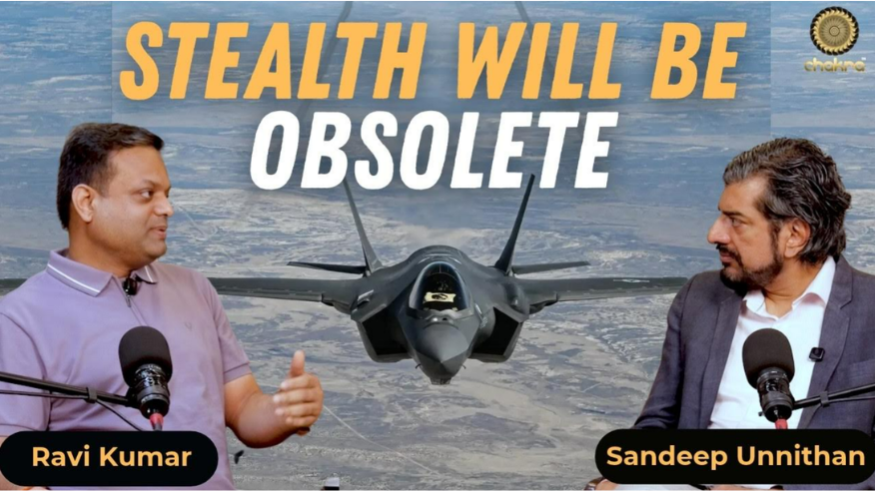
Quantum sensors could eventually help detect submarines, underground tunnels and even stealth aircraft by measuring gravitational signatures that cannot be hidden, said Dr Ravi Kumar, co-founder and chief technology officer of Singapore based quantum sensing company Atomionics.
Speaking on The Sandeep Unnithan Show, Kumar said gravity sensing offers a fundamentally different way of detecting objects from conventional radar and other electromagnetic systems. While stealth technologies are designed to reduce an aircraft or vessel’s radar signature, their mass still produces a gravitational signature. “You can never hide gravity signatures at all by any means,” Kumar said.
Atomionics is currently focused primarily on gravity sensing for mineral exploration and other subsurface applications. Its technology uses atom interferometry to measure very small variations in the Earth’s gravitational field. These variations can reveal differences in the density and structure of material beneath the surface, allowing the company to map underground features without physically drilling into the ground.
Kumar said the same principle has potential military applications. Quantum gravity sensors could be used to detect underground tunnels and facilities, including tunnels used for cross border trafficking. He said the technology could currently be used for detecting subsurface features at depths of roughly 20-50 metres, depending on the size of the feature being detected.
The company’s technology could also have applications in critical mineral exploration. Higher density mineral deposits produce small changes in local gravitational acceleration. By measuring these variations across an area and processing the data, the measurements can be converted into a three-dimensional picture of structures beneath the surface. Kumar described the technology as providing an “X-ray of the Earth’s crust”.
The more ambitious defence applications are still at an early stage. Kumar said a variant called a gravity radiometer could potentially detect large objects such as submarines by measuring differences in gravitational signals across a spatial area. However, the capability would require further development, particularly to achieve the sensitivity needed to detect objects at greater depths.
Kumar said Atomionics could potentially develop a submarine detection version of its technology in about 18 months if it had the required capital and support. However, he stressed that this would be a separate product line from the company’s present focus on mineral exploration, oil and gas and other subsurface applications.
The technology is also being developed for use on different platforms. Kumar said the company’s current systems weigh more than 200 kg, but Atomionics is working on a smaller version that could be mounted on a drone. The company has already moved its technology from laboratory systems that occupied an entire room to systems that can be deployed from vans and SUVs in the field.
Another potential military application is navigation in environments where GPS or other global navigation satellite systems are unavailable, jammed or spoofed. Kumar said quantum based inertial navigation systems could reduce the drift associated with conventional inertial navigation systems, which require periodic recalibration. This could be particularly useful for underwater operations, where satellite navigation signals are unavailable.
He also pointed to gravity aided navigation, where known gravitational patterns could be used as a reference for navigation. Combined with improved quantum inertial navigation, this could eventually allow platforms to navigate without relying on external signals.
The prospect of detecting stealth aircraft through gravity signatures is considerably further away. Kumar said the technology readiness level for detecting aircraft in this manner remains low and that development could take years. The challenge is the extremely high sensitivity required to detect a relatively distant, fast-moving object.
He said tunnels and large subsurface structures are currently more practical applications because they are closer to the surface and involve larger features. “This is the kind of entry point for us,” Kumar said, explaining why the company is currently concentrating on mineral exploration and other subsurface applications rather than military detection of aircraft or submarines.
Kumar also outlined a long-term vision in which quantum gravity sensing could contribute to a global navigation system. Sensors mounted on drones or satellites could eventually help build detailed gravity maps of the Earth. These maps could then support gravity aided navigation across land, underwater, in the air and potentially in space.
He said such a system could eventually provide a common navigation reference that does not depend on external signals. But he cautioned against putting a precise timeline on when the technology would reach that stage, saying its development would depend on investment, research and the specific applications being pursued.
Kumar said governments should therefore move beyond treating quantum technology purely as a research programme and focus more on productization and real-world applications. He argued that emerging private companies should receive access to government use cases and end users so that technologies can move more quickly from laboratories into operational systems.
For defence, the significance of quantum sensing lies in its potential to create new ways of seeing and navigating in environments where conventional technologies face limitations. But Kumar’s assessment also makes clear that the most dramatic applications, including detecting stealth aircraft and submarines, remain development goals rather than established operational capabilities.
Watch the Full Podcast: https://youtu.be/wEFqRgzvd14?si=gzPgPP68-S6md_du
Savio Rodrigues
Savio Rodrigues is a Research Analyst at Escape Velocity MediaWorks Pvt Ltd and writes for Chakra News on Defence, Geopolitics, National Security. He holds a Master’s degree in International Relations from the University of Mumbai.



Comments