







Is Iran Conflict Ending Soon?

Cutting Edge with Colonel Anurag Awasthi (Retd)
With Carice Witte, Founder and Executive Director of Signal Group
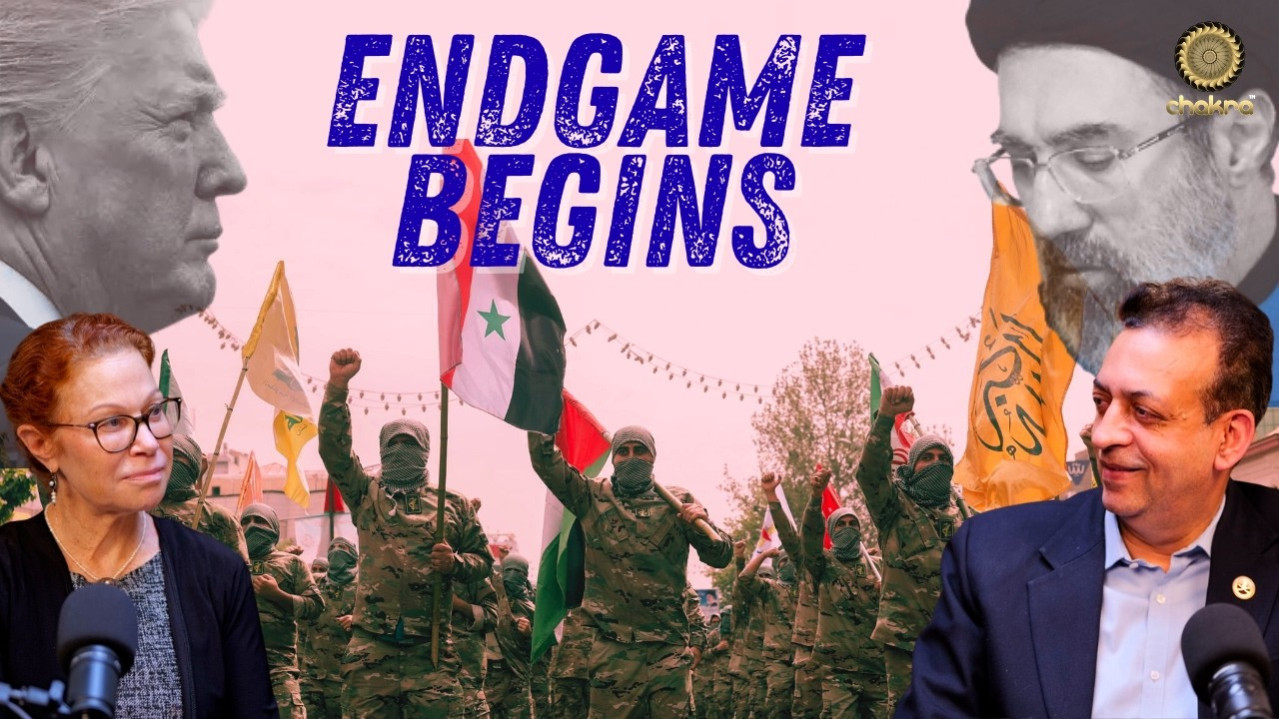
Colonel Anurag Awasthi (Retd): Hello and welcome to Cutting Edge, your show on geopolitics, defence, aerospace and whatever is happening all around the world. It has been a long time since we have spoken, and today we have Carice Witte all the way from Tel Aviv. She is the founder and executive director of Signal Group Tel Aviv, who is a very, very well-known research scholar, a thinker and a speaker in most of the Indian and international public forums. So, she has been here in Delhi to attend the Dialogue, and we really had a great time and a great effort to get her back to our studios and listen to what she has to speak about what's happening in the world with Iran and Israel war. Welcome, Kareese. What an honour to have you here again.
Carice Witte: It is a great privilege to be back. Thank you so much. Wonderful, wonderful.
Colonel Anurag Awasthi (Retd): I hope everybody down home is all right and everything's a lot of time in the shelters, but they're all good. Oh, that's good to know. So, let me start straight away with you and ask you, is there an end to what's happening, or is there still some time for this to, you know, be knocked off in some manner or the other? That's one. And the second thing is there's a huge amount of chatter which seems to be coming on to the social media, which says that, you know, a couple of formations down in the United States are now being prepped up for induction inside Iran as part of the boots on the ground option. You really think it's going to happen?
Carice Witte: First of all, I don't think that boots on the ground coincides with what is expected to be the end. Okay. And the end that we're hearing from Trump is that we need to get this going. It'll end soon. Not this week, implying maybe the end of next week. It has been assumed that this would be approximately a three-week experience or perhaps three weeks after the Straits of Hormuz were closed and energy stopped flowing, which took place relatively quickly within the conflict. So, I believe that Trump does not want to deprive the East of its extremely important requirement of energy. And overall, the war goals, more or less, are being achieved as we speak. Okay. And what would they be? Just to come back to the boots on the ground, I want to say that moving troops is a major logistical operation. Oh, yeah. And it takes time. Look how long it took just for Trump to get his hardware into the region. So, I think that there could be several reasons why there are, even though there's talk of preparation for that, they might actually be preparing. But when we look at it realistically, it doesn't seem to suit the goals of the effort and certainly the interests of the American people. Okay.
Colonel Anurag Awasthi (Retd): So, you really think the goals are going to be met now, pretty soon, as we speak?
Carice Witte: Well, Israel's goals are being met day by day, which is to degrade Iran's military capabilities. And each day that Israel and the United States carry out this bombing, they're slowing down Iran's capabilities. Trump's aims vary. And I think that in the end, he'll find a way to declare victory. Okay. So, there you go on that.
Colonel Anurag Awasthi (Retd): So, you've been studying China, and you're one of those very rare China specialists now sitting in Israel. So, how do you envision China's interest in this entire conflict? And where do you think China is looking at things? This is more complicated than it might seem on the face of it. On the one hand, we know that Iran and China are strategic partners. But for China, a strategic partnership is more about economics than about defence. Number one. So, China's economic interests in Iran are, of course, the well-known 10 per cent plus of oil.
Carice Witte: Oh, yes. They do some business. But that 25-year, $400 billion agreement that China and Iran supposedly signed some years ago has not really seen much fruit. The Iranians aren't too happy about the lack of investment by China in their country. Overall, China recognises the complexity of the geostrategic theatre and has hesitated to invest in Iran. Therefore, we have to look at the strategic interests. Why is China so interested in Iran when 10 per cent of the oil can come from other sources? I would say that having an anti-U.S. state in the Middle East has served China well. In fact, they say it. And they have said to me when I was there in December that the worst-case scenario for China would be not a more religious leadership. That wouldn't be good. Not a more militant, military government. Also, not good. The worst-case scenario is a pro-U.S. government. The chances of that happening at this point do look slim. But the Chinese are watching and ready to take whatever opportunity comes along. So, if Iran becomes a member of the family of nations, they see a smoother flow of oil, investment opportunities, and who is going to do the reconstruction. Yes, but then getting away from reconstruction and the entire calculus of how things are going to be shaping up in times to come. In the entire conflict or even the run-up to the conflict, when you look at it, I have a feeling that I have seen the Chinese just sitting on the fence.
Colonel Anurag Awasthi (Retd): They don't seem to be doing much. They are just waiting and watching, it seems. So, where is that strategic partnership?
Carice Witte: Well, I think that's a good question, and I think it's a question that many in the global south are asking. And China says we protest. We protest this war. We vigorously protest this war. Now, one way that they could act on that protest would be to cancel the visit of President Trump to Beijing at the end of this month. That would be a very firm sign that it supports Iran. It is against the kind of wars that it states it's against. But when asked about that, China's response is now more than ever that the US and China need to talk. We need to sit together, and we need to work together to solve the world's problems. So, I think that this is perhaps some enlightened self-interest on the part of the Chinese, where they feel a strong need for global stability, which mainly means better relations with the United States, in part because their domestic economic situation is very challenging, and to have to face external difficulties would be a lot to handle.
Colonel Anurag Awasthi (Retd): So, all of this is going on today in the West Asian part of the world and in the Middle East and the, you know, Hormuz and, you know, various, you know, it's tankers versus tanks these days and what have you. Do you really think Donald Trump's visit to Beijing will go through?
Carice Witte: Yes. That is my answer. That's a one-answer question. I think the interest on both sides is very strong. For example, the Chinese are talking about buying a large number of Boeing jets. Yes. At the same time, they are attaching that to a requirement to supply the Chinese with the engines they need for their C919. So, they would be getting an immediate benefit for the long term. It would take more than a decade to deliver those planes. So, they envision formulating deals that will certainly benefit China and perhaps look like they will also benefit the United States.
Colonel Anurag Awasthi (Retd): Oh, okay. But then, you know, getting on from, you know, swaying a little from what the Chinese have been doing, sitting on the fence, this, that and the other. There is a large amount of Chinese weapons and hardware, especially in the air defence domain, like the HQ9s, etc, etc. They haven't been very sterling during the war, yet again.
Carice Witte: You are right that those air defence systems do not look like they can handle the job. Yes. Because we know that Israel was able to take them out. In the 2025 June War. The question would be, to what extent is it the equipment? And to what extent is it the people who are handling the equipment? If it's Iranians, are they properly trained? Did they take this challenge seriously enough? But at the end of the day, you're right. It still doesn't look good. Other than that, I think China does supply technology, components, and training for Iran's military capabilities, not attack offensive weaponry necessarily. But there have been many, many, many reports about China supplying sodium percolate, which is converted into missile propellant and rocket propellant. And this was after the rocket propellant factory in Iran blew up. And China has continuously stated that it is the private sector, and the government doesn't know about it and doesn't have anything to do with it.
Colonel Anurag Awasthi (Retd): Okay, well, that was big news, by the way, when that blast and all of that happened there. So let me now get you back from China, where you specialise. And let me get you back to Iran. You really think after, you know, more than a week of war, actually ninth day of the 10th day today, what do you think is the relevance of IRGC? Is it still intact? Has it denuded a little? Is it fading? Is it not fading? Is it still the prima donna of whatever is being done in Iran? What's your view?
Carrice Witte: Well, the reality seems to be that Mojtaba Khamenei was their first choice for a number of reasons. And the fact that they supported him, and I'll go into the reasons in a moment. But just to answer your question very directly, it is indicative of the IRGC's continued control and power. They are in every arm and artery of the country. I'm not an Iran expert, but it is really commonly known that they run the show. And they would have chosen the leader or voted for the leader, the supreme leader, who would execute their interests. And given that he was involved in negotiating with them during the green movement in 2009, and that he does not have his own power base, neither militarily, of course, nor religiously either. Absolutely. Making him more dependent on them, and therefore they could control him.
Colonel Anurag Awasthi (Retd): Okay, so it's kind of, you know, a puppet kind of a system which has possibly taken shape. Is that what you think?
Carrice Witte: I wouldn't use the term puppet. But I would say that he does not have a lot of independent power at this point. So it does look like the IRGC reigns supreme. Oh, so IRGC still reigns supreme.
Colonel Anurag Awasthi (Retd): So, coming back from, you know, IRGC, and you know, one has been a little sceptical of the whole thing that mostly three days or four days of war, you found that IRGC suddenly realised that it needs to disintegrate into 31 segments, and have 31 commanders in 31 provinces of Iran, and give them, you know, fleeting powers to select targets and have decentralisation of command, this, that and the other. But somewhere down the line, that strategy also hasn't worked much because the kind of decimation that the Americans and Israel Air Force have done is pretty heavy. So, do you think that this kind of decentralisation in such a large country like Iran is possible or not? Is it feasible to do such things?
Carrice Witte: Well, I'm neither a military expert, again, nor an Iran expert. But looking at it logically, and as an Israeli, I would say that we have to remember the level of intelligence that Israel has on Iran is really, if I can use the term, mind-blowing. Okay. The fact that after the regime executed several people after the June 25 war, because they were called collaborators with Israel, and then mowed down perhaps tens of thousands of people after the protests, or during the protests to end the protests. Still, Israel was able to have the human intelligence necessary to know exactly where Khamenei and all of his leaders were going to be sitting in a meeting. Oh yes. In the exact time, moment and place. So, the fact that Israel's able to do that, I would say, indicates that wherever you are in Iran, there's a possibility that Israel knows where you are, and you're not necessarily safe because you are spread out. It also speaks to the fact that the war aims not to end with the area around Tehran, but to press across the country, and that's why it's taking some time, because there are launchers everywhere. We know it personally because I have sirens going off on my phone, even though I'm here in India, Central Command sirens, and we have been having sirens endlessly, also from Hezbollah and from Iran, and Hezbollah and Iran are coordinating, and I just want to add that because Hezbollah attacked Israel, this has given Israel the ability, the justification to go in and also address the Hezbollah threat. Oh, excellent, excellent.
Colonel Anurag Awasthi (Retd): So, you know, Carice, just before the war began, we had the second visit by Honourable Prime Minister Modi, and a huge amount of bonhomie was seen there, and you know, he had the privilege of addressing the Nasset also. Now, you know, there's so much of, you know, deep tech work, which India and Israel can do. And especially, you know, in Israel, you're the startup nation in the world, the kind of technologies, the destructive technologies that you can incubate the way you innovate, I think it's phenomenal. Do you find any scope for a lot of collaboration between India and Israel insofar as deep tech is concerned in the times to come?
Carrice Witte: I think that we have only scratched the surface. Israel's experience in this war has been really seminal in that for the first time in our experience, and I mean the Gaza war, we were sending engineers, we had most of the military that was reserves, we don't have enough of a standing army to handle what we had to face over the last two years. So, our reserves are between 22 years old and 45 years old. So, you have these senior leaders of startups, of defence companies, of all kinds of mid-stage companies on the front lines saying, this is a problem we need to solve. Here is another issue: bringing that home and immediately getting started. So, the amount of defence tech and dual-use tech that is coming out of that is absolutely incredible. And now the relationship between our two countries has reached this level of collaboration that is moving, I would like to say, in the direction of the kind of collaboration, the depth and the breadth that we have with the United States, that our two governments are establishing the economic ties that are needed to finance and support and facilitate an incredible blooming of collaboration and of course deep tech will be an important part.
Colonel Anurag Awasthi (Retd): Of course, so the operative part, which you just mentioned, is financing also because a bulk of issues get sorted by patient capital in deep tech because it takes a little time to reach a particular place, and the gestation periods are longer. So, this is great news, but then in the same sense that we are talking about the economics part of it, you really think IMEC is going to be a reality in the times to come?
Carrice Witte: You know, I am so glad you brought up IMEC. So, the India-Middle East Economic Corridor is a critical development for not only economic quarter and connectivity, but also is being seen in the larger context as a kind of economic defence, economic security and supply chain security. I was recently speaking to an expert from North-East India, and he was telling me that there is interest from Bangladesh in IMEC.
Colonel Anurag Awasthi (Retd): Oh, really? Yes. Well, that's news, that's news.
Carrice Witte: And I know that the US has named A Sherpa, who is guiding the US side of it, and he is from the State Department, and in fact, we are planning to hold our second annual conference on IMEC, an international conference bringing in global South and Indo-Pacific countries later this year. So, I think IMEC has great potential, there is a growing support among the participants, and one thing we should remember is that in this war, it was very surprising when we read the leak that the leader of Saudi Arabia, although he had said he did not want to see a war against Iran, he had lobbied Trump for exactly that. And when Iran attacked Saudi Arabia, they contacted Israel and said please hit these targets in Iran. So, it's possible that the relationship between Saudi Arabia and Israel will start moving from below the table to above the table.
Colonel Anurag Awasthi (Retd): That's absolute new news to a lot of us, and I'm sure it's going to be music to a lot of ears insofar as that is concerned. So, it's good to hear that IMEC is also on track, so somewhere down the line, this economic security and just not about supply chains is also on the agenda in India, Israel and largely the Middle East insofar as it. So that's been a great conversation, Carice, and I think we've touched nearly all topics, whatever we had to do, and all I wish is for this conflict to end soon, and I hope you fly back home as early as possible because it's been a little long for you. You've been all over the globe, starting from Korea to Japan to Raisina now and now here, and all I wish is good luck to everybody back home in Israel, and let's hope to meet soon.
Carrice Witte: Thank you so much. This has been a wonderful opportunity. It's always great to have a conversation with you, and I look forward to the next time.
Colonel Anurag Awasthi (Retd): Thank you very much. Have a great time. Thank you, and keep watching.
Watch the full podcast: https://www.youtube.com/watch?v=8GRdUfgqH78.
Arjun Dev Singh
Arjun Dev Singh has a deep interest in defence, security, and strategic affairs. With a strong analytical lens and a passion for military and geopolitical developments, Arjun strives to bring clarity and context to complex national and international issues.


Comments