



What Xi Jinping Fears About India

The Sandeep Unnithan Show
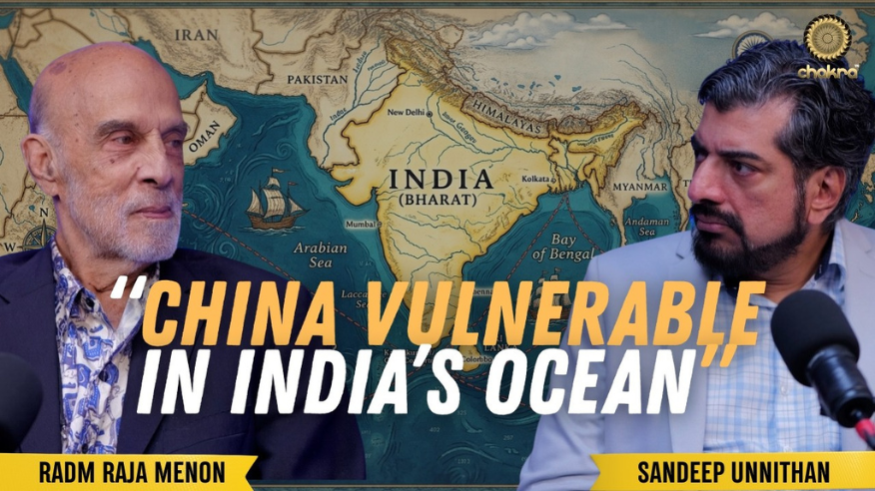
With Rear Admiral K Raja Menon (R), Former Assistant Chief of the Naval Staff, Naval Strategist
Sandeep Unnithan: Hello and welcome to the Sandeep Unnithan show, your weekly dose of defence, geopolitics and much more. Today, I'm privileged to have on my show Real Admiral Raja Menon. Admiral Menon, welcome back to my show.
Rear Admiral K Raja Menon (R): Morning, Sandeep. Pleasure to be here.
Sandeep Unnithan: We last spoke about nine months back, sir. So much has changed in the world, and yet so little has changed. One of them, one of those immutable factors, is the rise of China. Yes. That continues. Yes. Despite the war in West Asia, the United States, what are you seeing in China vis-a-vis the maritime domain, which you specialise in?
Rear Admiral K Raja Menon (R): Undoubtedly, the greatest event of the century is going to be the rise of China and the achievement of China's grand strategy, which is nothing fantastically new but just going back to where China was for 2000 years. The top of the pyramid in the confusion order of the world, in which China is the middle kingdom, and the other states pay tribute to China. What we are seeing is just a relocation of the same concept, and to achieve that, the long-term competitor of China is undoubtedly the United States. So, we really need to go into the details about how that competition is going. Some of the most analytical writers on what the result of that competition is, strangely enough, China-born Americans who are already saying that China is equal to the United States in all forms of engineering and electronics, biotechnology, and there are more users in the Western world of cheap Chinese AI LLM like Quen and Alibaba than the highly touted ChatGPT and Claude. And China is producing more research papers on the United States and has filed for more patents than the United States. The only area where the United States, I think, still holds the superiority is the nature of its competitive society. And if China has not already overtaken the United States, it has already overtaken the United States in purchasing power and GDP. So, the big issue for us is what is China's view of India's place in the world? And that, I'm afraid, is not very good. How does China see India, sir? I'll start with the declassified record of why China attacked India in 1962. Most Indians think it was over the boundary dispute. But declassified records now show that Mao Zedong called his army commander and gave him a four-word directive. Teach India a lesson. So the question is, what is that lesson? I venture to say that India must be taught its place in the Chinese world order as a tributary of China. That was the message. And subsequently, China has followed what I call a grand strategy, which is not, which doesn't mean it's just a big strategy, but it means certain definite things. One is that in grand strategy, war is one of the least desired options. The main objective is to win the competition, a long-term competition, using all forms of government. So China's competition is with the United States, and its strategy for India is to tie India down to South Asia using Pakistan. So, Sandeep, if I can use an analogy, China is like a fisherman using Pakistan as the bait to catch the Indian fish. So, when we get frantic about the Himalayan border and Pakistan, we are taking the Chinese bait because China's grand plan is global.
It was global until they attempted a strategic overstretch in Venezuela, and the United States replaced the regime and threw China out. So, China has since modified its objective into phase one, which is domination of Africa and Eurasia, and phase two, domination of the world. But we are now concerned with the domination of Eurasia and Africa.
Sandeep Unnithan: Are we in phase one, sir, of the Chinese grand strategy? How do you describe China's grand strategy in the last couple of years as it's evolved?
Rear Admiral K Raja Menon (R): That's a very good question, Sandeep. The only successful example of grand strategy is that followed by the United States after 1950, which resulted in the collapse of the Soviet Union without going to war. And China is, in my opinion, now using a grand strategy. And that grand strategy is unlike that of the United States. The United States grand strategy the manifestation are the six theatre commands. Europe command, Africa command, PACOM, CENTCOM, AMERICOM and so on. Special Forces command and so on. China is not following that route. China is following the route of trade domination, financial help, infrastructure, technology, international support for any regime and strategies like that, in which war is a very low option. So, unfortunately, I don't think India has the economic heft to also craft a grand strategy. I don't think it's possible with 4.5 trillion. Maybe. But even so, I admit that the nearest we come to a grand strategy is Viksit Bharat. But in my opinion, a grand strategy must have different silos of achievement. Our Viksit Bharat grand strategy does not appear to have a military silo.
So, that is a shortcoming.
Sandeep Unnithan: When you say that our grand strategy, that is the Viksit Bharat, doesn't have a military silo, you've actually seen statements to the effect that by 2047, we will be fully self-reliant in defence technology. We will be a major arms exporter. Where do you see the gap in statements?
Rear Admiral K Raja Menon (R): Excellent question, Sandeep. Excellent question. If we look at our defence budget, what we find is that by and large, it's an accountant's budget. How much money came in, and where the money is going. But that is not how large multinational firms and the United States defence budget are structured. Their budgets are structured to indicate what is the result being achieved by spending money. And that's called a program-based budget. For instance, we don't know how much money is going towards achieving air superiority or how much money is going towards tackling the northern border or the western border and so on. Unfortunately, well, fortunately, today we have a very omnipresent artificial intelligence. So, if one were to ask this question of AI, you will get more revealing answers. And the artificial intelligence admits that this is not based on any government data, and it is subject to correction. But the figures that we come to are that we seem to be spending 50 per cent of our defence budget on defending the northern border, 30 per cent on defending the western border, and 20 per cent on the oceanic front. Against China's grand strategy, therefore, the allocation of money doesn't seem to reflect our strategic priorities.
Sandeep Unnithan: Are you saying that you need to spend more on the maritime front as opposed to the northern front or the western front?
Rear Admiral K Raja Menon (R): Well, I don't want to appear partisan because I have a background in the Navy. But China's overall objective is global, in which the readjustment of the Himalayan border by a few hundred meters is inconsequential. But China would like to see that we focus our attention on the border and thereby prevent us from dominating the Indian Ocean, which is what will disturb Mrs Xi Jinping's sleep. And I'm not, I'm no expert on land warfare. But what strikes me as the most significant fact of the Galwan episode, which resulted in restructuring our strategy, was this: the Chinese troops and the Indian troops encountered each other without firearms, as agreed to earlier. But the Chinese appeared armed with steel clubs with spikes welded on all down the body, which could not have been made other than in a workshop at least a month earlier. So, it was not a chance encounter. The Chinese had come prepared at Galwan, where we lost that gallant commander of the Bihar regiment. And the Indian troops retaliated with rocks and boulders picked up from the river. And it looks as though that succeeded in focusing our attention on the border and away from the Indian Ocean.
Sandeep Unnithan: Admiral Menon, in recent months, we've seen a lot of movement in the Indian Ocean region. The government has sanctioned the Great Nicobar Island project, which you are a big votary of. The Prime Minister recently travelled to Indonesia, where we have taken up the development of Sabang port, which is a strategic port there at the mouth of the Strait of Malacca. The Prime Minister also visited Australia. There's a lot of engagement going on in the Indian Ocean countries. Do you see this as evidence of India finally moving to checkmate China in the Indian Ocean region?
Rear Admiral K Raja Menon (R): Yes, I do. These are great moves. And I commend the government for what they have done, including all that you said, Sandeep, and the establishment of an oil strategic reserve in the Middle East. These are great steps. But we must understand one thing, that the leadership of China consists of very hard men. And these foreign policy initiatives are beneficial and very good. But eventually, the decision that Beijing makes is going to depend on hard power. And I don't want to go into what exactly that means. But once this line of thinking is accepted, I'm sure the services will do what they are required to do.
Sandeep Unnithan: You also mentioned early on that Pakistan is China's cat's paw. We've known that for years. They have one cat's paw for the Indian subcontinent, another cat's paw for East Asia, which is North Korea. Do you think that we've been focused so extensively on the Pakistan cat's paw that we've devoted a lot of our resources towards the Western threat rather than the Northern threat? And what do you think are the kind of budgetary allocations you would like to see towards checkmating China, be it in the northern front or at sea?
Rear Admiral K Raja Menon (R): Again, that's a very good question, Sandeep. I'm afraid that the issue of Pakistan is hugely emotive. That's unfortunate. Is it because of the religious thing? Because of history. Partition and so on. But I'm sorry. In world affairs, we cannot afford to be sentimental. We have to be realistic. What is the realistic picture? The picture is that without the tanks, guns, aircraft, ships, submarines and most of all missile technology, nuclear weapons and satellite technology, what is Pakistan? It's a country with a GDP smaller than that of Tamil Nadu. So, I think we are missing the point here. What we have to achieve is to deter China from using Pakistan to tie us down. And the only answer to that is to dominate the Indian Ocean. That is not a service issue. It's an issue for India's grand strategy.
Sandeep Unnithan: What would India's grand strategy look like if it aims to raise the cost of a conflict with China and aims to raise the cost for China in any future conflict in the Indian Ocean?
Rear Admiral K Raja Menon (R): Just look at the world map. China's geography is not just poor, it's pathetic. It's stuck at one end of the Eurasian continent. And its prosperity depends on exports and foreign trade. And 80% of that trade flows westwards from China through the Indian Ocean. And they can't rely on that if they do not, if India controls, for instance, the Indian Ocean, the Malacca Straits, the Bab-el Mandap and the Suez Canal. Or at least it's an arbiter as to who controls the Suez Canal. For this, we need maritime power projection, which is the only thing that will deter China. It's huge geographical weakness. But with an economy of 19 trillion against ours 4.5 trillion, we have to realise that we are an asymmetric power. And we therefore have to rely on the only major factor in our favour, which is our supreme maritime geography.
Sandeep Unnithan: What are the aspects of India's maritime geography that give it that edge over China? One of course, you mentioned is the fact that there are choke points that are within reach of the Indian subcontinent. What are the other factors which we haven't paid enough attention to?
Rear Admiral K Raja Menon (R): We saw what happened in the Iran War. In the last 75 years, all the wars we have fought have not affected the economy and the prosperity of this country as much as the Iran War, a war that occurred 800 miles beyond our territorial borders. That is the effect of a world which today is economically integrated. If a country cannot remain economically integrated, it's dead. What is the country's chief vulnerability today? At the top of the list are data centres. The one project on which the maximum amount of money is being invested worldwide. And what is a data centre? It's a big, huge, concrete structure which any missile can knock down, followed by things like space connectivity, internet, international payment systems, your trade route, supply chains, critical minerals, oil reserves, and electricity grid. These are the state's vulnerabilities. The vulnerability of a state today is not territory. That era is gone. The era when we occupied Dhaka and forced Pakistan into a favourable peace talks in Simla in 1972, that era is gone because of many reasons. One is nuclear weapons. In 1999, Prime Minister Vajpayee refused the pleas of General Malik to allow the Indian Armed Forces to cross the LOC. There are other reasons. One of them is the lessons of the Ukraine war. What is the biggest lesson of the Ukraine war? It is that the biggest vulnerability of the armed forces is the human soldier. The drones about which there is so much hysteria in the world today were the 80% cause of creating 1.4 million Russian casualties by either FPV, direct attack on a soldier or the dropping of explosives by quadcopters. So, this business of holding ground with boots on the ground, that's gone. The new vulnerabilities are what I listed.
Sandeep Unnithan: So, do you believe that these two wars, the 88-hour Operation Sindoor that we saw last year and of course the Iran-US-Israel war, are actually what wars of the future are going to be? It's non-contact, kinetic, without forces crossing borders and holding territory.
Rear Admiral K Raja Menon (R): That's right. That's absolutely right. And I'm not saying something revolutionary here. I think by and large that has been accepted by the higher service organisations. I based that comment on the interview that I read in the week magazine of General Chauhan, where he more or less articulated what exactly you said, Sanjeev.
Sandeep Unnithan: So, the other aspect that we've seen in wars of the recent wars is the fact that technology favours the defender greatly, and we've seen that in the case of Iran and to some extent with Ukraine, in the Russia-Ukraine war. Ukraine, despite losing so much of its territory, has managed to inflict a lot of pain on Russia. Does that augur well for India's defence against China?
Rear Admiral K Raja Menon (R): I think the scenario for an India-China conflict is vastly different. It's substantially different, and I think we must also differentiate between the lessons from the Ukraine war and the Iran war. The biggest failure of the United States in the Iran war was that the conversion of President Trump's political objective into a military strategy was a big blunder, more than a blunder, because this successful translation depends on a frank conversation between the military and the political class. In the case of the United States, it was not a frank conversation. There was no conversation, and that is the primary reason for the fact that the United States did not achieve its objective. In the Ukraine war, I'm afraid there are questions of professional competence that arise from the performance of the Russian armed forces, but it's not very relevant to this discussion.
Sandeep Unnithan: Right, and you know, in the case of India, for instance, we've been debating on theatre commands, for instance, that's been on for seven, eight years now. We also see, you know, the demands for a conventional missile force. And the Air Force seems not to be in favour of this because it kind of takes away from the Air Force's role. How do you see this battle playing out, the fact that you need an integrated theatre command?
Rear Admiral K Raja Menon (R): I don't know what the exact form of the theatre command is going to take. But when the subject was first mooted, I did send a paper to the CDS on what I thought would be the ideal theatre command. And my big objection to what might emerge is that we are conferring a great power status on this country with a GDP smaller than that of Tamil Nadu. We are planning a five-domain tri-service theatre command against this feeble country, which is where we are indicating that we are swallowing the Chinese bait. It would make sense if our Western theatre were to expand continentally up to the Red Sea. That makes sense. But will that create ripples in the international arena? I think it will. So, this decision is at the political level. But what I think is going to emerge, I don't think is going to advance India's cause in any way.
Sandeep Unnithan: What is an alternate view of this? I mean, how do you see restructuring for a military architecture that will serve India's interests in the next 20 years or so?
Rear Admiral K Raja Menon (R): I want to point out to those who are in the know that China has global ambitions. But look at China's theatre commands. They are entirely continental. Does that mean China does not have global ambitions? Of course not. So, if the government of India is shy, and justifiably so, of declaring Indian theatre commands beyond the borders of India, then the answer would lie in not going into theatre commands, but fighting the war in theatres. Just a declaration of theatre command doesn't stop us from fighting the war in theatres.
Sandeep Unnithan: Right. And you've also, over the years, Rear Admiral Menon, you've made the point for interdiction of Chinese shipping in the Malacca Strait. We've seen that happening with this chokepoint warfare that you've spoken about. We saw that happening literally at the Strait of Hormuz. And Iran continues to exercise its chokehold over two and possibly control a third out of the seven chokepoints in the world. Do you see chokepoint warfare as one way for India to raise the costs of conflict for China?
Rear Admiral K Raja Menon (R): Absolutely. Absolutely. I'm not saying that we indulge in chokepoint warfare, but we hold out the threat of chokepoint warfare. Unfortunately, that's the only option we have. As I said, with a 4.5 trillion economy against a 19 trillion economy, that is our only option.
Sandeep Unnithan: And if an Indian maritime strategy were to focus on this, what are the kinds of expenses that you would see? How much would it cost us, really? What kind of reorientation of our strategy would it take? What kind of assets would we have to build up? Could you give us an idea of what this would entail?
Rear Admiral K Raja Menon (R): Yeah. Well, there is today, and I'm not going into what I think, but what is established. There is a certain hierarchy in deciding what a service strategy is. It draws from a national security strategy, which draws from national security objectives, which go beyond military objectives. It goes into things like digital sovereignty, energy security, the safety of 4 million Indians in the Gulf, and other factors. And the national security objectives are derived from documents like the Constitution, national values and so on. Unfortunately, these non-service directives have yet to be issued. So, in their absence, the services have to find their own way. And that's what the services are doing today. But definitely, one of the objectives is territorial defence, which is not adequate for the 21st century, because the vulnerabilities go beyond borders. And therefore, this needs urgent attention.
Sandeep Unnithan: And this point that you made, Admiral Menon, about chokepoint warfare, the fact that we need to reorient our budgets, capabilities, do you see a country like India being able to do that, given the fact that it's, say, regimes like Iran that can do things like this, North Korea that can do stuff like this? But can India actually do, you know, resort to something like this, which will paint it as the bad boy, you know, doing something when you're one of the countries that advocates for freedom of navigation at sea, for instance?
Rear Admiral K Raja Menon (R): We should continue to say that we are for freedom of navigation. Right. But what that means in actual practice can be what we conceive, which is that a hostile power to India cannot get away with depending upon open seas. Open seas in peace, yes. Open seas in a hostile environment, no.
Sandeep Unnithan: So, these contingencies would come into effect only in case of conflict. Or to prevent conflict.
Rear Admiral K Raja Menon (R): That's another issue. Sandeep, I think we are hugely confused by an English word called defence. Why is that? And a Hindi word called Raksha. Right. Don't they mean the same? That's not what armed forces are meant for. Armed forces are meant to prevent war. Because war is one of the most destructive consequences for a nation. So, we have to prevent war. And to prevent war, you must have an offensive capability that makes the enemy political leader think twice.
Sandeep Unnithan: There are friends of mine in the Air Force who say that, pretty much the same, that, you know, we have this concept of defence. I was just remembering what Air Marshal Deeptendu keeps talking about. The fact that the Air Force is actually an instrument. It's an offensive instrument of offensive power. And whereas our strategy is more defensively oriented. So, which is why you think that is one of the reasons why the Air Force is the last to be deployed in any conflict? Whether it should have been the other way around?
Rear Admiral K Raja Menon (R): Well, Air Marshal Diptendu Chaudhury is a good friend of mine. And we have great conversations between us. And I support the Air Force in its stand that the resolution of conflicts depends on the dominance of the air. No question. And that's one of the big lessons, which I didn't want to go into, of the Ukraine war. In the, in Moscow, the belief about the role of the armed forces is derived from the Soviet Union days. And in the Soviet Union, the primary objective of the country was to defend the Communist Party. And to defend the Communist Party, the Air Force and the Navy had no role. It could only be defended by the army. Therefore, the general staff in Moscow were dominated by the army. And the Navy and the Air Force had subordinate roles. And this is what happened in Ukraine. The Air Force was not allowed to act as an independent service. It was used by the huge Russian armoured column of 6,000 tanks, like something like an airborne artillery, which forced the Russian Air Force to fly low. And they got shot down by the hundreds of Stinger missiles supplied by the Americans. So that war doesn't teach us any useful lessons. But you saw, for instance, the complete freedom with which the Israeli and the American Air Force rampaged over Iran. That's how air forces are meant to be used.
Sandeep Unnithan: And therefore, you need a lot of fighter aircraft. You need manned fighters, and you need offensive air power. Yes. But when you're looking at instruments of offensive maritime power, what are the instruments that we really need? Do we have enough of those instruments?
Rear Admiral K Raja Menon (R): Not at the moment. Not at the moment. Because I think the most fearsome weapon today in all three services is a nuclear-powered attack submarine carrying 40 vertical launch silos. That's what we need. And that's what makes a hostile country think twice. But I don't see a difficulty in going down that route. We have brilliant technical people in the maritime arena. Just give them a chance, and they'll produce the good.
Sandeep Unnithan: But why is it that we've got an Arihant class series of ballistic missile submarines? Why is it that we've not had SSNs to complement them? I believe there was a plan in the 90s to have both of these parallel. But we chose one over the other. Why did that happen?
Rear Admiral K Raja Menon (R): That's a question of priorities, of defence priorities, which comes from higher defence thinking, which comes from the conversation between the defence and the political authority. We need to clear up that chain first. And that's what I'm suggesting now.
Sandeep Unnithan: But we have one submarine that's coming on lease from the Russian Federation, the Chakra, in a few years. Will one submarine be enough? Not at all. Not at all. What is the number that you have?
Rear Admiral K Raja Menon (R): Well, the primary weapon of the attack submarine today is not only the total capability of sea denial. That's just by the way. It is also a land attack weapon. And we need enough vertical launch silos to affect the thinking of the enemy country. And I would put that at a total Indian capability of not less than 6,000 to 8,000.
Sandeep Unnithan: 6,000 to 8,000 vertical launch silos.
Rear Admiral K Raja Menon (R): 6,000 to 8,000 vertical launch silos altogether, of which the Navy can comfortably field 4,000, 3,000 on board destroyers and 1,000 on board SSNs.
Sandeep Unnithan: And these would be tools that you could use to make China think twice before launching any offensive.
Rear Admiral K Raja Menon (R): Yes, Sandeep. We are not exploiting the advances in technology. Today, you can build a ship with a land attack capability, anti-submarine capability, anti-ship capability and anti-missile capability all in the same hull. We must exploit that advantage. The most brilliant defence industry in India today is naval shipbuilding.
Sandeep Unnithan: Yes.
Rear Admiral K Raja Menon (R): Give the boys a chance. They'll deliver the goods.
Sandeep Unnithan: I was looking at the timelines for, you know, how long it takes us to build warships. Anything between six and eight years for frigates and destroyers. The Chinese and the Japanese are now building frigates and destroyers at the rate of one every two or three years. Does that worry you a lot?
Rear Admiral K Raja Menon (R): Let's first give the shipyard the chance. Let's give the private sector a chance. Let them try to solve this problem that you've raised. If they can't solve it, then we can attempt to intervene. But for heaven's sake, let the competition work.
Sandeep Unnithan: You know, when you were talking about grand strategy, Admiral Menon, I was thinking about the fact that there's been considerable debate about where India's national security strategy is. You mentioned that we don't have one yet. It was supposed to have come out some years back. Do you see this as holding us back in our drive to visit Bharat? The fact that we don't have a written, articulated national security strategy. Is that a problem?
Rear Admiral K Raja Menon (R): It is a problem. It is a problem not stated because I'm saying it. That's the view of the three services. So I think that should be taken into account because that will more logically explain what we are spending our money on to achieve what outcome.
Sandeep Unnithan: So, the Raksha Mantri's operational directives, which are what is a substitute for a national security strategy, do not work in this context.
Rear Admiral K Raja Menon (R): No, it can work, but it needs constant upgradation. I'm not in the know of what the date of the last directive is, but that's up to the services to speak on.
Sandeep Unnithan: And national security strategy, if you can give our viewers what a national security strategy should look like for India, a $4.5 trillion economy, which hopes to be a developed country in the next 20 years or so, four times the economy it has today. What should a national security strategy for India look like?
Rear Admiral K Raja Menon (R): You remember, Sandeep, I listed what the vulnerability of a modern state is. We need to take that list and ensure that we can protect those and threaten the same list of the enemy country. Whoever the political class decides is our enemy country. We need to threaten those and defend ours. I think the national security strategy should look at that. That includes digital sovereignty, energy security, electricity generation, and a whole number of... I mean, what the destruction of these will achieve is that it will make a country deaf, dumb, mute, and in total darkness. That's the future of warfare.
Sandeep Unnithan: How is this different from wars as they were fought in the past? Is it possible to achieve these effects far more quickly with the kind of technologies that we are seeing today? For instance, algorithmic warfare, which, you know, integrates assets which have thinking machines, for instance.
Rear Admiral K Raja Menon (R): Definitely. Definitely. As far as that is concerned, we made a lot of progress with the present CDS and the integrated defence staff. They are talking about what you say, multi-domain warfare. That's all good. But when it comes to kinetic warfare, we have to decide what the targeting list is. And there, I think we need to up our thinking a bit.
Sandeep Unnithan: When you say targeting list, it's the list of targets, the target folder that the armed forces have of their adversary nations.
Rear Admiral K Raja Menon (R): Absolutely. And I mean, that's the biggest, I would say the biggest technology lesson that's come out of the Iran war. The Iran war indicated that the United States was able to generate a targeting list daily of more than 400 targets based upon extensive satellite surveillance, electronic surveillance and so on, fed into a project called Project Maven. And I'm sure we are capable of producing the same kind of targeting list. But we must first realise the necessity of waging war in that manner.
Sandeep Unnithan: Do you believe that our adversaries, and China is, of course, one of them, would actually plan to use these kinds of capabilities against us? And if so, how do you build resilience the way the Iranians did?
Rear Admiral K Raja Menon (R): At the moment, China is not intending to do anything of the kind against us. How do I say that? Because China puts out what it intends to do in documents. Those documents are available on the web. What are these documents? Five-year plans, communist party doctrines, military strategy guidelines, which are their form of military strategy, and defence upgradation plans. And in all these, China clearly articulates what the threat is, which is coming from the Pacific. India figures nowhere as a threat, other than a minor footnote which says, Limited war under informationalised conditions. It doesn't say India, but the worst you can assume is that that refers to us. Limited war.
Sandeep Unnithan: So, China's large amount of their mine space is still taken up by the United States.
Rear Admiral K Raja Menon (R): Absolutely, absolutely. I mean, we are talking about 5,000 missiles, 6,000 missile targets and all that. An exchange between the United States and China is going to involve targeting something like 20,000 targets, which goes from north of Japan all the way to Guam, Honolulu, the first island chain, the second island chain, and the same number of targets in mainland China. That's going to be on a different scale than what they are preparing for.
Sandeep Unnithan: And that scale is something that would itself deter the conflict of this from breaking out.
Rear Admiral K Raja Menon (R): Absolutely. I also want to say that we have to, you know, in all the military colleges of the world, the prime source is Clausewitz, class one Clausewitz, including in ours. But the number two position in all military colleges is Sun Tzu. And Sun Tzu's biggest he left behind a lot of Chinese sayings, which in the old days, people used to generally laugh at, saying, you know, old Chinese saying. But the Chinese armed forces today follow Sun Tzu. The number one aphorism is that a ruler, which means government, must choose war only as the last option. Because war is as destructive to one's own country as it is to an enemy invasion. That's what he said.
Sandeep Unnithan: Which is why the Chinese haven't fought a war in almost half a century.
Rear Admiral K Raja Menon (R): And the second thing that Sun Tzu says is that to fight and win in distant wars, you need to, in inverted commas, shape the environment. I don't know Chinese, but that's the best translation that comes out of what the Chinese said, shape the environment. That's what they're doing to us. How so? They gave nuclear weapons to Pakistan in 1980. We didn't seem to have read the signal. Then they fed them with, as I said, aircraft, tanks, guns, ships, aeroplanes. The Pakistan Earth Observation Satellite is a Chinese satellite launched by China. The ability of the Pakistan Air Force to launch air-to-air missiles is based on software that was installed by the Chinese. So, they are shaping the environment. Fortunately, the foreign office seems to have realised this, shaping the environment, because they tried to get into the Maldives, Sri Lanka, Bangladesh, and Myanmar. And diplomatically, we seem to have taken countermeasures. But hard power, not yet.
Sandeep Unnithan: But, you know, of late, Admiral Menendez has been a spate of BrahMos missile transfers. A colleague of mine has just written a piece on that, Deepak Badana, on how India seems to be playing China's game now, paying China back in the same coin, though not in the nuclear domain. But we've been selling the BrahMos missile, a very capable missile. It's a naval missile, of course, which first took the Philippines, then to Indonesia, now. Yes, yes. Are we checkmating China by transferring these kinds of things? What kind of...
Rear Admiral K Raja Menon (R): I think those are very good moves, as I said earlier. There seems to be a number of things going on. But my only complaint is that it is not enough. We need to demonstrate a little more hard power in the ocean.
Sandeep Unnithan: And by that, you mean the kind of assets like nuclear-powered attack submarines? Or is it transfers to friendly nations of warships or...
Rear Admiral K Raja Menon (R): Well, that... Let's be clear about one thing, which is that a nation is not going to suffer human casualties for another nation. So, Quad and all that, good. Yeah. But if we think that the Americans are going to accept body bags to defend India, we are being naive. Where the United States comes in, as far as we are concerned, is technology. United States technology is world-standard. And therefore, we need relationships.
Sandeep Unnithan: But the Americans don't share technology very easily. One of their top officers once told me that you're asking us for technology. We don't even give our closest allies. Do you see that as a problem?
Rear Admiral K Raja Menon (R): That is a problem. Every institution in India has a problem. The defence forces have a problem in defending. The diplomats have a problem in foreign affairs. That is a foreign affairs problem. I'm sorry. They have to solve it. How they do it is their business. That's what they're paid for. They have to convince the Americans that technology transfer to India is to their mutual benefit. How they do it is up to them.
Sandeep Unnithan: But, you know, they've not had a track record of ever sharing technology with us, as opposed to, say, the Soviet Union and now the Russian Federation. The BrahMos is a classic example of that. Dr Pillai was here, and he was talking about how it was actually authorised by the president himself. President Putin would interfere every time he had a problem. He would go to him. You don't see that kind of cooperation from the Americans. On the contrary, you actually see from Russia. Well, you don't see the Americans doing this kind of technology transfer. On the other hand, you actually see a lot of strings attached to even conventional platforms sold off the shelf, where engines don't come up in time. They're not delivered. There are strings attached, supply chain issues.
Rear Admiral K Raja Menon (R): I agree. These are problems. But that's why we have the MEA. They have to look after the external relations of this country. And I don't envy. I mean, I have told many of my friends in the MEA that I don't envy their task, for instance, in creating peace with Pakistan. I don't envy them one bit. They have a difficult task. Just as we have a difficult task. So, each institution must work for the betterment of the country.
Sandeep Unnithan: Absolutely. And on that note, Admiral Menon, such a pleasure speaking as always.
Rear Admiral K Raja Menon (R): Wonderful, Sandeep. Thank you.
Watch the full podcast: https://www.youtube.com/watch?v=NgyIiH4uVQo
Chakra Desk
Chakra News is a specialised digital media platform committed to in-depth coverage of India’s defence, national security, geopolitics, and critical technologies.


Comments