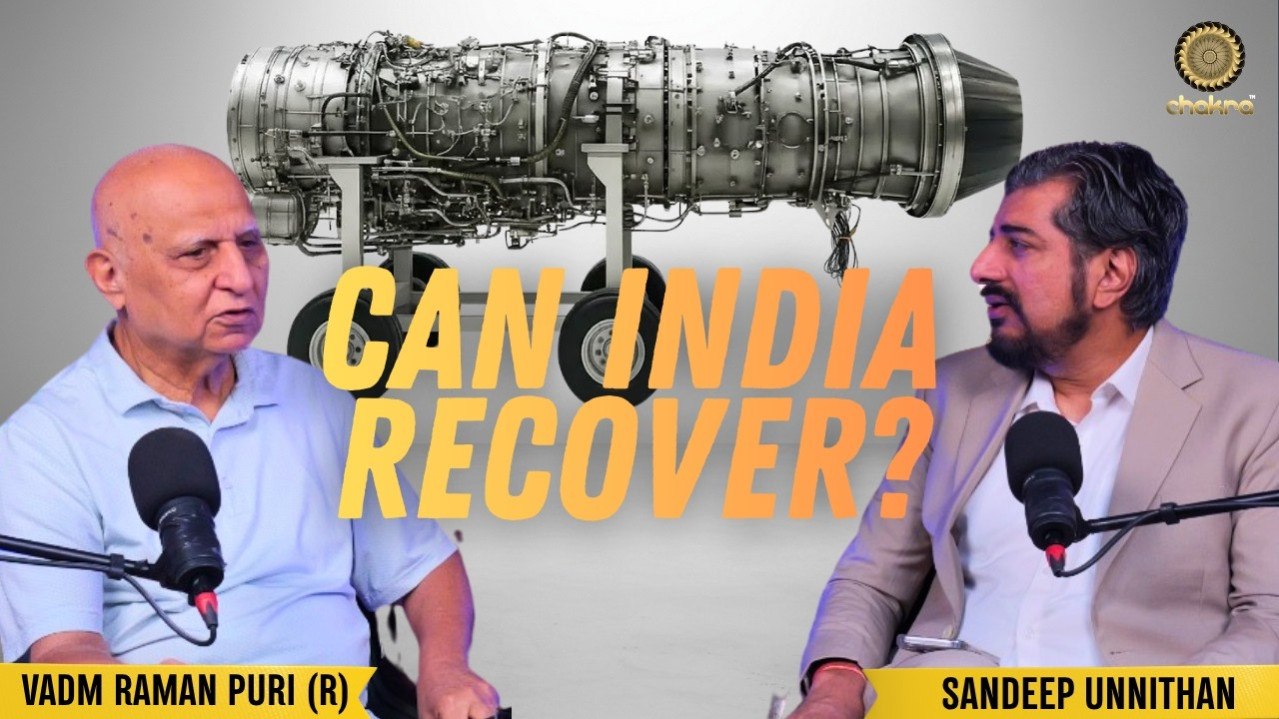








Who Killed the Kaveri Jet Engine

The Sandeep Unnithan Show
With Vice Admiral Raman Puri, Former Chief of Integrated Service Command (CISC)
Sandeep Unnithan: Hello and welcome to the Sandeep Unnithan show, your weekly dose of defence, geopolitics and much more. Today, I am privileged to welcome back on my show Vice Admiral Raman Puri (Retd). Admiral Puri was the former Chief of Integrated Defence Staff, a long-time votary of made in India as opposed to make in India and of course IDDM, Indigenously Designed, Developed, Manufactured Systems. Admiral Puri, welcome back to my show. Thank you so much. We were talking about engines, Admiral Puri and I was asking you about the Kaveri engine. Every discussion about jet engines in India begins with the Kaveri engine. What really happened with the Kaveri engine, and is it too late to revive the Kaveri?
Vice Admiral Raman Puri (Retd): I think I will go back to history first. I was in the chair as CISC from 2003 to 2006, early 2006 actually, not much of 2006. Somewhere, I think in 2004, 5, 6, there was talk of the Kaveri not doing well. What had happened was that Kaveri had gone for, I may be off by a year or two, thought of years, because now it's 20 years past, Kaveri had gone for, went for its high-altitude trials to Russia, and this may have been the second or the third trial they went, and the problem was that every trial took about a year. You had to first pack up the whole thing, do customs clearance here, do customs clearance there, wait for your turn to get a trial, do the trial and even if there was a minor thing to be done, you get the engine back here, start working on it. So, I do not know which iteration it was in. As a matter of fact, this is one of the reasons that caused the delay in the Kaveri; it has nothing to do with the people who are working on it, it is just that we did not have the required test facility.
Sandeep Unnithan: High altitude test facility.
Vice Admiral Raman Puri (Retd): You require two types of tests, one is a high-altitude test facility, and then you require a hack aircraft, which can actually take that engine to those engines and prove it to you.
Sandeep Unnithan: Would this be like an IGMDP without a Balasore or a Chandipur on it?
Vice Admiral Raman Puri (Retd): Yeah, I want to do the same. I want to do the same. You see, we talk so much about joint ventures and all that. Boeing, because of some purchase we must have made, whether it was civil aircraft or whatever, was committed to giving us a high-altitude test facility set up in the country. And Nagarjuna Sagar dam, because a high-altitude test facility requires a lot of water. I mean, some lakhs of gallons per second evaporate, and that is how that evaporation really produces the cooling, but they backed out. So, all this thing called offset, that offset did not work. Anyway, that is history now. So, we were fixed to go to Russia. In the final trial, when they went, what happened? The dry thrust engine was built in about 2005-06. The dry thrust engine was okay; it was developing, I think about 46 kilo Newton, where it should have developed for 49 or 50 kilo Newton, but that was not a great deal; it required some fine-tuning. There was a problem with the wet thrust engine that it had against the rated 72 kilo Newton. It was, I think, about 10-12 kilo Newton less than that. GTRE said basically, we understand the problem. They had done a lot of due diligence on this with an OEM. But by this time, I think there was impatience in the whole setup, you know, so many years have been taken.
Sandeep Unnithan: Which setup? You mean the user?
Vice Admiral Raman Puri (Retd): No, no, no. In the DRDO? Well, I would say in the system, not DRDO, DRDO was working on it. Between the Air Force, the Ministry, I mean, there was impatience, or whatever you may call it, I do not know. They set up a committee to see how we should proceed. To say there were delays when you know that you do not have a high-altitude test facility, you do not have this, and I must give credit to the people who thought of this program despite all these difficulties. But anyway, be that as it may, this committee, the DRDO stand was that look, let us continue with the, we know what the problems are, we know what to do with them, let us continue with the Kaveri. As a standby, EJ-200, which is the Eurofighter engine, gives a thrust of 90 kilonewtons, and does not require any major modification to the structure or aft structure of the aircraft where the engine would have to go. That would be, that is the option we would take. But the committee, which was headed by an Air Marshal from the Air Force, I think this happened, I think I had retired by then, and the committee was set up, I think in about 2007 or so. The committee sat down with one engineer from ADA, DRDO, represented by their, they did not have Director General, they had Chief Controller. So, Chief Controller ARO, DRDO stand I have told you. The committee, the other two members in the committee or maybe, I do not know, the insides of what the committee, how the committee came to this decision, they said no, GE-404 is the only option. But GE-404 was the only option; the net result of that was that the Kaveri program was to be closed. GE-404 is our option now. There is no backup option available. DRDO still said that, look, let Kaveri continue, EJ-200 could be an option or if you are so impressed with GE-404, but GE-404 unfortunately could not be the option of DRDO. Because if you put GE-404, the aft fuselage has to be redesigned, modified to get the engine inside. Finally, the decision taken was that we will close the funding to the Kaveri program. Although EJ-200, even if you ask me, I would say it was a better option because A, you are not making any modification to the aircraft, B, its thrust was 90 kilonewton. Here GE-404 thrust was, I think, in those days 80 or 81 kilonewton. A modification had to be done to upgrade it to 85 kilonewton, and that is why it is called GE-404 IN-20. But because the Kaveri rest of the structure was not the intakes, etc., they were not really designed for this engine; there were leakages, there were other problems. With the 404. With the 404, so that the available thrust was, I think, about 76 kilonewton at the end of the day. So, in hindsight, this was. In hindsight, I suppose the designer would have known even then. And the committee should have known, whatever it is, I am not. That was a catastrophic mistake. I cannot, whatever, it is not a catastrophe, with that, the aircraft is doing quite well. Right, with the 404. With the 404, there is nothing wrong with the aircraft; it's that the 404's availability is a problem. Yes, the availability of the 404 is a problem. For doing their tests, they readily supplied you with the engines. But for your LSP program, they readily supplied, but when it comes to production, that is where they sit down on your head, knowing that you cannot go anywhere else now. You think it is deliberate? I do not know, I mean, that is geopolitics, I would not know what it is. I would like to comment on it. But my view is that GE, then it became an ITAR problem, I am told. You have to get clearances, all know what. And GE probably was not too interested. They would rather sell.
Sandeep Unnithan: Anyway, whatever it was. So, what about GE's reliability as a supplier? We are getting deeper and deeper into it.
Vice Admiral Raman Puri (Retd): You judge it for yourself. 414, I do not know, every day I hear the contract has been signed, 80%.
Sandeep Unnithan: Cost escalation?
Vice Admiral Raman Puri (Retd): No, no, not cost escalation. See, I am not, I mean, you need aircraft. Anything that we buy will be far more costly. So, I am not worried about the cost part of it. But I am worried about the sustainability of the engine. In the sense that the aircraft requires parts. Some changes daily, some changes monthly, some changes yearly, some major. So, all this requires parts which will have to come from there only. In the case of 414, perhaps 80% of the things will be made here. But the 20% which you will not get, I mean, I do not know exactly what is there. But I reckon it will be the flight control system software you would know. The FADEC? No, that is the flight; FADEC is the engine control. Engine control, lube oil control. This control system will not be in your hands. So, whether you are held up because the engine is not coming or you are held up because this control system is not coming, you are in the same situation. So, this is where we are.
Sandeep Unnithan: So, that decision led to the Kaveri being delinked from the LCA in 2009? Roughly that time.
Vice Admiral Raman Puri (Retd): I mean, I would not go, as I told you, that my memory cannot be accurate to that extent. But roughly that period, 2009. And so today, to say so many years we have been working on, what have you been working on? You only worked on it until 2009 or so? I mean, any aircraft engine will take you 20-25 years if you are starting from scratch to develop. Thereafter, fine-tuning, all this will take place. But whatever the case may be, we would not be in the situation we are in today. If you do not stop, you continue with the Kaveri program, you would have done 72 kilonewton, you have gone up to 90 and 100 kilonewton also. And the fundamental issues in an aircraft development are its control systems, in the engine development are its Fuel, its lube-oil system. All those are the fundamental things which were practically solved at 62, it will also be solved for other things. But the net result of all this is that we are in the situation we are in today. And what is the situation for you? So, today the situation is because the funding was stopped, and I think DRDO's chairman's powers were small till about I think 4-5 years ago, when they were increased to something like 300 crores. At that time, this is my guess; I am not very sure what happened. At that time, DRDO funded the development to get one prototype made through industry, where the industry will get involved with the GTRE and understand the requirement of components and all that, and get many of them manufactured through an ecosystem that it sets up, all that. So, this way they got an engine developed between GTRE and Godrej, and I must say Godrej did a wonderful job. I visited Godrej and saw this facility; they have done a wonderful job. They are not denying the fact. So, this engine was built, and we can now get to almost 85 per cent. You know there will be some material which we do not have and all that. So, if you take those percentages, it will go up to about 90 per cent will be an indigenous engine, but nothing as critical as the FADEC is not available or the lube oil system. All those critical systems have been done, and there is an industry which has done all these systems. The second thing I would say is that this industry, I think, then the MOD was approached and another grant got, I do not know how many crores for them to produce six prototype production-grade engines. Dry thrust. Dry thrust. So, those engines have come up, I think some have already been delivered, and they are doing well. This is for the Ghatak UCAV. For the Ghatak.
Sandeep Unnithan: But the Kaveri as such in the configuration that it was.
Vice Admiral Raman Puri (Retd): I really do not know the present state, but I am told that some work is going on. But even if you produce a Kaveri today, I mean, will you re-modify the and if you re-modify and fit this engine in? I mean, those are things that really fit this engine. There will again be a certification issue, which will not take less than four years.
Sandeep Unnithan: Right.
Vice Admiral Raman Puri (Retd): So, we have to have, in my opinion, we now need to do this Kaveri to prove it. You can prove it in one LSP or on some aircraft. Prove it. I am not saying do your test.
Sandeep Unnithan: LSP and LCA Mark 1.
Vice Admiral Raman Puri (Retd): Put it in Mark 1 and prove it as much as you can. I do not know the mechanics of how it will be done. Right. But if I were to think about it, I mean, I would still if it works, I will run this LCA with the 72 kilo Newton. With a derated, I mean whatever it is that is 76 ultimately. See in some analysis that I had been involved with, one ex-designer of the GTRE, who is no more, is no longer in the system, I think about 6-7 years ago. He said that, at ground level, there will be no difference in performance. As a matter of fact, at ground level the with the Kaveri as it is, the aircraft will perform better. At about 3000 feet, the performance will be equal. But when it goes up higher than that, say 30000 feet beyond 10000 feet, then the degradation will be about between 5% and 10% in performance.
Sandeep Unnithan: So, you are saying that a limited series LCA is possible.
Vice Admiral Raman Puri (Retd): So, I said, even if you get, I do not know the mechanics of how they are going to achieve it. But if it was giving me 72 kilo Newton and getting 76 out of the GE today, maybe we can see that the subsonic performance, which is most of the performance of the aircraft, is with the dry thrust only. Wet thrust is only used when you want to. But that is necessary. I am not saying it is unnecessary. You have to get away, and all that you need is your wet thrust. But I suppose the aircraft can still go and fire a long-range missile without anything stopping it. If you are doing it from your own territory and not meeting the other guy, you can still use it. But anyway, these are speculations. To get the right performance out of an LCA Mark 1, you need about 90 kilo Newtons. I mean, if I were to do it today, I would develop a 90-kilo Newton thrust engine. And in my assessment, then see you take the numbers between LCA Mark 1, LCA Mark 2 and the first 6 squadrons of AMCA, you are totally a group of something like 500 engines, 500 aircraft. 500 aircraft, which will require engines over their lifetime. Now, this is half the air force. Half your air force is just this LCA Mark 1, LCA Mark 2, and in time to come soon, there will be a time when Mirages will go all these aircraft they have been there for a long time, but I suppose we will continue with them till we have to but fact is this will amount to half your air force.
Sandeep Unnithan: So, we were speaking earlier before the show, and you mentioned that you actually need multiple engine programs.
Vice Admiral Raman Puri (Retd): I agree with you. So, I personally feel that the quicker we started the better. I have a 90 kilo Newton engine program for which all material, everything is available, we know what to do, we don't require any JV or anything for it, and I don't think we will require it even for a 98 kilo Newton, which is the LCA mark 2 requirement and the AMCA mark 1 requirement. So one program 90 other program 98 now whether you can do develop a 90 kilo Newton and in the design itself make provision for it to be upgraded to 98 I am not technical person I can't tell you but definitely we need a program to produce a 90 kilo Newton to produce a 98 kilo Newton the mechanics of producing it will be one can think about I mean can I produce a 98 kilo Newton and then do the derating part of it in the design itself to bring it to 90 kilo Newton for I do not know but these programs you require I need a 90 kilo Newton engine I need a 98 because these are your workhorse engines these are two of my workhorse engines then 124 kilo Newton which is your which is now there is I am thinking I do not know what stage the joint venture is in today but if they have already entered into a joint venture proceed with it but I would still if I was my own view would be I would still do R&D on key parts of that engine I will still do R&D so that my own domestic technological readiness level in those areas at least goes up to four, five, six so that I am even in a joint venture I am sitting there as a very knowledgeable person the more knowledgeable you are the more you will contribute to that joint venture in that joint venture I suppose certain things will be our responsibility but certain things will be his responsibility but in whatever be the distribution of responsibilities I think we should those areas where which may not be in my part but maybe in the other person we should still do R&D to know what and raise.
Sandeep Unnithan: Our….
Vice Admiral Raman Puri (Retd): Technology Level.
Sandeep Unnithan: And not.
Vice Admiral Raman Puri (Retd): In this area not be you give me and I will fix it I mean I may even do joint work with them I don't know what are the parameters of this but 124 when is the AMCA mark 2 coming where is it what are the I don't think there are even sanctions given for it is it any work starts I mean aircraft design even if you because of the engines that are already there I mean the work that has already been done you may not take them full 20 years to develop that engine but I don't think 10 to 15 years has gone anywhere to be able to do aircraft development engine development then certification it's at least 15 to 15 years program I can't see it being less so we need actually multiple engine programs going on in the country we need also to seriously set up high altitude facility and set up get a hack aircraft hack aircraft we should get in any case we don't have it we don't we still
Sandeep Unnithan: Nirbhar on foreign suppliers as of now, yes, what are India's actual gaps today, sir, when it comes to building a jet engine, is it the hot section materials, is it the FADEC, is it high pressure
Vice Admiral Raman Puri (Retd): I am looking at it this materials especially the hot parts yes that's but up to 80 kilo Newton I think we are okay 80 and even 85 we will be probably okay beyond that I know some years ago I mean not within the system but outside the system in tanks and all that we were just sitting and talking the cost will be about 6-7 thousand crores to develop those materials and something may have already been done I mean after all DMRL is not just sitting quiet and doing nothing so lot of things may already be there so I couldn't tell you what is the current state of material development
Sandeep Unnithan: But.
Vice Admiral Raman Puri (Retd): These are generally the areas where we falter it is in the hot parts hot parts and then another area is the single crystal blade but we have got directional blades only thing that you suffer with the directional blade is that the life of the directional blade is half that of so instead of lasting for 8 years it will probably last 4 years but I would say that with my back to the wall I will accept that direction directionally solidified single crystal that technology exists single crystal blade I do not know where we are so do you
Sandeep Unnithan: Think that we should build up our technological capabilities from scratch.
Vice Admiral Raman Puri (Retd): or go through
Sandeep Unnithan: The Safran route, you know, like a ToT with Safran
Vice Admiral Raman Puri (Retd): ToT business is fine but even having done that ToT for the area that you did ToT with the other person you better start building your those areas also ToT doesn't work no ToT I am a very my own view on ToT has been that it's alright in the initial stages to get something through but nothing like I mean if the naval program today is working it is because of two reasons a we have not done gone through the ToT route b we have specialized manpower available for the purpose though the numbers are very small but with greater numbers greater funding available you do much better but that's for all design organizations even DRDO the problem is the same I mean laboratories today are at half the strength to do what they were during Abdul Kalam's time
Sandeep Unnithan: What is the reason?
Vice Admiral Raman Puri (Retd): I mean somewhere I think it was in 2010 11 I don't remember some they know there were manpower freeze all over the country including all the design organizations but that freeze has never gone I mean then if somebody retires you take one more and some you put up keep putting up cases and you get little amounts I remember doing the long term technology plan for DRDO and at that time I had estimated they require at least 3000 more scientists for the projects they were doing so they are understaffed definitely all laboratories are understaffed all design houses are
Sandeep Unnithan: Understaffed, I mean
Vice Admiral Raman Puri (Retd): We have shut down some laboratories. I would never shut down ANURAG, it is, I mean, if you shut down ANURAG, your processor requirements, at least they knew that area was building up, no, it will take time, then we shut down, and that is we shut down and down.
Sandeep Unnithan: Why is this blindness when it comes to technology development or this manpower thing? Is it because it's a one-size-fits-all for everyone, every government?
Vice Admiral Raman Puri (Retd): I don't know frankly. To me, I can only say what it should be. Why is it not like that? I think somewhere in the decision-making circles, there is not enough appreciation for what R&D is all about. Information technology is not the only R&D that we do where there are youngsters doing it, right? But even those youngsters require mentors, right? No R&D works without a mentor.
Sandeep Unnithan: And that's one of the biggest contributions of scientists.
Vice Admiral Raman Puri (Retd): By having the retirement age fixed at 60 for scientists in the DRDO, or I think in other major organisations, we are losing. I mean, I remember when I was running my ship, and we had a problem, and we used to call for Russian help. And the people coming were 70, 80, with white hair all over, but the brain was ticking. One of the Soviet-built ships. One of the Soviet-built ships. I mean, we had some systemic problems. They would come in to resolve them. They had to send from their design bureaus the people to solve those problems. But they did it. But the people were knowledgeable. They were solving mathematical problems while they were doing the problem. So, my point is that what manpower is required in the design organisation is one thing. The Department of Atomic Energy. See, they have a regular intake of human beings coming in. DRDO, for I think good 7 years, had no intake. They resulted in a situation where there were more scientist’s G's and F's than scientists B and C. The net result of that, when you create such, even if I start correcting today, it will take time. But I do not see the corrections taking place, frankly. But I would say that now the only way is, there was a Japanese paper I was reading. It was called India Technology Evaluation. Who produced it, I cannot really say. It was there in the net for a very short time. And the paper, he says, please increase the retirement age of all DRDO scientists to 65 years. And for some, you may increase it to even 70. I mean, if you require some 70, then induct a thousand people at the junior level straight away. I mean here, so if outsiders can see this and they are right about it, I do not know why we cannot think about it ourselves.
Sandeep Unnithan: You mentioned earlier about the naval programs and you know this has been one of my thrust areas as is that I see a problem in the way the engine programs are structured, the advanced technology programs are structured and you have an in-house program, the advanced technology vessel program which is driven by the Indian Navy, 90% of it is by the Indian Navy, a very unique organization. Is that the answer to the engine problems?
Vice Admiral Raman Puri (Retd): Let me put it this way. The program is managed by the Navy, but the program is run under the DRDO. The processes and procedures for the financial requirements, the decision-making, etc. Today, if you ask ATVP to, I mean, I have worked in the Navy also, if I were to run this program from a directorate in the Navy, it won't work. Won't it work? It won't work. Why not? It is difficult to work on it. Then, if I used to start going to the IFA of the Navy and then start doing the things, or you just add it, it won't work.
Sandeep Unnithan: So, this was structured for years by knowing all these programs.
Vice Admiral Raman Puri (Retd): It was structured very well, and the decision-making here, I mean, being the program of its nature, the decisions came very fast. Decisions came fast. I remember having met and gone to this program. There is a program. One great thing about this program was that they took it on themselves to say that if we take all care to select a vendor, but once you have selected a vendor, if he fails, I also fail. I mean, here it is, you have failed, you have done this, you have done that.
Sandeep Unnithan: So, it is basically a partner rather than a vendor; it is a development partner.
Vice Admiral Raman Puri (Retd): Yeah, it was a development partner approach that has taken this program forward. I mean, there are many good things. One has to learn the, actually, in VIF, I wrote a, there are two studies available. One is Make in India through R&D by DRDO stroke Industry. Next, I called Self-Reliance through R&D. I mean, this is part one and part two, actually. Only when I first wrote the report did I call it Make in India. By then, by the time I was writing the second report, it was, I think, 2015 or so, and this word Atmanirbharata had come in. So, I changed the title of this to Self-Reliance. I mean, a Prime Minister has got a great vision, Atmanirbharata. But the system below also must know how to convert this vision into a practical one. But you know, coming back. The system below, I am afraid, doesn't know. I mean you leave it to, everybody has got an opinion, but opinions don't make, I mean opinions don't make judgment. So, my view is that we definitely need, rather than joint ventures, we need to be doing what is called indigenously designed, developed, and manufactured. IDDM. But IDDM can't have a provision to leapfrog technology; you may do joint ventures. Joint ventures don't work, do you mean? Definitely not. The point is, it doesn't give you any self-reliance. I mean, you will get a system.
Sandeep Unnithan: But the BrahMos is a joint venture, isn't it?
Vice Admiral Raman Puri (Retd): BrahMos is different. I mean, joint venture with the DRDO.
Sandeep Unnithan: Right.
Vice Admiral Raman Puri (Retd): Where scientists were dealing with scientists. But when it comes to the services, you are not dealing with scientists. You are dealing with manuals. And the reason why a lot of indigenisation could take place is because the specifications and all that, there were designers who were looking into the whole thing. Right. Even today, it is produced that way. So, it was system designers who knew what, you see, to be able to develop a system or to design a system or to give a specification. For example, I have worked with the ONGC for some time as their security advisor, very keen to know how billion-dollar programs come up on time. And the key to that was they had two institutes just to develop specifications for what they wanted. Two institutes in ONGC used to work to develop specifications for what they want. That is the difference.
Sandeep Unnithan: So, how would you structure an organisation for these high-technology projects, like you mentioned, multiple engine programs? Are you talking of one authority?
Vice Admiral Raman Puri (Retd): I agree with you. But for ADA, there will be no LCA. But for ATVP, there would be no Arihant. No nuclear submarines. So, you definitely need project organisation when you have complex problems to deal with. You definitely need project organisations. Now, who is to drive them? Is it a question of where the domain knowledge lies? Domain knowledge in design and development lies. I mean, at least the project organisation should have an understanding of that. Are you not in favour of a user-driven approach? No, I am not saying, nothing against the user driving it. The air force? Yeah. I mean, frankly, I would not be able to comment on it. But it is a question of whoever has to be able to, for example, ADA designs aircraft. So, the design of aircraft is very, the person must know. But I do not say you could not have a good project manager, but he would have to probably be in the stream for some time. It cannot be that I am a CNS one day and the next day I am driving this program.
Sandeep Unnithan: You need to be an aircraft designer, you have to be like a ship designer, you are a ship designer, therefore, you drive an ATVP.
Vice Admiral Raman Puri (Retd): You are a ship designer or a submarine designer or something. I mean, if you see the ATVP, the design, there have been constructors, and there have been electrical engineers, the proper electrical engineers driving that program. And so, there are two major elements, and the design of the submarine itself has been done by the ship design organisation, SDG. The weapon systems design and development have all been with the DRDO. It is this project organization which has been able to bundle everybody. But then you require knowledgeable people there. They must have an understanding of how system engineering takes place from TRL 1 to 4 and 4 to 9. How do you take this whole system and button it up? I mean, somebody in ATVP would be better suited to talk about it than I can. But why is the whole structure very different from anything that is there elsewhere? Here you have had, there are people who are designers who have managed the organization and there have been systems, I mean our electrical system engineers who have managed this organisation. So, and for training you have, and there is a wing for training, which is manned by the submarine. There is a good submariner over there who is looking after how the training is to get this. So, my view is that yes, you must; they can be designed and done, but there must be people with the right type of domain knowledge put in place. Now, I do not say the Air Force does not have them or the Army does not have them. But if that can be done, by all means drive it. But even then, both these programs are working because they are with the DRDO.
Sandeep Unnithan: Right. You are saying that they would not work if they were not by the service. It will be difficult.
Vice Admiral Raman Puri (Retd): With the services, it will be very difficult. The method of sanction, the way, the, see services are designed to, a naval headquarter is designed to run an ATVP. To be able to define what they would want the day after tomorrow. Right. They are also designed to operate the Navy, to logistically support the Navy in terms of material, everything. I mean, that is the major task.
Sandeep Unnithan: Right. But then you also have ship designers, submarine designers, WESEE, you have all these WESEE is funded.
Vice Admiral Raman Puri (Retd): Yeah. That is where it, the chairman of WESEE is also in DRDO only. So, just see the Manning structure of WESEE. A person goes there, and he remains there for five years or six years, even. I think the Air Force has an equivalent organisation called the Software Development Group. I do not know what their task is, but they are also, they are trying to, but WESEE is much larger. They can design, develop and think. Command and control systems, for example, WESEE is excellent at, but that is what there has been.
Sandeep Unnithan: So, you do need a change in the kind of organisational structure to write this project.
Vice Admiral Raman Puri (Retd): To produce complex systems, should I say. When you want to produce complex systems, you need a good project organisation to drive that system. For example, every major project in DRDO today is being run by a project manager. There is a project, PD this, PD this thing. Although frankly, the powers they require, the manpower they require is nowhere near what they should have. I mean, I am making a statement. I feel the powers that the project manager should have, and the type of financial control that is exercised over them. I mean, once you have sanctioned a project for each line in that project, if I have to go back to a FA to say yes or no, then I mean, my, what is the, what, financial powers required of project managers to run a major project should be very different from what we get done.
Sandeep Unnithan: So, you are calling for sustained ring-fenced budgetary support, which is not caught up in this budgetary.
Vice Admiral Raman Puri (Retd): Every major program in the US, for example, has had both time and cost overruns. Yes. They have been in billions of dollars for multiple years. But you read the government accounting officer's report. Nowhere are they castigating everybody. Audit objection: Why has this not been completed? They go, they try to understand, and they say that, yes, a hypothesis went wrong. So, there is no change in the hypothesis being made. I mean, you really go into it, I mean, after all, no fools were working over there. Things can, but to start putting audit objections because things are not completed, then I think it is, you are going the wrong way.
Sandeep Unnithan: How do you build a specialist propulsion engineering cadre that will run this program for 15-20 years, because human resources are so important, as you pointed out?
Vice Admiral Raman Puri (Retd): Yeah, I said human resources are very important. For the immediate future, I would just take back the designers who are available. Not necessary, they may be in industry, they may be in academia, you can take the designers from wherever you get them. But most of them will come from GTRE itself, or there will be somebody in the National Aerospace Laboratories. For example, flight control systems and all that, Aeronautical Development Establishment, the National Aerospace Laboratories, and then humans work. And now they know what it means to design, your missiles are being designed. I mean, they all require the systems that have been set up in the missile systems; if you see, they have not come overnight. They have taken a good three decades to build, come. Today, that is why you can see me every day. I hear, yeh missile launch ho gayi yaar, wo missile. Today, they can go into the system where they are fairly reasonably clear that the system will deliver. It will meet the objective. So, all this has to come, and my only view today that I fear about is that we are losing the mentor part of our research, especially in the DRDO, at a very fast rate. People are retiring at 60. Because of this gap that took place because there was no recruitment, and even now, you have fixed the number of people, young people trickling into laboratories. I cannot imagine, I am not inside, so I do not know. But I cannot imagine being more than two people, three people here and there. You need people to come in at the junior level, work, and dirty their hands. They become useful after two to three to four years, and they have to be mentored all the way through. And you cannot lose that, and mentoring starts when they are scientists Fs and scientists Gs, then they can mentor the youngsters also. But I think we are, we think everything is information technology where you find so many hundred thousand people in TCS. But even there, they are not working without a mentor. Everywhere. You need mentorship. You need mentorship. You see Tata Engineering Services. You see, there is a lot of talent in the country. There are a lot of human resources available in the country. But you have got to start trusting our own people. You have got to place more. If a financial irregularity takes place, which does take place in organisations, do not put in so many controls that the bloody organisation stops functioning. So, we need to be more prudent about these things. All right, take him to task. Take him to task very severely and in a very quick time. But for God's sake, do not spoil the system.
Sandeep Unnithan: Right, absolutely. So, now, since you mentioned so, we are actually, to use an Air Force term, we are short of runway length when it comes to the indigenous jet engine program. Eight years is what you are saying it would take.
Vice Admiral Raman Puri (Retd): I do not think so. Four years, I mean, the certification part itself.
Sandeep Unnithan: That will take another four, five years.
Vice Admiral Raman Puri (Retd): Four, four. So, I mean, a total of eight to ten years. So, we are at least a decade away from seeing an indigenous jet engine. I think that we probably see an engine, all right. I mean, if you keep working on the Kaveri, you will see. You will probably see a 72-kilo Newton engine that can come earlier, also. But a properly developed 90 kilo Newton engine, which I think the LCA Mark I will require. And no matter what ToTs we do or all that, I think systems have a life cycle of something like how many years, 30 to 35 years, or 40 years also. I mean, B-52s have been running for how much?
Sandeep Unnithan: Yeah, the airframes have been running around for 50, 60 years.
Vice Admiral Raman Puri (Retd): The systems, only you keep changing, upgrading all the time. And that is going to be the trend in future also. So, if that is the case, I would in any case go and start this program. Ten years down the line, I will require them. By 2036, you will have your engines. By 2036, I will have. I mean, I will require them no matter if, for today's requirement, beg, borrow, steal, you need those engines. But I think if we start programs today and fund them, they will be much less than any aircraft deal that we make.
Sandeep Unnithan: You mean the import?
Vice Admiral Raman Puri (Retd): The total funding required. And provide so much manpower in the country, build so much capability in the country. Even where a program does not succeed, in the human resource development part of it, we gain a lot.
Sandeep Unnithan: Right. Absolutely. And how would you define success for all of these programs? I mean, would you say LCA Mark 1 flying with an indigenous engine, Mark 1A flying with an indigenous engine, Mark 2?
Vice Admiral Raman Puri (Retd): No, I would say as far as the aircraft is concerned, with a proper engine flying. I mean, I would not say LCAs, which are flying now, are not successful. They are successful. A Mark 1A, which flies, will be a successful aircraft. But the long-term sustenance if we look at. As a matter of fact, our whole procurement system does not look at sustenance. Over the life cycle of a platform? Nothing. When you do a ToT, I mean, going by L1 does not solve your life cycle problems. I mean, we have now started doing performance-based logistics in this thing. But that takes you for 5 years, it takes you for 10 years. And what is the cost you are paying? And then you will have someone else come and do your maintenance also.
Sandeep Unnithan: What is, to your mind, sir, the single biggest hurdle that could derail this roadmap that you outlined for the next 10 years? What is the biggest risk? I do not know.
Vice Admiral Raman Puri (Retd): It is the vision of the people who are going to make these decisions. I mean, I may not be correct. But whoever is taking this decision, much will depend on the vision that he has. Because it is the vision of the people who decided to go for a 124 kilo Newton engine and not worry about, I mean, leave this for ToT and import. That is their vision. I differ with it. That is all. Maybe they will turn out better than my vision. I do not know. But the vision thing is really important. The vision, I mean, what is your vision? And the vision has to be based on some understanding of the subject you are dealing with. It cannot be vision, vision. Vision can be my, see, when I say Atmanirbharata, yeah, what is my vision on Atmanirbharata? Just manufacturing it over here? What is my vision? And then after every five years, going and getting a re-ToT? So, my vision is important. And I feel Atmanirbharata only comes when you design, develop, and manufacture. IDDM.
Sandeep Unnithan: That is the sole criterion.
Vice Admiral Raman Puri (Retd): But IDDM, but for IDDM to succeed, the system to define your requirements has to be different. The system to develop from A to bring it to the induction stage, and then somebody to look at it when I am taking it to the induction stage, what will be the sustenance requirements that will come on the way? And how will I plan for them? I mean, so, you know, the easiest thing to do is ToT and a program. And then, as we run the program, we understand the sustainability problems and keep solving them all the way.
Sandeep Unnithan: Right. Absolutely. Thank you. Thank you so much, it's such a pleasure speaking with you. And as you've outlined, I think, and what you always repeat is that Atmanirbharata means Indian design, develop and manufacture, IDDM.
Vice Admiral Raman Puri (Retd): I am saying, I don't want to say there should be an autarky. But I do say that in design development, certain common-use components are available from multiple sources, and I may not do it. But there will be critical systems in the whole game that I am working on. For example, if I have an aircraft, I must know the flight control system. I must, for the engines, I must know where the FADEC is going to come from. I can sign a ToT, but the FADEC will be from that fellow, the hot part will be from that fellow. And then every time I go, I mean, there are lots of things one can talk about, what I have seen in my last, I mean, what my family says, when I had my 80th birthday, they said, Dad, you are 18 years old with 62 years of experience.
Sandeep Unnithan: On that note, thank you so much. It's been a pleasure speaking with you. One of the biggest votaries of IDDM, Atmanirbharata, as always, it's so good to speak with you and to know about the roadmap for India's jet engine program, as you outlined for us. Thank you so much for being here.
Vice Admiral Raman Puri (Retd): Thank you. Thank you so much.
Watch the full podcast: https://www.youtube.com/watch?v=lhLXN11JFbw
Chakra Desk
Chakra News is a specialised digital media platform committed to in-depth coverage of India’s defence, national security, geopolitics, and critical technologies.




Comments