





China’s ‘Naming Game’ Is a Long Game; India Must Counter It: Sriparna Pathak

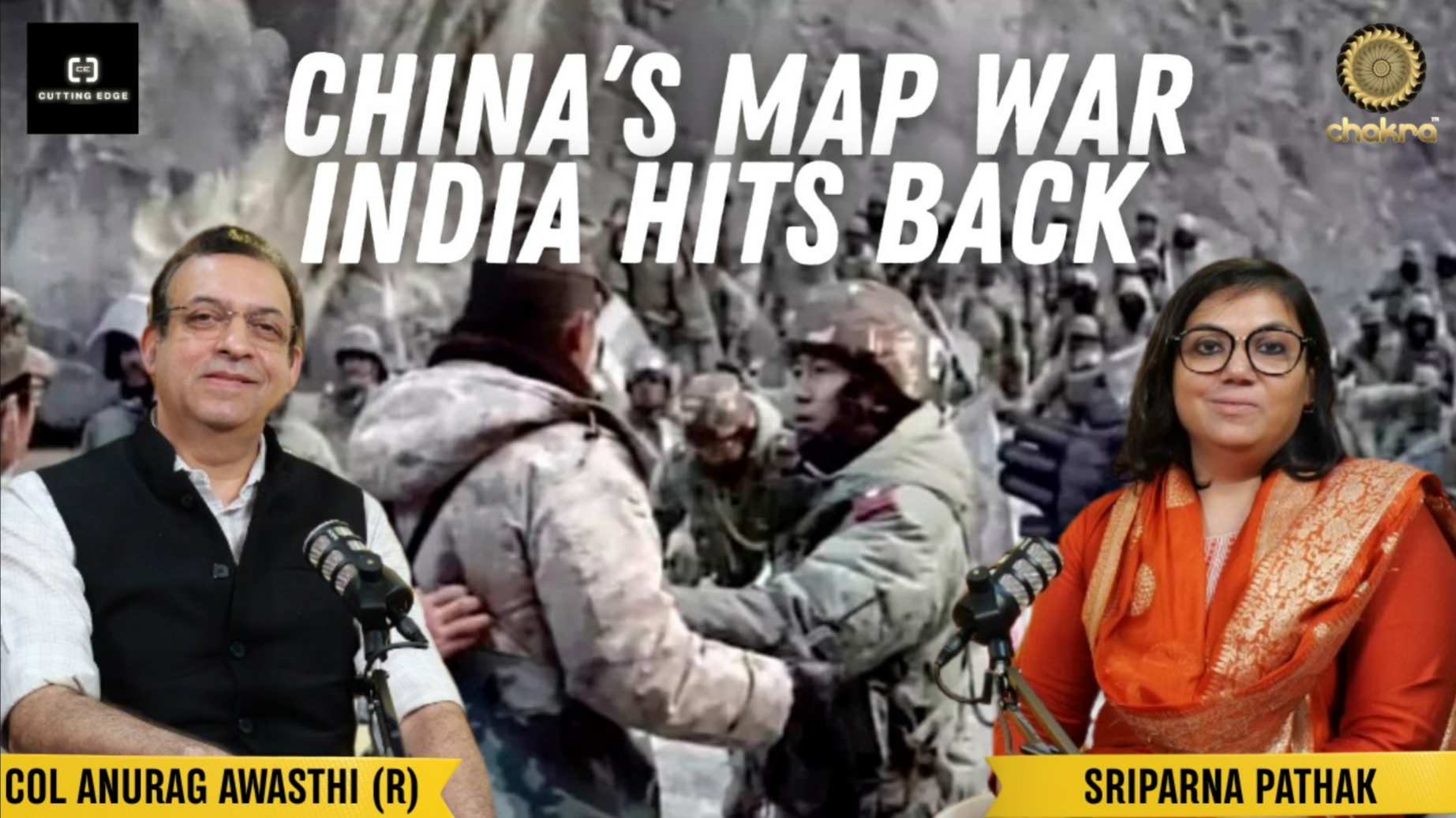
China’s repeated attempts to rename locations in Arunachal Pradesh are part of a broader, sustained campaign aimed at shaping cartographic records, public narratives and institutional memory, according to Dr. Sriparna Pathak who is a Professor of China Studies at Jindal Global University. Speaking on Cutting Edge with Col Aunrag Awasthi, Pathak described Beijing’s approach as a “sustained multi-domain grey zone campaign” combining cartographic aggression, psychological warfare and legal warfare.
China has issued successive lists of what it calls, ‘Standardised names’ for locations in Arunachal Pradesh, since 2017. Dr Pathak argued that the timing of these announcements has often coincided with developments involving India or Tibet. “The timing is rarely random and it is often reactive to either Indian or to Tibetan actions,” she said, pointing to the 2017 list following the Dalai Lama’s visit to Tawang and subsequent naming exercises, similar to that time.
Pathak welcomed India’s decision to officially standardise the names of 27 locations and geographical features in Arunachal Pradesh. She said that the move establishes an authoritative Indian cartographic record and directly challenges China’s attempts to create its own documentary trail. “China plays the long game,” she said. “They are trying to create a trail of documents so that from 50 years from now, 100 years from now, they will try and show, look, we had, we have this list.” She explained, this move would serve as a counter to Chinese claims arising in the future.
According to her, the significance goes beyond maps. The inclusion of historically important locations such as Longzhu and Thagla, along with sites associated with the 1962 war, embeds India’s historical and military legacy into its official geography. She argued that China’s repeated use of names such as Zangnan, its term for what it calls “Southern Tibet”, is intended to gradually normalise Beijing’s territorial narrative. “Erase the institution,” Pathak said, explaining the broader objective behind repeatedly using Chinese nomenclature. “They play the long game.”
The discussion also examined information warfare surrounding developments in Arunachal Pradesh, particularly reports concerning Upper Subansiri and Taksing. She cautioned against equating reports of Chinese personnel being observed near the border with permanent territorial occupation. “Temporary patrols or seasonal presence is not equal to permanent camps,” she said, stressing the importance of historical baselines, satellite imagery, patrol records and official verification when assessing such claims.
Dr Pathak argued that India needs a more comprehensive framework to deal with disinformation campaigns by the Chinese side. Existing fact checking mechanisms such as those by the PIB or the military, she said, are largely defensive because they respond after information has already circulated. She thus proposed a new concept of “Algorithmic Manipulation and Interference”, or AMI, as a possible framework for addressing hostile information activity.
The conversation then turned to the McMahon Line and the 1914 Simla Convention. Pathak argued that Beijing’s rejection of the McMahon Line is closely connected to its unwillingness to acknowledge Tibet’s treaty making capacity at the time. She also pointed to what she described as an inconsistency in China’s approach towards its boundary with Myanmar. “It's unfortunate that no one called them out on that,” she said. “India should have done that immediately after gaining independence.”
Dr Pathak also characterised recent India China engagement as ‘’stabilisation rather than settlement’’. According to her, Chinese diplomatic language focuses on “management” of the boundary dispute, while India continues to speak of its resolution. “Managing the boundary dispute means that they will not resolve it,” she said. “They're telling us very clearly, we don't want to resolve it.” She argued that maintaining an unresolved boundary dispute can keep Indian resources, attention and military personnel focused on the frontier, which can potentially constrain India’s wider economic and strategic priorities.
The final part of the discussion examined the reported visit of US Ambassador Sergio Gor to Ladakh and Washington’s growing engagement with Tibetan issues. Dr Pathak said the visit was likely to concern Beijing, particularly against the backdrop of increased US legislative and diplomatic attention towards Tibet. “It's definitely going to rattle them,” she said, while adding that India and the United States have areas of convergence on Tibetan cultural and religious freedoms.
For Dr Pathak, however, the broader lesson is that China’s long-term strategy requires an equally sustained Indian response. “If the PRC is going to play the long game, we play a more powerful game and a more aligned game with like-minded partners,” she said.
The discussion ultimately underscored that the contest with China is no longer confined to physical territory. Maps, terminology, historical memory, digital platforms and international diplomacy have all become part of the strategic contest. For India, the challenge is to ensure that its response remains equally persistent across all these domains.
Watch the full podcast: https://youtu.be/MVWB_sBDLx4?si=YDR298RAlFG4RCB_
Savio Rodrigues
Savio Rodrigues is a Research Analyst at Escape Velocity MediaWorks Pvt Ltd, where he writes extensively for Chakra Newz on defence, national security, geopolitics and emerging technologies. He holds a Master's degree in International Relations and Strategic Studies from the University of Mumbai and has experience in geopolitical risk analysis, strategic research and international affairs.



Comments