






China’s Grand Strategy Is Running Ahead of India’s

The first successful example that we have of this is what the US did after the Second World War, when they received a very long telegram from their ambassador in Moscow - George Kennen, who had been there for about 10 months, which said three rather explosive things. The first was that the Soviet Union, until recently their ally against Hitler, intended to continue the confrontation between communism and capitalism until the finish. The second was that they respected US military strength and they didn't seek a military confrontation. And the third was that they would support what they called wars of national liberation wherever they occurred.
To this, the Americans responded about a year later. They were taken by surprise. They were in a euphoric mood, and they put in place a number of measures. If there's anyone here my age, I doubt it, you'll be familiar with all this. First was the Marshall Plan to build up Germany and Japan into formidable industrial democracies against the Soviet Union. Second was the Truman Doctrine to support regimes affected by wars of national liberation. The third were all these pacts, NATO, CENTO and so on. And the fourth was technology denial, so this is not something new, it's quite old: total customs embargo, economic isolation.
And the last is what today would be called cognitive warfare. But there was a huge budget for the Voice of America Russian language broadcast. I can personally attest to the efficacy of that, having listened to it while in the former Soviet Union.
Coming to China, analysts have declared that after the arrival of Xi Jinping, China has transitioned to a grand strategy. So, I'm not trying to tell you that China has a grand strategy which is my opinion, but it is derived from specific Chinese documents. Among them, the most important one I'm just showing you now. You can Google this whenever you like, but the most important of these documents is the last one which I've put in red. That is The Science of Military Strategy, published by the NDU in 2020. That's the one that really affects us. I'd be grateful for anybody here from the military to confirm whether this book exists with us. Anyone? It does. Great.
This English translation was published by the US government. And for those who haven't seen it, at the end I'll just show a brief summary of what it is. But a big but. The Chinese grand strategy does not imitate that of the US because the US one was founded on military domination, which it inherited after the World War, with the collapse of the pound sterling and the dissolution of the British Empire. So the foundational strength is on the military, supremacy of the dollar, the reputation of the US as a safe place for investment, and lastly, the US Treasury, where in fact most of our $700 billion forex resides.
So, coming to what is China's grand strategy? I'm not saying anything unique. This is a country with a GDP of near $20 trillion. They are in competition with the United States and they want to win the competition without conflict.
So this basically has six silos, which you can see, all six of them. Among those six, we are concerned only with four of them, which is geostrategy, military, technological and economic. They have specific objectives. This may look like a very simple one, but I didn't want to clutter up the visual. There is a certain method to each silo. But I just want to say two things here. One is war is not considered a desirable option, and the second is it intends to win, if not successfully challenge, US domination.
So when we come to examine the four silos that concern us, we come to a very important point.
So far it's all been theory, but this is on the ground. How far has China got with its global grand strategy? It either owns or operates 129 ports in 65 countries. It is a preferred trading partner for 120 countries. The dollar transaction in the international financial system has fallen to 57%. It dominates manufacturing. It dominates all green technology, solar cells, batteries and everything else.
They have successfully weaned Russia into the yuan international financial system. Turkey, last week, hedging about the weakening of NATO, has joined the Mecca Agreement. Chinese manufacturers have so decimated European manufacturing that there has been a political pushback, and France and Germany are likely to move to the right. They've also virtually decimated Italy's high fashion industry. The cross-border version of the cross-border interbank payment system is rapidly challenging SWIFT, and according to the four great pollsters in the world, Council on Foreign Relations, Pew, BBC and Gallup, more people see China as a benign power today.
But what about the rest of the journey? Will they succeed in their long-term competition of challenging the United States? Very frankly, I don't know, and I don't think anyone does either. What I'm most alarmed with is that the technique of coming to a conclusion on a subject which has eight or nine domains is called net assessment, and unfortunately net assessment has the ability to tell unpleasant truths. So the Net Assessment Office, which started in the US, has been abolished by Hegseth, which is not surprising.
If you look at this, you can look at the probable outcomes, but the important thing is that somebody must put all these eight domains together, and that would take, I don't think, less than three to six months. I don't think anyone in India has attempted this. Some institutes in the US and Australia have done so. As you can see, the US still leads in military power and China is rapidly catching up in AI, and long-term demography may be against China if the US continues to accept immigrants. But this may also explain why China is so advanced in robotics.
In the near term, I think China is definitely going to catch up, but they are far superior in areas like engineering, civil engineering, electrical, electronic and so on.
But when we come to the four that concern us, there is a big gap in assessing what China intends to do because there is a big cultural difference between us and them. They think in decades. They don't believe any of the strategists that we believe in, or the US, or Britain, or France, or Germany. From 2014 to 2015 onwards, they rely solely on Sun Tzu, and he is the source of that document which I said, which apparently we have copies of. I'm so glad to hear.
But in this there are three aspects which are shown in red, which I will amplify one by one. The first is deception. This is not the same as our principle of surprise. Surprise is during operations. Deception is pretending to be interested in an area where you're not. So that's completely different. The second is that they believe that they must attack the enemy's strategy, not his military. And the third is that, which particularly applies to us, shaping the environment so that they achieve victory without fighting. So I'll take the last one first.
What do they mean by shaping the environment? Don't worry about the details of this slide, but the slide is actually much longer, and this has been going on for over half a century. They converted a technologically backward country into a nuclear weapon power against us. They have given them a satellite today, a Chinese satellite launched from a Chinese site, which has an orbit solely for observing India night and day.
The question that I want to ask you is, what is it that we don't get? Haven't we understood this? How long does it take for us to catch on that they want to tie us down in a senseless escalation?
Let's deal with the next one. Since instituting their grand strategy around 2015, after Xi Jinping came, I'm showing you the list of what they have done since then. Army officers here will be familiar with the left hand column. Naval officers here, I'm sure, will be familiar with the right hand column. But I have doubts whether anyone has put these lists together.
What I'm trying to say is that if you look at the right side column, as things get tighter for them or as they proceed, they are initiating action on the left hand side almost as if to say to us, "Look, look this way, look this way." So finally, after Galwan, it appears that we did look that way, and we spent a lot of money building infrastructure, which I don't think is a bad idea. It's national infrastructure. But the big question I want to raise is, is this not deception?
So against this, what can we do in an asymmetric situation when we are a $4.2 trillion economy and they are $19 to $20 trillion? The third dictum of theirs is that they must attack our strategy, and that is what they're doing by making us perceive a northern threat, perceive a western threat, and they are attacking our weakest point, which is our defence budget.
So there isn't enough money to dominate the Indian Ocean. And that is the only advantage we have against a $19 trillion economy. I don't believe that a country with a $4.2 trillion economy can sit across the table with a $19 trillion economy and come to an equitable peace agreement unless we have some card to play.
And this, I believe, is the card. I'm not suggesting getting into a conflict with the Chinese Navy, but what they believe in is conventional deterrence. Conventional deterrence: open seas, open Indo-Pacific in peace, no access in war.
Unfortunately, while we are cobbling our strategy together, theirs is running ahead. And we've recently had the Iran war. At the end of the Iran war, whatever the agreement may be between the US and Iran, it will certainly emerge as the dominant power in the Middle East with a denial capability that is indicated in the circle. And how has Iran actually achieved this? You don't have to believe the press about the brilliance of the IRGC and all that. I don't subscribe to that. This is the source of all the trouble.
China has been arming Iran from early 1980, the same time they started weaponising Pakistan. I don't think it's a coincidence. The ability of Iran to have knocked out the main American radar in Jordan came from data from a Chinese satellite. The Iranians actually own a satellite which is made in China and launched by China. So this is going to create further trouble.
It is, I think, in response to this that the Mecca Agreement has been formed. But on 20th July 2028, the Houthis, who are armed with 900 missiles and 1,000 drones, announced the blockade of the Bab el Mandeb against Saudi Arabia, only Saudi Arabia for the present.
But you've seen the source of the trouble. So this Chinese aid to Iran has been going on for over 50 years. And we should not forget that it was the Iran war that created the maximum damage to the Indian economy, over $7 billion, a war that took place 650 miles away from our borders where we were concentrating on.
I'm not pointing fingers. We were caught by surprise. But it would be a tragedy to be caught by surprise again, which I think might happen if you don't look after this. The eastern littoral of the Bab el Mandeb is dominated by a power which owes its weapons finally to China.
Why Iran? So I think I'm running out of time, so I'll just finish. The last thing I just want to say is this: there is no harm in looking at our borders, but the era of war to gain territory is over. Wars may occur at the border, but it will not be about the border. War will be across the border. And why is that? Because these are the vulnerabilities of any modern nation. You destroy any three of these or two of these and the country will be back to the Stone Age and in darkness. So these are the realities that we need to confirm.
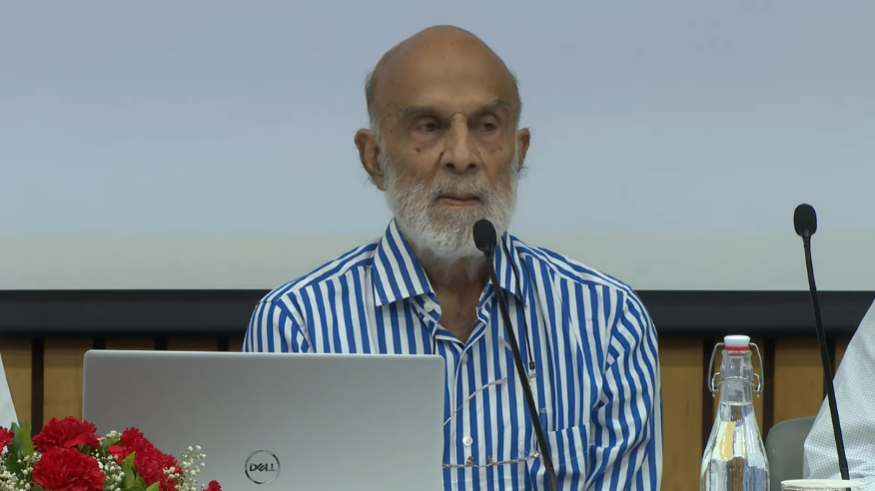
Excerpt from a panel discussion on the topic- “China’s Grand Strategy: India’s Long-Term Response in an Asymmetric Strategic Environment”
Rear Admiral Raja Menon (R)
Rear Admiral Raja Menon (Retd) is a distinguished retired Indian Navy officer, prominent strategic analyst, and author. He is widely recognized as one of India's leading voices on maritime security, nuclear strategy, and geopolitics.




Comments