








US Deploys Weapons in Space. Has the Space Arms Race Begun?

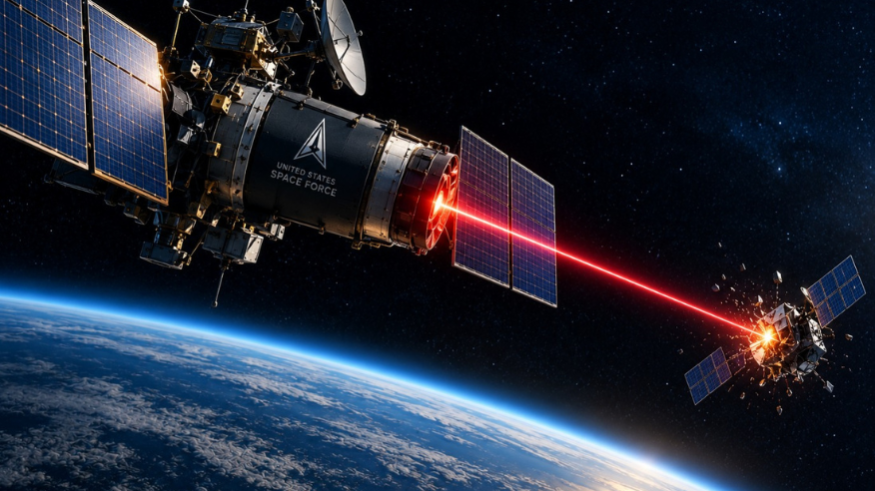
Deepak Bhadana was in conversation with space law expert Dr Ranjana Kaul on the implications of weapons being placed in space and the possibility of a new space arms race. Dr Kaul explained that the 1967 Outer Space Treaty does not ban all weapons in space, but prohibits nuclear weapons and weapons of mass destruction in Earth orbit. She discussed kinetic and non-kinetic anti-satellite capabilities, the dual use nature of satellites, space debris and liability, and the challenges posed by commercial systems in conflicts. On India, she said India supports a binding treaty to prevent an arms race in outer space, but needs to improve its institutional understanding of space law and recognise that peaceful use does not simply mean civilian space activity.
Following is the Transcript of their conversation:
Deepak Bhadana: Hello and welcome to Chakra News. Now the US has admitted that it has placed weapons in space. So, does that mean a new space arms race has begun? Are we entering the era of space wars? To understand the implications of this for the world at large and for India in particular, we've got with us expert in space laws, Dr. Ranjana Kaul.
Dr. Kaul, thank you for joining us. Thank you. Thank you very much for inviting me here.
Dr Ranjana Kaul: It's our pleasure and it's good to have you back. I mean, we had a wonderful conversation with you on the Space Club of India. And it's good to be back.
Deepak Bhadana: And it's good to be back and hear all your news and all Sandeep's news. Excellent. Thank you, ma'am.
Ma'am, let's begin with the 1967 treaty. I mean, everyone's talking about it. Now, the 1967 treaty stated that no weapons of mass destruction or nuclear weapons would be placed in space.
But the US has placed these anti-satellite weapons as they were in space. So are they in contravention of the laws that they agreed to the treaty or are we looking at something else? So the Outer Space Treaty does not say that there will be no weapons in outer space.
Dr Ranjana Kaul: What it says is that the states that had that is to say that the states that have ratified the Outer Space Treaty, they undertake not to place nuclear and any other weapon of mass destruction in the orbit around the earth. Right. And that is all that it says that it will do.
In other words, the orbit around the earth is denuclearised. Right. That is in Article 4 and Para 1. The Para 2 which relates to the moon and celestial body says that the moon and celestial bodies will be exclusively for peaceful purposes.
That term exclusively for peaceful purposes is a euphemism for complete disarmament. And second of all that Para 2 says that testing of any type of weapons. So where in Para 1 it is saying nuclear and any weapons of mass destruction. On the moon it is saying any type of weapon which you could interpret to mean also conventional weapons.
So we leave the moon and the celestial bodies for the moment. We will just talk about the earth orbit. So in specific terms what it is saying, what it has done is that it denuclearises the orbit around the earth. Now what the US has said is that it has got weapons to control space in orbit. Now exactly what is the nature of those weapons? Are they kinetic or not kinetic? That is also explained that they are both kinetic and not kinetic.
Both. Kinetic and non-kinetic. Both is what that statement reads.
We do not know whether that means nuclear and WMD because that would be a total breach of the outer space treaty which the United States has ratified. So for the moment let's just assume that there are no nuclear and WMDs that have been placed by the US. So now when you are talking about weapons in space which are neither nuclear nor WMD and are kinetic and also could be non-kinetic.
So kinetic we understand. If you are saying that there is capability of an anti-satellite test space to space, it has to all be in space, then it is a space weapon. In the true sense.
But when you talk about an anti-satellite weapon of the kind that we have tested in 2019, the Chinese in 2007 and the Soviet Union and the United States extensively between 1963 and 1985. So these are all tests. It has never been converted into a weapon for the reason that it has not used any other country's satellite as a target.
It will change its persona from a test to a weapon if it is used against another state. So at the moment that is earth to space offensive capability yet to be used. Now do they mean that they have a kinetic anti-satellite test possibility? Well one way in which I think about space to space as opposed to earth to space is a rocket that goes and impacts the satellite.
Here you can have two operational satellites. You can go and bump into another operational satellite. That is amounts to the same thing. So that's one part. As far as the non-kinetic is concerned, then you know that for the last more than 20 years, you heard of rendezvous and proximity operations.
And you have heard of proximity operations. Yes. Without the robotic arms.
Now if you look at your Indian space policy, there is encouragement to develop refuelling in space, capability for refuelling in space, capability for active debris removal. So you remove debris and then thereby you clean up the space orbits and so that people are able to operate safely. But think about the same thing in military context.
So if it is a robotic which goes close up to your satellite and opens its robotic arms and seizes your satellite, what is called non-cooperative. If I offer you services for refuelling your satellite, obviously, and, you know, maintenance and all the rest of it, then obviously I'm going to use my robotic arms and then your satellite and mine will have to dock and I will use the robotic arms to do all the things and the services provide you, which we are under contract. And the same robotic arm can be used for offensive purposes.
Well, I mean, if there's a between you and me, the relationship is cooperative. But if I use that same against a country which has not authorised me in any formal manner, certainly no contract that would be construed as non-cooperative. OK.
Similarly, if you tell me that, look, you have got the capability, I need you to go and inspect my satellite, close up and report to me if you see that there is an anomaly and what needs to be done. Then it is an inspection that I will carry out for you. I'll go around and around your satellite and say, all right, so this is this, that and the other.
But if I'm coming close up to your satellite. And not doing inspection, but doing inspection for military purposes. And gathering information because every satellite, every space object, image signals.
Radio frequency, every hardware without radio frequency spectrum, you cannot operate in space. Now, maybe I want to know what kinds of frequencies you're using. It gives me a pretty good idea of what exactly your capacity and capability might be or the purpose of it.
Yes. That is called espionage. So you see, you have exactly the mirror opposite of Beland.
Deepak Bhadana: Yes. So when the US says that we have space control to control space weapons that are both kinetic and non-kinetic, you could speculate that it could be any of these. And it could be something that we will soon find out about, I imagine, in due course.
Dr Ranjana Kaul: Right. So it's sort of a grey area. What the Chinese and the Russians have said is that they have asked the US not to engage in a new arms race in outer space and not to prepare for war in outer space.
That is what that statement is all about. And the response of the other two superpowers. Right.
Deepak Bhadana: Coming to my next question, and you've already laid out the scenario, you know, what if a nation uses its satellite with robotic arms to interfere with another nation's satellite or even a non-kinetic weapon? For instance, they could use jammers, EW to essentially blind another satellite. Are there any laws governing such scenarios and what happens then? What do you do? Look, we will distinguish two things. One is a robotic or a non-robotic space object, which engages in some kind of non-cooperative activity against another space object.
Dr Ranjana Kaul: So that is to do with the space treaty. Now, in the space treaty, the cardinal issue is, first, liability. So if I'm going to hit you and you imagine the velocity at which these systems are operating, I do not know whether you're aware that the lowest stable orbit for a man-made satellite is 160 kilometres above the surface of the Earth.
Now, for that launch vehicle to place it into orbit, let's say 300, 400 kilometres, whatever, now it is going straight up from the Earth. And it has to enter and go around the orbit and then keep on its journey along the way. To enter the Earth orbit, I mean, to be able to complete that full, that space launch vehicle must have a velocity of 28,400 kilometres.
That's the velocity at which everything is moving. And then this velocity reduces as you go higher and higher to the geostationary orbit, where the velocity at which space objects or any object will be travelling is somewhere between 11,500 kilometres per hour. So the possibility of, even in technological terms, the possibility of distinguishing whether that thing that just went past is a military satellite or a civil satellite is impossible.
So you do not distinguish satellites as military or non-military satellites or civil satellite. You distinguish them from the purpose for which that state that owns that satellite has tasked that satellite. So if I have technology, and you know that this is dual-use technology, so if I'm using, like India, I'm using the technology to do civil space activities.
So this is the purpose why my satellite is up there. There is another country that has military satellites and civil satellites. So do we now, very soon.
You have a RearSat and you've got a MESat and all those are military. Our military is using it. We have ourselves declared it. It's a public domain. So the purpose of that satellite is very different. Whereas the purpose of a communication satellite that ISRO might put up is very different if it is only giving you and me the ability to talk to each other on phone.
So this distinguishing of military and civil satellite is very, very difficult. So you have to ask what is the purpose for which it is going to be tasked. What is the intention behind that purpose? So intention and purpose are very closely linked when you're trying to understand the space treaty or indeed activities in outer space.
As far as your electronic jamming and all that has nothing to do with space. It has everything to do with spectrum. Of course. So non-governed under the space treaty. But speaking of liabilities, now we've come to a scenario where a nation chooses.
It decides that the other satellite is a dual use or a military use satellite. And this nation, shall we say, America, chooses to go and destroy it. Right.
Now in space, Let's just say for convenience sake, physically destroy.
It goes, rams it, does whatever, you know, takes a kamikaze satellite, destroys it. And consequently, you've got space debris, which is already a major problem. I think we're seeing a scenario where every year space debris is becoming more and more dense around the Earth.
And this debris will sooner or later hit other satellites, other, you know, perhaps aircrafts that are going into space. Who is at fault here? Like, how do you attribute liability in this case? So you heard of a space situational awareness and space traffic management. Right.
I've heard of the latter. I've heard of the latter. So what it is, is that quite obviously a country that is operating satellites in space has to keep a close eye on that space object, which belongs to it.
And it also wants to keep a very close eye on any other man-made object that is coming around the vicinity of its object. So there are two reasons when you're operating in outer space. One is safety.
Now, safety is a civilian construct. It refers to the unintentional threat from man-made space debris to the physical safety of your operational satellite in outer space. So for that purpose, you need to have somebody providing you service to say that, listen, these are all the pieces of debris that are coming your way.
And you're talking of trackable debris. So at the moment, internationally, the technological capability to track man-made debris is 10 centimetres plus. Right.
So if I am an SSA provider to you, I am going to tell you that this is the probability of conjunction between that piece of debris and your satellite. And you take a call on it. And then you will take a commercial call on whether you should conduct a collision avoidance manoeuvre, meaning that get out of harm's way, because that piece of debris is a piece of metal.
Deepak Bhadana: Yeah. It's a projectile. It is just going around at that terrific velocity.
Dr Ranjana Kaul: And the best thing that you can do is to simply move out of harm's way and then come back to where you need to be. So that is the function. Now, the question that arises is that every single object that is launched into outer space is required to be registered by that country that launches in it.
It has to maintain a register of space objects, a national register of space objects. It will give a designation, a number to it, and then also to provide this information in the register of the United Nations. Now, many countries do it immediately.
Some countries may launch and then do it five years later or 10 years or whatever. But the superpowers had already got a system. Both of them were talking from the earliest time where they would catalogue everything that entered into space because it was their business to know what the other chap is doing.
So there is a nine alpha numeral designator. Now, the open source that our SSA provided, Digantara, for example, will use is what is called the NORAD, you know, the US NORAD. Yes.
North Atlantic. That maintains this satellite catalogue and every single man-made object has got a designator. They have even got numbers that they have assigned to Russian and Chinese satellites. Russia and China have their own data banks, but those are closed. It's not open source. So they have also got everything.
So your space object is noted. Now, in due course of time, that space object finishes its active life and now it becomes a derelict and it's going around and around. Because of that velocity, it might explode.
Deepak Bhadana: Yeah. And it gives birth to hundreds and thousands of pieces of debris, some of which will be trackable, others are non-trackable. So if you have a SSA service provider, he will give you information depending on the altitude that you are and so forth.
The question that arises is that whereas the whole of that object has a designator, when it explodes, its little little pieces don't have individual designator. So if a piece of debris were to come and hit me, trackable debris, how should I attribute? I can only attribute to the state that caused me damage according to the treaty. That means I must know which satellite birthed this piece of debris.
Dr Ranjana Kaul: Right. So what you want your SSA service provider, as and when you hire one to provide services, is to ask him that in case this piece of debris hits me, causes damage, it may not destroy me physically, but it might disable me altogether. Of course.
Such that it's no longer operational. Then are you, so what happens is here's a piece of debris and it's trackable. So your SSA provider is tracking it along its predictable path as it goes round and round and tells you that this is coming your way.
Deepak Bhadana: So my question I was talking to on the same subject to an SSA provider and I said if this were to happen to me, do you have the capability to track this piece of, firstly can you give me in this day and age of videography, that this is the impact. And then can you tell me that this and track it back along its predictable path to the point where it was birthed. Right.
And give me the number of that satellite which is the parent. They said yes, we can do it. So I said good.
If I know now that that is the piece of debris and that is the state to which it belongs, then I must file a complaint or a claim through diplomatic channels under the treaty. So we have had one case long, long ago, 1978 or 76 where a Soviet satellite carrying nuclear fuel, it crashed into Canada in the northern region meaning if you go due north of Montreal, for example. So there is a lake area there called Yellowknife.
And that is where it crashed and there was all this radioactivity all over the place. That was settled as between the two states, Canada and Soviet Union, I think for three million dollars, US dollars.
But in this case, it won't be, you know, a satellite that went derelict and then broke apart. In this case, it will be a satellite which has been destroyed by another country. Now, if it is destroyed by another, then you know which satellite has destroyed you by which country has destroyed you.
So it is that country which will be responsible. The point is that when it has destroyed you, how has it destroyed you? Maybe it has used an anti-satellite ASAT weapon, earth to space. And then you know which country hit you. It's pretty much obvious that it has caused you damage in outer space. So you're governed under the outer space treaty.
Or if it is a case that it's not an earth to space, space to space, that deliberately another object has been brought close to you and it is dashed into you, that makes two satellites are breaking up. Now two satellites are breaking up.
So that is generating zillions of debris which will have to be trackable. But the state whose object came and hit you deliberately is the one who is liable because it has caused damage in space. Okay.
And then you go through the diplomatic route. The difficulty arises is that these treaties are made at the time when the states are operating exclusively. Now you have commercial companies. You know this new terminology, sovereign commercial. When you have commercial company and it is, let's say, a dual-use satellite system and then there is an armed conflict. Take Ukraine. Starlinx is a dual-use system. And it was providing secure communications to the Ukrainian army and forces.
Maxar Technologies was providing it. Planet Lab was providing it. Ice Eye Finland was providing. And short point of it was that the Ukrainian army was able to launch two anti-ship missiles and sink the Moskova, which is the Russian flagship, which was the Russian flagship in the Black Sea. Yeah. So what happened after that? What happened after that? And, you know, you spoke about diplomacy, I think, when I was reading your brief.
The question is, it's not that Russia does not know. Of course, Russia knows. It is a superpower.
It knows everything that it needs to know. But does it want to escalate this? Or does it want to give a warning? Remember that in the early part of the Ukrainian war, the Starlinx satellites were being jammed by the Russians. And there came a time when those jammed, the jamming, jammed satellites were withdrawn.
And because they were software defined, they were quickly reconfigured and sent back into the system. Now came a situation that this dual use satellite system and directly contributed to what happened to Moskva. And therefore, in the United in the Outer Space Treaty, Article 3. Article 3 subjects all space activities to the limit of the United Nations Charter and to international law.
So all of the countries, including our own, which has ratified the Outer Space Treaty, is first and foremost a member of the United Nations and governed under the UN Charter. And what is the most substantive protection of states under the Charter? It's Article 51, the right of self-defence. Okay.
The question that then arises is you must apply laws of armed conflict to this dual use satellite. Necessity, proportionality, proximity. How do you distinguish which transponders are giving this service and which transponders? Very difficult.
But the Russian delegation made a statement in a topic on general discussion on space so they did not escalate it at a very sort of peak level. But in the first committee, to the effect that the Western states are trying to impose their domination through their quasi-civilian infrastructure in space. Why quasi-civilian? Because military and civil.
And could be construed as legitimate targets. It's a warning. So it is building up. It has not happened as yet. We do not know how it will go because if anything of this nature actually happens, it's not as if Russia does it that nothing should happen to Russian satellites. They are also operating there.
Everybody stands to lose including the one who is doing all this. It could be just that it is and it is a matter of tension and it will give impetus to an arms race in the sense that there is a concept called security dilemma. Back in the day, the two did not trust each other.
So they kept on. No, no, I'm sure that the opposite side is doing more things. So I should do more than more things. And now, of course, we tell each other that we've got these weapons in space and so forth. It's an open declaration. You can imagine what the reaction will be globally of countries that have concerns over this.
Deepak Bhadana: Nothing may happen, but who can say? Moving on to my last question. Now, India and a lot of other countries have long been supporters of keeping space out of the domain of war, as it were. But then when this sort of a situation arises, what do we do? Do we also aspire to putting our own guns of weapons in space? Are we looking at some sort of a new legal framework? How do we reconcile our diplomatic stance where we are peaceful in space to this new reality where weapons in space may be something that everyone would want?
Dr Ranjana Kaul: Well, first and foremost, I don't think India is trying to keep war out of space.
It just happened to have chosen to do civil space activities. And the incongruity of the situation is this, that although we are openly, ISRO has launched military satellites, you're openly announcing sovereign commercial systems and you're doing all of that military activity under a civil space policy. But we've supported, we've said long held this view that, you know, there should be no space race while at the same time India has also developed anti-satellite weapons. So, that is a very different thing. So, firstly about this war thing. And secondly, the incongruity of our approach.
So, for sure, India's position on arms race in outer space, prevention of arms race in outer space, PAROS, has consistently been that there must be a binding treaty and that there has to be a some way in which this arms race does not escalate and, you know, somehow go out of control. The fact of the matter is that the US has always been opposed to any form of binding treaty and they prefer norms and guidelines and responsible behaviour and all of that. As I was telling you that after the Chinese ASAT test, for sure China was castigated, so to speak, if that's the word, for having created all this debris.
But no state took it to the United Nations to say that China had breached the Outer Space Treaty for the reason that it has not. There is an article, Article 9, in the Outer Space Treaty that provides, it is understood, as providing a regulatory underpinning for states to undertake various kinds of tests that are required to be, you know, technological tests and so forth that they need to undertake to develop capability. And so what it says is not to engage in any kind of harmful interference, to seek consultation prior to if you feel that, you know, there would be and overall to avoid introducing extraterrestrial material into space environment.
And so it is on record that it seems that the Chinese had already informed Japan and South Korea and the United States and the countries that if Russia and so forth that it was going to conduct this test. So the way in which the United Nations responded to that was with the debris mitigation guidelines. Now in the following year, China and Russia together with their allies submitted to the Conference on Disarmament, which is a downstream entity under the UN First Committee that deals with disarmament and international security.
And it submitted a draft treaty, the full title of which is Prevention of Placement of Weapons in Outer Space and the Threat or the Use of Force against Outer Space Objects. Now prevention of placement of weapons is already established in Para 1 of Article 4 that we undertake not to place weapons around. This was only a treaty confirming exactly that.
The second limb of it is not to use threat or force against objects in outer space. Now Article 3 of the United Nations of the Outer Space Treaty, as I told you, brings space activities under the limit of the UN Charter. And Article 2 of the UN Charter says it prohibits the use of threat and use of force in international relations.
So when you look at this language and you're familiar with the treaty, you understand what was happening. Now of course, USA said that no this draft is not good enough. Why? Because there was no verification mechanism that had been provided, that there was no definition for weapon and there's no definition for use and there was no what about accident and what about if it's not an accident but an intentional act.
These things have not been dealt with and therefore it didn't find approval with the US. Then a revised draft was established in 2014 but that has also been rejected. The short point I'm trying to make is not that one country is better than the other or the other is worse than the first.
It is that great powers don't like to be restrained. I can put up a treaty perhaps knowing that you will never agree unless you agree it's not going to happen. If you agree and I agree, this is how it happens.
First both parties say okay fine this is a good treaty and we should adopt it. So it gets adopted. The second stage is that each individual state must ratify that ratification is part two.
First is the adoption. Adoption is by consensus in the United Nations Committee. That means that in a committee if let's say there are 100 members, all 100 must vote in favour or to put it differently no member must vote against it.
That is consensus. So now it is adopted it becomes a UN treaty and they say that you know five states must ratify it to bring it into force. So let's say five states ratify it comes into force.
Each state is required to signal whether they wish to be legislated under it. That is called ratification. So now all of us we are enemies but we agree yes it's a wonderful treaty it should be adopted but in the second limb I don't ratify it.
You ratify it. But can I use it against you? Can you use it against me? No. Unless we are both ratifying states it doesn't become applicable between us.
There are very many ways and means in which you can avoid being regulated. So the short point of PPWT is it's still in draft form and frankly there is if countries really want to states really want to prevent an arms race there absolutely nothing that prevents them from agreeing on consensus on the various critical issues adopting the treaty and ratifying the treaty. They've all ratified outer space treaty.
Many treaties have been ratified. But not this one. So it's a matter of what you might call security dilemma. So yeah what do we do now and where does the world go? What do we do now? Well first and foremost we do in India. Yeah let's speak about India. I mean that's we're here. So people of India don't have to do anything very much. The institutions in India they have to evaluate. They have to understand what the space treaty is.
If our institutional understanding of the space treaty is limited to our understanding that peaceful use means civil space activities then there's absolutely nothing that you can do. You can continue and as we should continue to support and be in favour of a binding treaty on Paros which we do consistently. In fact you'll be happy to know that in the recent past when India made a submission it said categorically the binding treaty where norms of responsible behaviour may be supplementary but not a substitute for a binding treaty.
This is a very very excellent. I mean I was very proud to have read that. That was very good.
But when it comes to implementation at home then you must understand the space treaty for what it is and if your entire understanding and decision is based on your limited understanding not the interpretation just the understanding that peaceful must mean civil. Just like you're saying what if it hits my civilian settler.
You can't make out whether it's civilian or not. It's going at that terrific velocity and for example when those aircrafts went into the world trade centre were they carrying dynamite? No. But it had plenty of fuel.
It was kinetic force. It was kinetic force. When we tested did that rocket carry TNT to blast our satellite? No.
It's just a kinetic force, the velocity. So it doesn't matter whether it's military or non-military. If you now have decided that I'm going to intentionally bump into this other satellite well then.
That's your essential service provider. And you don't really need a military satellite or a satellite to do that job. You can simply ram into another one. If you wanted to do it you would do it because you have the technological competence to do manoeuvres.
Deepak Bhadana: That's something I hadn't thought about. Yeah, absolutely.
Dr Ranjana Kaul: Absolutely. so when you say that you know what proximity operation means let me give you an example. I won't name the countries.
So there is a country that I mean at the moment there are only two space stations in orbit. One is a multi-governmental arrangement and the other is of one country without any partner. Now you have the satellite which we until now think that it's a dual use.
It is actually a multi-use capability satellite system which from an altitude of around 560 kilometres which is where this constellation is operating comes down to around 390 kilometres. It manoeuvres down and goes very very close within eight kilometres of that country's space station. That's called proximity operation.
Now what was it doing and what was its intention we do not know that. But certainly this country has submitted a report in writing to the COPUOS, the Committee on Peaceful Uses of Outer Space to the Secretary General of the United Nations to report this entire sequence together with the identification number of these satellites. The three of these satellites were travelling down from 500 and something down to 300 and something and doing evasive manoeuvres in front of this space station.
All this is recorded you see. So the point I'm trying to make for you equally if you look at Google and for most of you your only source of information is Google. Yeah it's the most popular search engine.
It is the only one that you people look at and so you have a situation when NATO has complained that in the geostationary orbit Russian satellites are doing proximity operations. Everyone is complaining about the other party. Right.
So that's the way it's unfolding. But for India we need to understand what the space treaty is. If you're going to caveat your entire approach, institutional approach top to bottom that peaceful use means civil space activities well good luck to us.
Our diplomats are brilliant people. When we were under sanctions and when we suffered technology denial well they stood their ground. Our colleagues in the issue stood their ground.
They burned the midnight oil. They got us out of it. But notwithstanding all that if the institutional there's a I don't know how else to say it except to say that there's a legal vacuum in understanding this corpus of international treaties that govern outer space.
The sooner we fix it I think we will be benefited. It will provide us clarity of what is it that we could or should do. On that note ma'am I think I've come to the end of my line of questioning for the day and it's something that I will listen to again and process it and perhaps I'll bother you again with some more questions on this topic which is bound to become more and more important because this is one domain that is going to be critical in any hostile action even on ground on Terra Earth.
So that is something that's so you know just as a as a last to tell you that where one country has said that outer space is a war fighting domain and the other country has said no no no it's for peaceful purposes. You need a debate within our own country in think tanks and media of exactly how shall we understand these two positions but if the reaction is no no no we must never talk about these things then fine then. Yeah well thankfully we are talking about these things.
Deepak Bhadana: So that's why. You and I are. I'm sure ma'am there are better people than me and more.
No I think I think that our government think tanks must deliberate on these issues. Yeah well on that note ma'am I must thank you so much for taking out your time. Not at all and thank you for inviting me again always a pleasure.
Ma'am the pleasure is entirely mine. With that our show comes to an end. Thank you so much and I look forward to talking to you again ma'am.
Dr Ranjana Kaul: Thank you Deepak. Thank you. Bye.
ENDS
See the full conversation: https://youtu.be/GSP8dc8CQ80?si=661ySoz8Nl56cfFj
Savio Rodrigues
Savio Rodrigues is a Research Analyst at Escape Velocity MediaWorks Pvt Ltd and writes for Chakra News on Defence, Geopolitics, National Security. He holds a Master’s degree in International Relations from the University of Mumbai.


Comments