










US Confirms Weapons in Space, Signals New Era of Space Warfare

The United States has publicly acknowledged for the first time that it has deployed space weapons in orbit. Air Force Secretary Troy Meek made this disclosure on September 14. However, the US has not revealed exact details of the weapons or their exact capabilities.
Richard L Palmer, Director of the Capability and Resource Integration Directorate at US Space Command, described the announcement as a landmark development. Speaking at the Space Defence and Security Summit in Paris, Palmer said the US now has space-controlled weapons on orbit and is “prepared to use them to defend its national and collective interests”.
Palmer stated that the capabilities are intended to protect US and allied forces from space enabled attacks. He also linked them to deterrence. According to him, the US and its allies depend heavily on space for military operations, communications and their economies. The US therefore wants to ensure that space remains accessible and resilient.
Chakra News spoke to Lt Gen PJS Pannu, former Deputy Chief of Army Staff and founder of the Space Club of India. Gen Pannu said the US’ announcement indicates that Washington has already built substantial capabilities before publicly acknowledging them. He said the reference to both kinetic and non-kinetic capabilities suggest that the US is already prepared for offensive and defensive operations in space.
Pannu said the development marks a shift towards treating space as a formal warfighting domain. He said space warfare could involve denial, disruption, delay, deception and physical destruction of an adversary's space assets. These capabilities could target the satellites that support communication, navigation, command and control and intelligence, surveillance and reconnaissance.
He said the announcement has potential to trigger a new space arms race. Pannu pointed to the long history of counter-space development by major powers. The US demonstrated a direct ascent anti-satellite capability in 1985, while China demonstrated a similar capability in 2007. India demonstrated its own anti-satellite capability through ‘Mission Shakti’ in 2019.
However, Gen Pannu said space warfare extends far beyond anti-satellite missiles. It can include electronic warfare, jamming, spoofing, cyber operations, directed energy weapons, orbital systems and satellites designed to protect other satellites. He said an adversary could also try to force a satellite to manoeuvre repeatedly, consuming its limited fuel and reducing its operational life.
For India, he said the development highlights the need to strengthen space security capabilities. He said India needs greater space domain awareness, stronger satellite constellations and greater redundancy. He also called for persistent capabilities in positioning, navigation and timing, communications and intelligence, surveillance and reconnaissance.
Gen Pannu also proposed for larger military role in India's space architecture. He said the Defence Space Agency could eventually evolve into a full-fledged space command or a space force. He said, such a force would need the ability to monitor space activity, protect Indian assets and develop counter space capabilities.
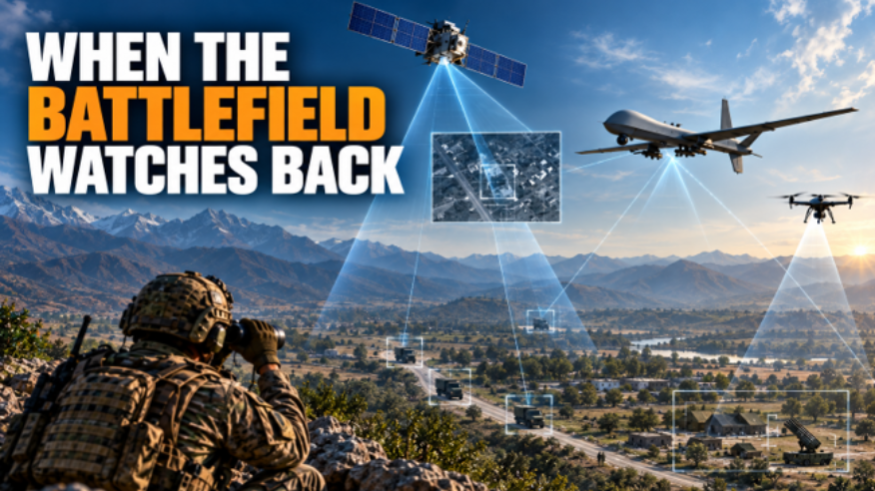
The announcement by the United States comes as major powers increasingly depend on satellites for military and civilian functions. Satellites support communications, navigation, intelligence and battlefield operations. Any disruption to these systems could therefore affect both military forces and wider economies.
Gen Pannu said India has made progress with the opening of the space sector to private companies. But he added that India will need to invest significantly more as space becomes an increasingly contested domain.
The US disclosure does not provide details about the weapons deployed in orbit. But its significance lies in the acknowledgement itself. Washington has now openly stated that it possesses such capabilities and is prepared to use them if traditional deterrence capabilities fail.
Savio Rodrigues
Savio Rodrigues is a Research Analyst at Escape Velocity MediaWorks Pvt Ltd and writes for Chakra News on Defence, Geopolitics, National Security. He holds a Master’s degree in International Relations from the University of Mumbai.



Comments