








Pakistan's ‘Major General Sahib’ Mystery Behind 26/11 Mumbai Attacks

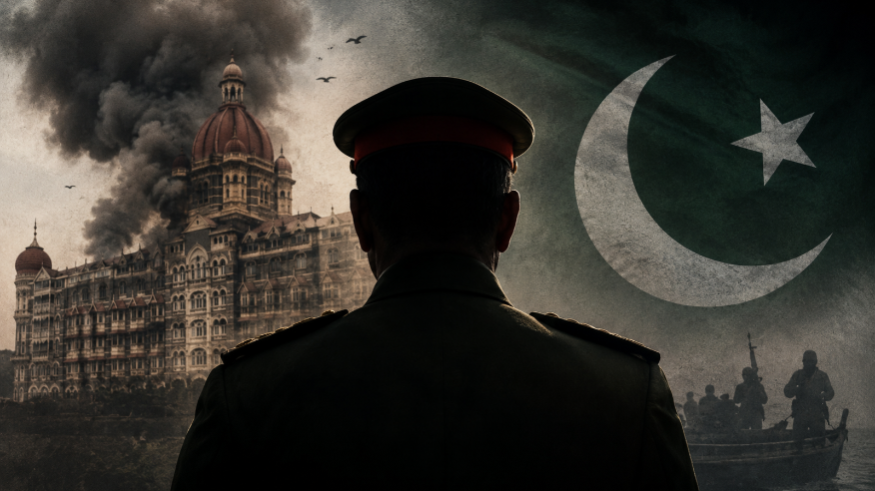
One of the last great mysteries of the 26/11 Mumbai terror attacks is the identity of a mysterious Pakistani officer referred to as “Major General Sahib”. The Mumbai police’s 2009 chargesheet lists him as ‘Accused Number 20: Major General Saheb - name not known.’
The officer, who reportedly visited Lashkar-e-Taiba (LeT) training camps and was involved in overseeing the preparations for the attacks and was in the loop when the attacks unfolded, is Major General — Asif Duraiz Akhtar.
Major General Asif Duraiz Akhtar was one of the senior officers in Pakistan's Inter-Services Intelligence (ISI) before the 26/11 Mumbai terror attacks. He headed Directorate S — the agency's external operations wing, dealing with militant groups and covert activities outside Pakistan. Akhtar was commissioned into the 13 Punjab Regiment of the Pakistan Army in the late 1960s. He also served in the 1971 India-Pakistan War on the Western Front.
Senior journalist and Editor in chief of Chakra News has authored ‘Black Tornado - The three sieges of Mumbai 26/11’ believes Akhtar is the two-star official in question, for various reasons. “The S branch is the most sinister of the ISI's 12 directorates it directly controls terrorist groups inside India and Afghanistan. Akhtar was the chief at the time the terrorists were being trained in the LeT’s camps in Muzafarrabad in PoK, an extremely important mission for the ISI. It is extremely likely Akhtar is the man Kasab was referring to in his testimonies to the Mumbai police," Unnithan says.
In September 2008, Akhtar was overlooked for promotion, moved out of the ISI and appointed Director General of the National Guard. The transfer came less than two months before the Mumbai attacks.
Akhtar's military career included an overseas deployment with the United Nations peacekeeping mission in Somalia. According to his LinkedIn profile, he served in Mogadishu between February 1992 and March 1993. He initially worked as a senior liaison officer with the US Force Headquarters. Following the arrival of a Pakistani brigade, he took over as its Deputy Brigade Commander. He also participated in operations under the United Nations Operation in Somalia II (UNOSOM II).
He later pursued a Master's degree in Strategic Studies at Pakistan's National Defence University between 1996 and 1997. His listed areas of study included international affairs and economics.
In June 1999, Akhtar took over as a Divisional Commander in Peshawar, in Pakistan's Khyber Pakhtunkhwa province. His LinkedIn profile states that he commanded a force of approximately 25,000 personnel. During this assignment, he was also involved in a poverty alleviation project sponsored by the central government and provided assistance to the provincial government on development initiatives, including energy-related work.
In April 2000, he was appointed Director General Logistics in the Pakistan Army, a position he held until August 2003. His responsibilities included overseeing the movement of military personnel, equipment and supplies over long distances. This also involved logistical arrangements for overseas deployments in support of United Nations peacekeeping operations.
After his military career, Akhtar entered Pakistan's diplomatic service. He served as the country's High Commissioner to Nigeria from November 2009 to November 2011. During this tenure, he was also accredited to Ghana, Benin, Cameroon, Equatorial Guinea and Gabon. His profile mentions extensive travel across Central and West Africa during this period.
Akhtar joined Synergen International as its Executive Director in January 2012, a position listed as continuing on his LinkedIn profile. The company describes itself as a trading firm operating in the oil and gas sector. Its activities include supplying equipment to oil and gas companies and providing supply chain services to fertiliser companies. Akhtar also lists management and logistics as areas of specialisation, drawing on his previous military experience.
Akhtar's career profile on LinkedIn skips his ISI tenure between 2006 and 2008. His next listed assignment begins in November 2009, when he took over as Pakistan's High Commissioner to Nigeria. The six-year period between these two appointments is not explained in his public professional history.
An unusual aspect of Akhtar's public profile is how few photographs of him are available online. Despite serving as a two-star general and Pakistan's High Commissioner to Nigeria, very few publicly accessible images of him can be found. This stands in contrast to other senior Pakistani military officials of that period, including Akhtar’s S branch successor, Major General Mumtaz Bajwa, whose photographs are widely available.
Akhtar’s LinkedIn profile skips his three-year stint with the ISI between 2006 to 2008. A US diplomatic cable dated October 8, 2008 — published by Dawn in 2011, also identifies Major General Asif Akhtar as the “Director of Directorate S”. It records that he was moved to the post of Director General of the National Guard following the September 29 military reshuffle. He was among the senior officers who were superseded for promotion and transferred to other assignments. The reshuffle also saw Lieutenant General Ahmed Shuja Pasha replace Lieutenant General Nadeem Taj as the Director General of the ISI.
The timing raises eyebrows — coming less than two months before the 26/11 Mumbai attacks. The planning and preparation for the operation had taken place during the tenure of Nadeem Taj as ISI chief. Akhtar's position in Directorate S placed him within the agency's external operations structure during this period.
According to the accounts of Ajmal Kasab — the lone attacker captured alive during the Mumbai operation, this officer visited the LeT training camps where the 10 attackers were being prepared. He interacted with senior LeT figures, inspected the trainees and took a direct interest in their combat readiness.
During one of his visits, “Major General Sahib” asked the trainees about their training and whether they had any complaints. He also inspected their shooting exercises and praised Kasab for hitting his target. His references also appeared in the communication between the handlers in Pakistan and the attackers during the operation.
The description of “Major General Sahib” as a senior Pakistani military officer, combined with his reported access to LeT leadership and involvement during the preparation of the attacks, brings the investigation back to Akhtar. His senior position in Directorate S during the planning period and his transfer in September 2008 form key parts of the evidence linking him to the mysterious officer.
David Headley — who conducted reconnaissance for the attacks, identified Pakistani military and intelligence personnel among his handlers, including Major Iqbal and Lieutenant Colonel Hamza. Major General Mohammad Khalid Rao and Colonel R. Sadatullah of the Special Communications Organisation were also linked to the communications network between the handlers in Pakistan and the attackers in Mumbai.
A Pakistani naval officer identified as ‘frogman Abdur Rahman’, reportedly advised the LeT operatives on maritime training and landing locations. He is believed to be from the Special Services Group- Navy.
Today, 18 years after the attacks, the 26/11 case remains unresolved in both countries, with trials pending against the accused. The primary accounts and secondary investigation point out the coordinated network across the border, involving the Pakistan Army, the ISI and the Navy, with LeT carrying out the 26/11 Mumbai Attacks.
Savio Rodrigues
Savio Rodrigues is a Research Analyst at Escape Velocity MediaWorks Pvt Ltd and writes for Chakra News on Defence, Geopolitics, National Security. He holds a Master’s degree in International Relations from the University of Mumbai.


Comments