



A Living Museum on Tracks: The Case for a Historical Tank Squadron
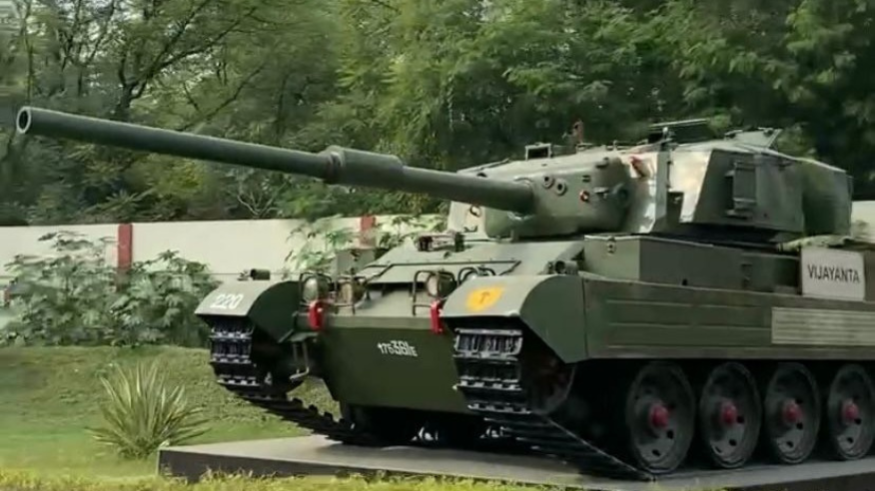
Seven years ago, on an assignment for India Today magazine covering the India-Pakistan skirmishes along the Line of Control (LoC) I saw a lone Vijayanta tank. I was puzzled. The Vijayanta, a license-built version of the Vicker’s Centurion, had gone out of service over a decade ago. The officer accompanying me explained what I was looking at — it was an ‘I’ tank or an Infantry tank— a tank retired from frontline service now being used as a mobile armoured pillbox in a direct firing role. The Vijayanta’s powerful 105 mm main gun used to shatter Pakistani bunkers on the LoC. The tradition continues. I saw on a June 6 post on X by the Vajra Corps with three T-55 (UG) ‘I’ tanks.
The Centurion, T-55 and the Vijayanta are three of Armoured Corps most storied tanks. Lt Arun Khetarpal led a squadron Centurions when he destroyed 10 Pakistani Patton tanks at the Battle of Basantar, a feat for which he was posthumously awarded the Param Vir Chakra. Close friend and colleague Colonel Anurag Awasthi, a distinguished armoured corps veteran who commanded 45 Cavalry, has told me stories of the legendary PT-76, the Soviet-built amphibious tank that swept into East Pakistan (now Bangladesh) during the 1971 Indo-Pak War as leading pincers of 4 Inf Div and 9 Inf Div of the newly raised 2 Corps. War diaries in his Regiment explain the exploits with the small Stuart Mk-IV as part of the Burma Campaign.
The Indian Army’s Armoured Corps fields one of the world’s largest tank armies— over 4,000 tanks in 67 regiments. The Corps traces its mechanised lineage to 1 May 1938, when the Scinde Horse became the first cavalry regiment to trade its horses for tanks.
In the near-century since, the Corps has operated an extraordinary succession of armoured fighting vehicles — from armoured cars to the amphibious PT-76, nimble tanks like the Stuart and AMX-13, Soviet T-55, T-72s and T-90s, to an indigenous Main Battle Tank, the Arjun — each representing a sterling chapter of national military history.
The story began with the Vickers Light Tank (inducted 1931–38), the first armoured vehicle issued to Indian cavalry regiments, followed closely by the Chevrolet Armoured Car. These gave way to the American M3 Stuart and the iconic M4 Sherman, which spearheaded the 14th Army’s pursuit of Japanese forces through Burma during the Second World War. The Shermans later saw action at Zoji La in 1948.
Post-independence, the Corps inherited British Centurion tanks and the lighter AMX-13 from France, both of which proved their mettle in the 1965 Indo-Pakistan War. The Soviet era brought the amphibious PT-76 light tank (acquired 1962), which achieved legendary status in the 1971 war’s eastern theatre, outmanoeuvring Pakistani M24 Chaffees in the floodplains of East Bengal. The P-76 was complemented by the workhorse T-55, which served extensively through the Cold War years. The T-72M Ajeya (inducted 1982) modernised the Corps significantly and remains its most numerous platforms today, alongside the formidable T-90S Bhishma, the current backbone of Indian armoured power. Crowning the lineage is the Arjun MBT — India’s own indigenous Main Battle Tank developed by DRDO — which, despite a troubled development history, represents India’s ambition in armoured warfare. On the horizon stands the Zorawar, a light tank designed for high-altitude operations against threats in Ladakh and the Himalayas. There are few armies that have deployed tanks in such multifarious operational environments.
Why a Historical Squadron Matters
For all this storied history, the closest that most Indians, or potential recruits to the Armoured Corps, will get to seeing the history of one of the oldest and most decorated fighting arms of the subcontinent, is through ‘gate guardians’, retired tanks placed as exhibits outside cantonment areas, and military bases. These are static, some of them in poor material state and poorly described.
The time has come to honour the legacy by establishing a dedicated Historical Tank Squadron: a fully operational or museum-standard unit housing one example of every tank ever fielded by the Armoured Corps. (A squadron has 14 tanks). I reckon this squadron could be raised by re-engining all existing tank hulls for under Rs 30 crore, that’s the cost of one Arjun Mark-2 MBT. This investment will pay back in the following ways:
Heritage and Regimental Pride: Like all Indian Army units, armoured regiments are built on tradition. The black beret, Armour Day (May 1), regimental battle honours — all reinforce an esprit de corps that translates directly into battlefield performance. A historical squadron would serve as a physical embodiment of that tradition, reminding every tanker of the shoulders upon which they stand.
Professional Military Education: Modern officers benefit enormously from studying how tactical doctrine evolved alongside technology. Walking around a PT-76 that fought at Darsana,Bogra and Garibpur and stormed into Dacca, or a Sherman that climbed the Zoji La, makes doctrine come alive in ways no textbook can replicate.
India is currently designing multiple armoured platforms— several light tank designs, and a Future Ready Combat Vehicle (FRCV) to replace its frontline tanks. The battlefield has evolved since the time these tanks were inducted into service, but these could help designers and ‘tinkerers’ understand first principles of tank design. Nations with strong armoured traditions — Germany’s Panzermuseum at Munster, Russia’s gigantic tank museum in Kubinka, the US Army Armor School at Fort Benning — have long recognised this pedagogical value.
Public Diplomacy: A well-curated historical squadron with all working tanks, open to the public at the Armoured Corps Centre and School in Ahilyanagar (erstwhile, Ahmadnagar), would serve as a powerful instrument of public engagement. It would honour veterans, educate citizens, and project the depth of India’s military heritage to foreign delegations and defence attachés. Tanks from the historical squadron could form part of parades on events of national importance and give youngsters and potential recruits to the Corps, a feel of the old steed. This could well be beyond the grandeur of the existing Tank Museum, being mobile in nature.
Conservation : Many of the early tanks have already been lost to time, scrapping, neglect, or in some cases, used as shooting targets. The PT-76 fleet has been retired; the T-55 is gone; even the Centurion survives only in scattered examples. From what I know, the operational tanks outside of the ‘I’ tanks would be in single digits.
A structured preservation programme, institutionalised within a historical squadron, is urgently needed before the last serviceable examples are irretrievably lost. India’s Armoured Corps has rolled across deserts, jungles, frozen mountain passes, and flooded river deltas in the service of the nation. A historical tank squadron would not be an indulgence; it would be an investment in identity, education, and institutional memory. The tracks of history must be preserved before they rust away entirely.

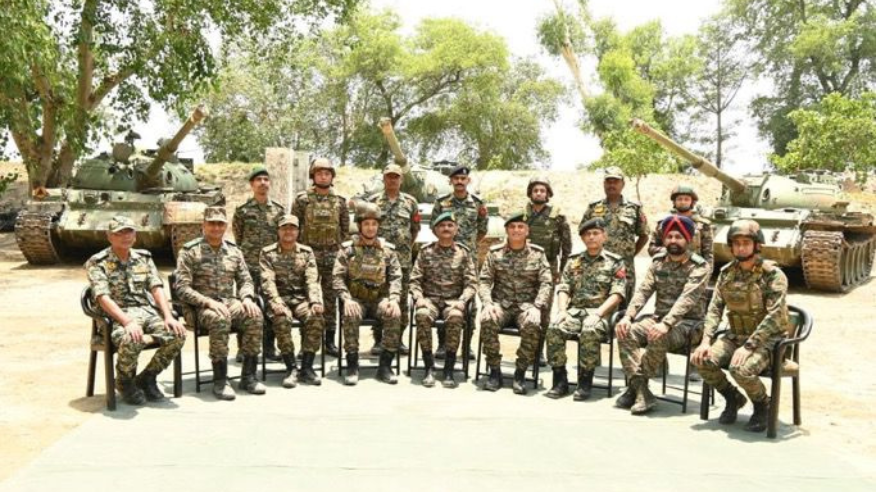
Officers and men of the Vajra Corps with three T-55 (UG) ‘I’ tanks.
Sandeep Unnithan
Veteran journalist with 30+ years in media, Sandeep Unnithan is a national security expert and author of two acclaimed books, including Black Tornado, adapted into the web series State of Siege.


Comments