




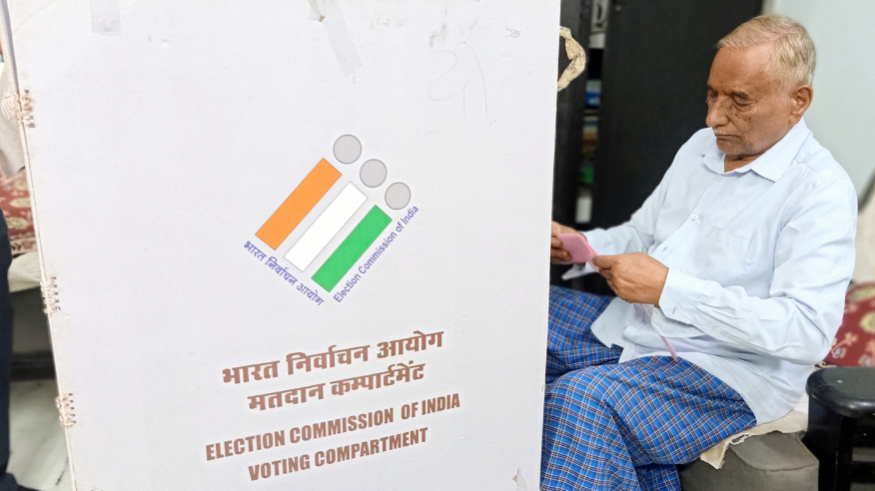
India’s Electoral Machine: A Marvel Under Attempted Scrutiny
India’s electoral process stands as one of the largest and most enduring democratic undertakings in modern history. With nearly a billion voters, the scale and complexity of its execution dwarf the combined electoral operations of nearly 90 nations. The Election Commission of India (ECI), a constitutionally mandated body, bears the solemn responsibility of regulating this colossal democratic exercise. Despite formidable geographical, political, and social challenges, it functions with remarkable efficiency.
From Indira Point in the Andamans to Tashigang in Himachal Pradesh—the world’s highest polling station at 15,256 feet—the electoral grid stretches to the remotest corners. Polling booths are set up in terrains with temperatures ranging from sub-zero -35°C in the Himalayas to 52°C in the Thar. Trains, aircraft, boats, mules, and porters contribute to a mind-boggling logistical choreography. Each booth is equipped with EVMs, VVPATs, PPE kits, signage, and updated rolls—self-sustained and secure.
The EC virtually oversees the country’s administration during elections, with district officials reporting directly to it. Much of this institutional strength stems from T.N. Seshan’s transformative leadership, which empowered the Commission beyond imagination. Election Day becomes a national festival—vibrant and sacred. Media outlets provide 24x7 coverage, while lakhs of police and CAPF personnel ensure law and order. Compared to procedural delays in countries like the U.S., India’s electoral conduct remains a marvel.
Yet, beneath this logistical triumph, murmurs of distrust persist, largely from opposition parties. If they win—like in Karnataka, Telangana, or Himachal—there are no objections. But when they lose, they question everything: voter rolls, EVMs, turnout data. Ironically, when outcomes favour them, their silence is deafening; when not, they resort to delegitimising the entire process.
A telling example of this is the criticism of the Special Intensive Revision (SIR)—a constitutionally mandated revision of electoral rolls to remove ineligible entries and ensure only citizens are listed. Unlike routine revisions, SIR is initiated where there is credible evidence of large-scale inaccuracies or the inclusion of non-citizens—especially in regions witnessing demographic shifts due to migration or suspected infiltration.
This is not mere administrative housekeeping—it is a national security imperative. Since 1971, India has witnessed a steady influx of illegal infiltrators, especially from Bangladesh and, more recently, the Rohingya population. What began as a humanitarian concern has morphed into a complex, deeply entrenched socio-political issue. It affects governance, civil administration, demographic balance, and internal security.
Political parties across the spectrum have historically avoided addressing this issue, prioritising vote-bank politics over national interest. The principle of secularism—intended to guarantee equality—has been distorted and weaponised. Under this cover, illegal immigrants have been granted documentation and voting rights without proper verification.
This has led to the rise of religiously homogenous ghettos, particularly in urban areas, some of which have turned into identity-based political strongholds and, in certain cases, radicalisation hubs. Intelligence inputs have raised concerns about sleeper cells, money laundering, and cross-border terror networks leveraging these unverified populations. Yet, political parties continue to view them as strategic assets rather than national threats.
When the EC conducts SIR to cleanse rolls of such illegal entries, the same parties cry disenfranchisement. The contradiction is stark: when rolls serve them, they applaud the system; when they don’t, they vilify it. Their outrage is not rooted in democratic principle but in electoral arithmetic.
Despite the EC’s consistent invitations to opposition parties to audit and observe its processes, such offers are rarely accepted. One suspects this is deliberate—engaging with the process would rob them of political ammunition. On polling day, agents from all major parties are present at booths. Yet, the number of verified complaints remains negligible, showing that checks and balances work.
The Association for Democratic Reforms (ADR), led by Prashant Bhushan, has petitioned the courts against the June 24, 2025, order mandating documentation for voters not on the 2003 rolls. Their contention: there is no credible evidence of large-scale infiltration in Bihar, unlike Assam. But that’s exactly what SIR is designed to determine—through verification.
The Supreme Court has refused to stay the SIR process, emphasising it cannot obstruct a constitutional function. However, it has flagged three concerns for review on July 28:
Whether the EC has legal authority under Section 21(3) of the Representation of the People Act;
The rationale for requiring documents from long-time voters;
The timing—given Bihar’s elections in November.
The EC must respond by July 21, before the draft rolls are issued on August 1.
At the heart of this controversy is the EC’s mandate: to ensure that only Indian citizens vote. SIR is not exclusionary; it is corrective. Its aim is to protect electoral integrity from systemic distortions and infiltrations. Projecting it as a disenfranchisement drive is a political tactic—not a principled critique.
Institutional scepticism is healthy—when evidence-based. But when driven by convenience, it corrodes trust in democracy. India’s electoral process, while a logistical feat, must also remain a moral beacon—above suspicion and beyond compromise.
The EC says it will adhere to Article 326 of the Constitution and Section 16 of the RPA. It must continue upholding both procedural excellence and public confidence. But the opposition must also rise above petty politics and engage in good faith. Participation must be responsible; dissent must be informed.
Ultimately, it is not ADR, Prashant Bhushan, or the ruling party that will determine the SIR’s legacy—but constitutional institutions and the Indian people. Every democracy reserves the right to verify who its citizens are. Electoral credibility is not just about how well elections run—it is about the confidence voters have in the system. That confidence is earned when every eligible vote is counted—and every ineligible one is excluded.
Dr (Lt Col) Atul Tyagi (Retd)
Author is ex-servicemen voluntarily retired and now engaged as Practicing Advocate & Faculty in Practice. He has Many papers on legal, social & political aspects published in Online & offline newspapers.



Comments