


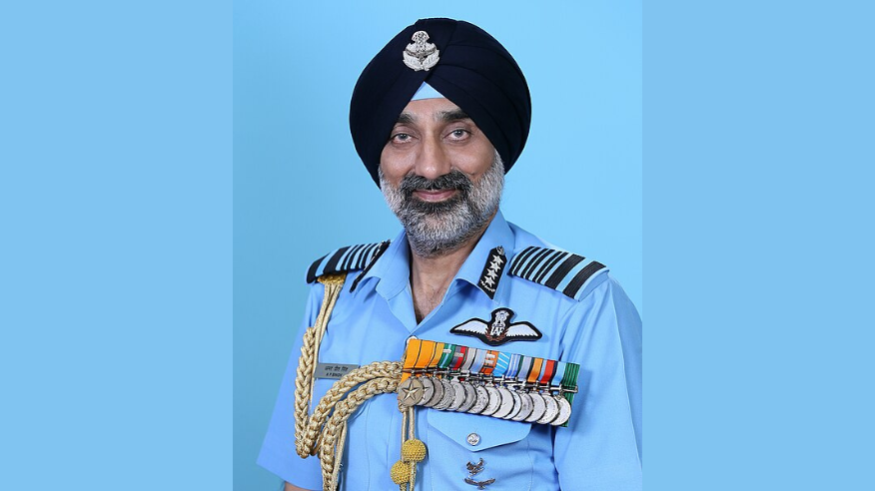
Military power ultimate arbiter of national power: Air Chief

Military power is the ultimate arbiter of national power- not having a robust military means subjugation, Venezuela and Iraq being the most recent examples, Air Chief Marshal AP Singh said in New Delhi today. The air chief was addressing the 22nd Subroto Mukerjee Seminar. He said military power is important, but the will to use that military power is even more important.
“Unless you have that will, you can keep showing restraint, but that restraint will be seen as a weakness. It is only when you're strong enough, and you show restraint, that it is seen as a capability."
The seminar was organised by the Indian Air Force and the Centre for Aerospace Power and Strategic Studies (CAPSS), the IAF’s think tank, which is celebrating its Silver Jubilee this year.
Air Chief Marshal Singh described how Air Marshal Subroto Mukerjee built the Indian Air Force in an era of constraints, uncertainty and limited resources. ” Don't think much has changed. So, when we talk about the law of constraints and limited resources of that time, it was very different.”
Air power is not just about aircraft and weapons and platforms, but about thinking innovatively and utilising the resources to one's advantage and thinking ahead of the adversary, he said.
A nation uses its power, its comprehensive national power, comprised of many things. The whole idea is to use that comprehensive national power in a manner to impose your will over the other nations. He described the components of national power: geography, size, location, and the kind of topography a nation has. This will also decide on what kind of neighbours a nation will end up having. Apart from that, natural resources, minerals, fuel, energy resources that a nation has, which are, again, given by nature, and how to harness them, how to take them out, and how much effort a nation puts in towards that.
The Subroto Mukerjee Seminar commemorates Air Chief Marshal Subroto Mukerjee, the first Indian to command a flight and a squadron in the Indian Air Force. He was the first Indian Chief of the Air Staff of independent India's Air Force.
Centre for Aerospace Power and Strategy Studies (CAPSS) was established in 2001 as an autonomous defence research and analysis body for research and focused analyses on issues related to national security, defence, and aerospace issues in the evolving strategic and international security environment. Its objective is to facilitate greater understanding of these issues amongst the Armed Forces, the strategic community and the public, besides contributing to policy generation and decision-making.



Comments