












The Supersix Unveiled: Poseidon Test Fuels Concerns Over New Nuclear Arms Race

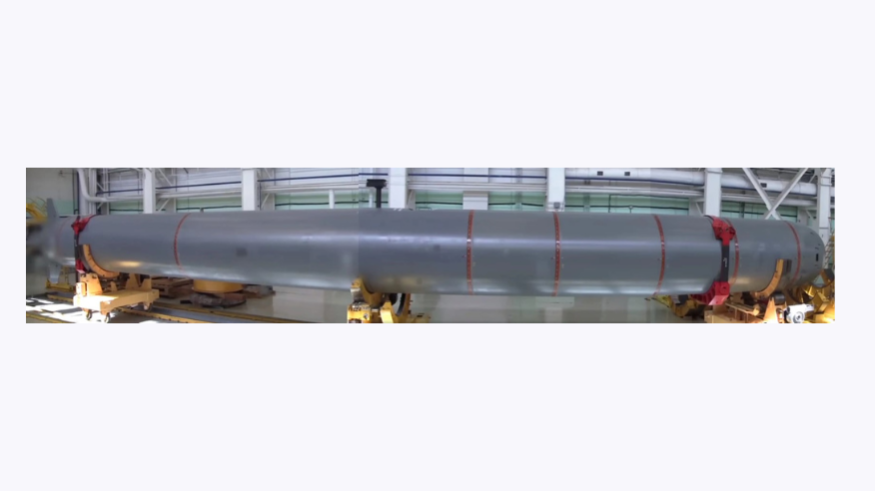
Russia has tested the nuclear-powered weapon Poseidon on October 28. The Poseidon is a nuclear-powered drone named after the Greek God of the sea. The weapon is a part of the Supersix weapons, or known as Super weapons. Russian President Vladimir Putin announced the successful test of the weapon while having tea with Russian soldiers who were wounded in the ongoing war with Ukraine at a hospital in Moscow and said “ For the first time, we managed not only to launch it with a launch engine from a carrier submarine, but also to launch the nuclear power unit on which this device passed a certain amount of time. There is nothing like this. This is a huge success,” and claimed that the power of Poseidon exceeded the power of the Sarmat intercontinental ballistic missile. The weapon test comes after the test of the nuclear-capable Burevestnik missile on October 26.
Poseidon’s Capabilities
The Poseidon is an unmanned underwater vehicle (UUV), estimated to be around 24 meters (79 ft) in length and 2 meters (6.5 ft) in diameter, weighing up to 100 metric tons. The drone is powered by a small, onboard nuclear reactor. The liquid metal reactor provides an unlimited operational range, allowing the drone to cross entire oceans without surfacing. According to Russian media, it can travel at speeds of up to 100 knots (185 km/h). Some military analysts have suggested a more realistic speed of around 70 knots (130 km/h). The Poseidon is believed to be able to operate at extreme depths, possibly more than 1,000 meters (3,280 ft), making it exceptionally difficult to detect and target with current anti-submarine technology.
It is designed to carry a multi-megaton nuclear warhead, with some sources speculating a yield of up to 2 megatons or more. There has also been speculation about the use of a cobalt bomb to enhance radioactive contamination, though experts question the feasibility of such claims. The weapon is equipped with an autonomous guidance system that likely includes GLONASS satellite navigation and an AI system.
Its nuclear propulsion system gives it a virtually unlimited range to cross oceans to reach targets on other continents. The Poseidon employs passive stealth methods to avoid detection. Its main strategy is to travel at a very low speed during most of its transit, increasing speed only in the final stages of an attack. The drone is launched from specially modified submarines. The Oscar-class submarine Belgorod and the new Khabarovsk-class submarines are being built or modified to carry Poseidon drones. There are also reports of a seabed-launched variant.
The Poseidon is designed as a "doomsday" retaliation weapon, intended to guarantee a devastating second-strike capability. Its purpose is to overcome missile defense systems by traveling underwater rather than through the air. It could be used against coastal cities or naval targets like aircraft carrier groups. The Russian state media has claimed the weapon can cause massive radioactive tsunamis. An underwater nuclear detonation would spread in all directions and be less focused and powerful than a conventional tsunami.
Russia’s Supersix Nuclear Weapons
While giving an address to the Federal Assembly in March 2018, President Putin announced the Supersix nuclear weapons and stated that the weapons provided the strategic capability that was impossible for America to intercept, restoring Russia's nuclear deterrence capability in the face of American technological developments following America's withdrawal from the Anti-Ballistic Missile Treaty. The six supersix weapons systems being developed by Russia are:
First, the RS-28 Sarmat Intercontinental Ballistic Missile (ICBM), which is a super-heavy, silo-based missile designed to replace the Soviet-era R-36M (Satan) ICBM. It has an estimated range of up to 18,000 km, can carry 10 or more nuclear warheads, and can deliver a payload over either the North or South Pole to evade anti-missile systems.
Second is the Avangard Hypersonic Glide Vehicle (HGV), which is launched via an ICBM. This nuclear-capable glider can travel at speeds of up to Mach 27 and perform sharp, evasive maneuvers in flight. This combination of speed and maneuverability makes it extremely difficult for conventional missile defense systems to intercept.
Third, the 9M730 Burevestnik Cruise Missile is a nuclear-powered, nuclear-armed cruise missile that reportedly has an unlimited range. This is due to a small nuclear reactor that propels the missile, allowing it to loiter in flight and fly at a low altitude to evade radar. In the recent test, Russian Chief of the General Staff Valery Gerasimov stated the missile flew 14,000 kilometers (about 8,700 miles) over 15 hours. He noted that this was not the missile's maximum possible range. The International Institute for Strategic Studies (IISS), citing a 2021 Russian military journal, reported that the missile's potential range could be up to 20,000 kilometers (about 12,400 miles). This would theoretically allow it to strike targets in the continental United States from anywhere within Russia.
The fourth superweapon is Poseidon Unmanned Underwater Vehicle (UUV), which is a nuclear-powered and nuclear-armed autonomous underwater drone that can deliver a large nuclear warhead.
The fifth one, Kh-47M2 Kinzhal Air-Launched Ballistic Missile, which is derived from the ground-launched Iskander missile, the Kinzhal is a nuclear-capable ballistic missile launched from aircraft like the MiG-31K. It can achieve hypersonic speeds, making it a formidable weapon against ground and naval targets. The missile has a range of 2,000 kilometres and is being used in the ongoing conflict with Ukraine.
The last one, 3M22 Zircon Hypersonic Cruise Missile, is a scramjet-powered, nuclear-capable missile designed primarily for anti-ship roles but also capable of striking land targets. It's claimed top speed of Mach 9, combined with maneuvering capabilities, presents a significant challenge to existing naval defenses and has a range of 1000 km.
US response: A start of a nuclear arms race?
President Donald Trump has announced that the US will be conducting tests of nuclear weapons after thirty years. It has not conducted any nuclear test since 1992. President Trump said in a post on social media, "Because of other countries' testing programs, I have instructed the Department of War to start testing our Nuclear Weapons on an equal basis," before meeting the Chinese President Xi Jinping in South Korea. The announcement indicates the start of a nuclear arms race, as the adversaries of the US, like North Korea, Russia, and China, have been testing nuclear weapons.
Arjun Dev Singh
Arjun Dev Singh has a deep interest in defence, security, and strategic affairs. With a strong analytical lens and a passion for military and geopolitical developments, Arjun strives to bring clarity and context to complex national and international issues.




Comments