







India's military is finally building a Defence Strategic Communication Division

Operation Sindoor showed why it can no longer wait.
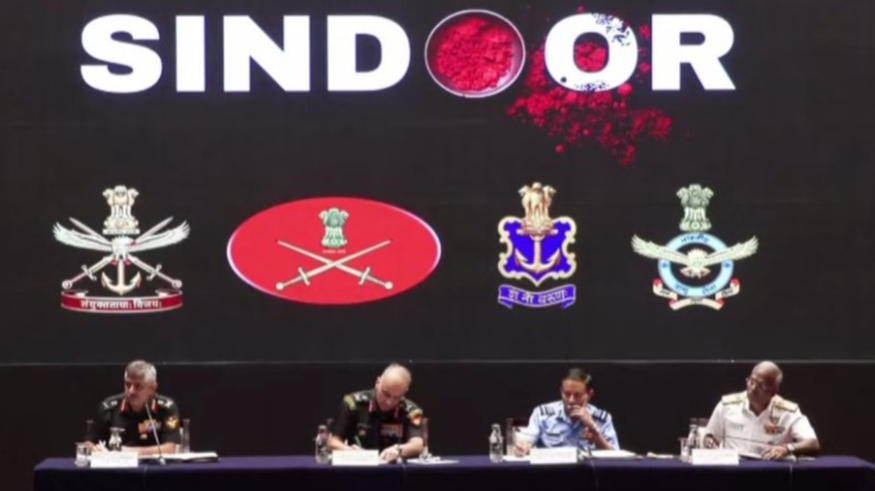
At the tri-services press conference at Jaipur on 07 May 2026 to mark one year of Operation Sindoor, Lt Gen Zubin A Minwalla, Deputy Chief of Integrated Defence Staff (Operations), flanked by Lt Gen Rajiv Ghai, Deputy Chief of Army Staff (Strategy), Air Marshal A K Bharti, Deputy Chief of Air Staff, and Vice Admiral A N Pramod, Director General Naval Operations, announced that India is establishing a new Defence Strategic Communication Division (DSCD) leveraging AI-enabled tools to counter misinformation in real time.[1,2,3] The doctrinal statement that accompanied it was unambiguous: modern warfare is no longer limited to land, air and sea. The information domain has become equally critical.
This is the right call. And it is overdue because artificial intelligence has transformed the information environment faster than any standing institution was designed to absorb. AI now enables voice-cloned audio, lip-synced deepfakes, automated narrative amplification at algorithmic scale, and synthetic battlefield imagery generated in minutes. The speed and believability of what can now be fabricated have outpaced every reactive fact-checking mechanism in existence. Operation Sindoor, in May 2025, was the first major operation in which AI-generated synthetic media operated at scale, in real time, across an active conflict window.
A year on, the threat has not paused. Within hours of the Jaipur briefing, a digitally altered video of Lt Gen Minwalla himself began circulating online, falsely attributing inflammatory communal remarks to him — that the Indian Air Force had reduced Sikh and Muslim officers by 50 per cent following Operation Sindoor. D-Intent Data traced the clip and confirmed it as a Pakistani propaganda operation.[4] AI-detection tools confirmed synthetic audio and unnatural facial movements.[5] The officer who announced the division to counter synthetic disinformation was himself the subject of synthetic disinformation within the same news cycle. Nor was Gen Minwalla the first senior officer targeted - A digitally manipulated video of Air Marshal A K Bharti falsely depicted him admitting that India had lost fighter jets during Operation Sindoor and that the ceasefire had been accepted under pressure.[6] A deepfake of Defence Secretary Rajesh Kumar Singh — repurposed from his original remarks on India’s defence exports — falsely claimed India’s cyber systems had been jammed on May 10.[7] Manipulated videos falsely attributed inflammatory political statements to CDS General Anil Chauhan — including a fabricated admission that India had lost seven jets and requested a ceasefire.[8]
The targeting extended well beyond the active conflict window. In October 2025, a deepfake of Lt Gen Rajiv Ghai, who served as the DGMO during Operation Sindoor, went viral, fabricating remarks in which he warned against the “saffronisation” of the Indian Army. AI-detection tools returned a 99.4 per cent probability of artificial generation; the audio had been synthesised from his address at the Forces First Conclave on October 18, where he had in fact described Operation Sindoor as “a synchronisation of political will and military planning and execution.”[9] The pattern is consistent: senior officers targeted with synthetic media timed to the most sensitive moments of the conflict calendar, and sustained long after operations concluded.
The evidence of what India’s forces and citizens were contending with during Operation Sindoor is specific and documented. False claims that the Pakistan Air Force had struck Srinagar airbase circulated almost immediately, using footage from Pakistani sectarian clashes in 2024.[10] A January 2025 civilian plane crash in Philadelphia was recirculated as live footage of India attacking Karachi Port.[11] Arma-3 video game simulation footage gathered 1.7 million views on X as supposed evidence of IAF action in Bhuj.[12] Old IAF MiG crash photographs from 2021 and 2024 were spread internationally as downed Rafales.[13] BOOM’s post-conflict analysis found that 68 per cent of its May 2025 fact-checks were Operation Sindoor-related[14] — a volume no manual debunking operation can absorb at the speed AI-enabled disinformation now moves.
Speaking at the Shangri-La Dialogue in May 2025, Chief of Defence Staff General Anil Chauhan acknowledged that 15 per cent of operational time during Operation Sindoor was spent managing misinformation and disinformation.[15] One in seven operational hours, consumed not in the conduct of military operations but in managing a disinformation environment with no pre-positioned structure to hold it steady. In a nuclear dyad, that is not merely an inefficiency — it is an escalation risk.
This is structural to modern conflict, not unique to any single adversary or theatre. The global architecture of information warfare has been taking shape for years. India's move now places it squarely within that evolving doctrine. China’s Three Warfares framework — public opinion warfare, psychological warfare, legal warfare — has been codified in PLA doctrine since 2003 and operates continuously, in peacetime and conflict alike, as a parallel and permanent campaign.[16] NATO-affiliated strategic communications doctrine, developed through the StratCom Centre of Excellence, formally designated cognitive warfare a major security domain in its 2024 frameworks.[17] Israel’s IDF Spokesperson’s Unit operates through a centralised wartime communications structure designed for rapid, coordinated response across global media and digital platforms — a parallel operational function that runs alongside kinetic operations, managing simultaneous multi-language narrative environments in real time.[18] These architectures share one essential characteristic: they were built before the crisis, not assembled during it. The DSCD joins this generation of capability. The question is how quickly it can be built to match it.
India is not starting from zero. The Defence Cyber Agency, the National Technical Research Organisation, service-level information directorates, and intelligence-monitoring structures already perform important functions across cyber, technical, and information-monitoring domains. The PIB Fact Check unit and the blocking of over 1,400 URLs under Section 69A of the IT Act during Operation Sindoor[19] were genuine efforts deployed under genuine pressure — and they held the line further than the volume of disinformation had any right to allow. But holding the line is not the same as dominating the space. These were reactive measures: responding after false narratives had already spread across platforms, accumulated millions of views, and entered the broader information ecosystem. The DSCD represents an institutional shift from reaction to anticipation — from debunking after virality to detecting and countering hostile narratives before they gain momentum. That is the shift modern information warfare now demands.
For the division to function as capability rather than optics, four things must be in place before the next crisis.
First, AI-enabled monitoring built on formal platform data-access agreements. Post-2023 API restrictions by X and Meta’s closure of CrowdTangle[20] have made ad hoc social-media monitoring increasingly non-viable. Real-time detection of coordinated disinformation campaigns, synthetic-media amplification, and cross-platform narrative manipulation now requires institutional data-access agreements and AI-assisted analytical infrastructure — not volunteer-driven or reactive tracking.
Second, pre-approved rapid-response protocols for the most likely crisis scenarios — false aircraft-loss claims, fabricated casualty reports, deepfake military communications, nuclear-site disinformation — so verified information reaches the public in minutes rather than hours. These protocols must be pre-delegated, pre-exercised, and pre-cleared for legal compliance. They cannot be drafted under fire.
Third, civilian lateral recruitment: linguists, behavioural analysts, digital-forensics specialists, OSINT practitioners, data scientists, and cyber investigators — because uniformed career pipelines do not produce this expertise at the pace technological change now demands. The adversary information environment is shaped by algorithms, influence networks, and transnational synthetic-media operations that require specialist interpretation. Hybrid staffing models, already used by allied services, offer the template.
Fourth, integration into joint military planning and tri-services exercises from the start — so information-response architectures are rehearsed before operations begin, not improvised after they unfold. Until information warfare is war-gamed and red-teamed with the same rigour applied to air-land integration or logistics sustainment, it remains an institutional vulnerability.
India’s armed forces have always understood that doctrine must evolve as the battlefield does. The DSCD is that evolution applied to the information domain.
The next phase of warfare will be fought as much through perception, narrative and digital disruption as through conventional force. India now has the opportunity to build the institutional architecture capable of meeting that reality with confidence, speed and strategic clarity.
Sources
-
ANI / Lt Gen Minwalla on DSCD at Jaipur anniversary press conference — 7 May 2026
-
Business Standard / Jaipur tri-services anniversary briefing — 7 May 2026
-
D-Intent Data on X / Digitally altered video of Lt Gen Zubin A. Minwalla flagged as Pakistani propaganda & https://x.com/PIBFactCheck/status/2052996318642212951
-
Deccan Herald / PIB Fact Check on false Srinagar airbase strike claim
-
BOOM Fact Check / Philadelphia plane crash footage falsely shared as Karachi Port attack
-
Alt News / Arma-3 simulation footage falsely shared as IAF action in Bhuj
-
BOOM Fact Check / Old IAF crash photos falsely shared as downed Rafales
-
BOOM Research / May 2025 Operation Sindoor misinformation report (68% finding)
-
Jerusalem Post / IDF Spokesperson's Unit wartime communications structure
-
PIB / Government blocking of over 1,400 URLs during Operation Sindoor (Section 69A, IT Act)
-
TechCrunch / Meta shutdown of CrowdTangle and restricted replacement access
Shivani Dasmahapatra
Shivani Dasmahapatra is Founder of Lest We Forget India and serves on the Editorial Advisory Board of the Forces Law Review. She co-edited In Her Defence: Ten Landmark Judgments on Women in the Armed Forces. She tweets @_ShivaniSD.


Comments