








Trump Signals Possible End to Iran War While US Maintains Military Presence

On November 9, US President Donald Trump signalled that the war against Iran could be nearing an end, saying that Tehran's military capabilities have been largely destroyed. He said that the war was "militarily effectively over" following a meeting with Qatari Prime Minister Sheikh Mohammed bin Abdulrahman Al Thani at the White House. He also indicated that further military action against Iran was unlikely at present.
The remarks suggest a shift towards diplomatic efforts after over eight months of military confrontation. However, the US has not announced a withdrawal of its forces or an end to its military operations against Iran. The naval blockade of Iranian ports remains in place, while American forces have continued limited strikes against Iranian military targets.
On the same day, Trump also said there was “positive momentum” towards ending the conflict and that a resolution could come fairly soon. Qatar has been playing a mediating role between Washington and Tehran. Its Prime Minister discussed negotiations and the possibility of reaching an agreement during his meeting with Trump and Vice President JD Vance.
However, a formal agreement remains uncertain. Iran has demanded an end to the US naval blockade, sanctions relief, access to frozen assets and compensation for war damage before engaging in nuclear negotiations. Iranian officials have also rejected claims that formal talks are underway.
"The military action doesn't seem to be a very necessary thing, but we're locked and loaded, ready to go for any reason that changes," Trump told reporters. Washington continues to maintain a significant military presence in the region.
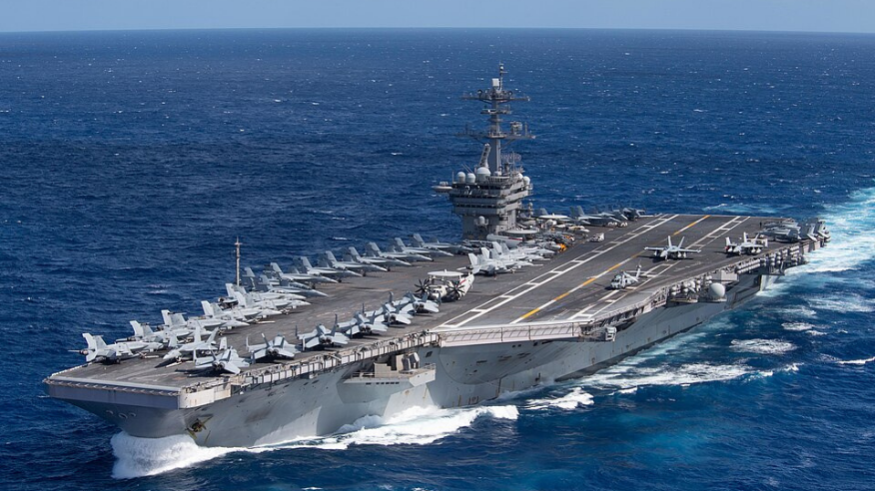
According to the US Naval Institute's November 9 Fleet and Marine Tracker, two carrier strike groups — USS George H.W. Bush (CVN-77) and USS George Washington (CVN-73) are operating in the Arabian Sea in support of US operations in the Middle East. A third carrier strike group, led by USS Theodore Roosevelt (CVN-71), is heading towards West Asia. It is currently operating in the Andaman Sea after departing Singapore. The large deployment of American aircraft carriers highlights Washington's ability to resume military operations if the situation changes.
However, the deployment may not represent a permanent reinforcement. USNI News reported on November 6 that the Theodore Roosevelt Carrier Strike Group is expected to relieve the George Washington Carrier Strike Group. It remains unclear whether the US will maintain a three-carrier presence in the region for any period.
The deployment provides the US with continued naval and air power in the region even as Trump signals a move away from further large-scale strikes. The carrier strike groups can support air operations and provide a range of military options if diplomatic efforts fail.
Trump's remarks also come amid growing domestic political pressure following the Republican Party's losses in the November 3 midterm elections. Democrats have won control of both the House of Representatives and the Senate, ending Republican control of Congress. The new Congress will take office on January 3, 2027. Until then, Republicans retain control of both chambers. The change will give Democrats greater powers to scrutinise the administration's foreign policy and challenge its military decisions.
The Iran war has also emerged as a major political issue in the elections. The eight-month conflict has contributed to higher fuel prices and economic pressure in the US. Trump has acknowledged that the war was among the reasons behind the Republican defeat.
A Reuters/Ipsos poll published on November 10 found that 71 per cent of Americans wanted Congress to pass legislation to end the war. The figure included 93 per cent of Democrats and 51 per cent of Republicans.
However, the change in congressional control will not automatically prevent Trump from ordering further military action. The President retains his powers as Commander-in-Chief. Democrats could use legislation, defence funding and congressional oversight to put greater pressure on the administration.
The administration has also indicated that it can continue putting pressure on Iran without resuming large-scale military operations. US Secretary of State Marco Rubio said on November 10 that sanctions and the naval blockade were causing significant economic damage to Iran. "We don't need to conduct military strikes if we're achieving the same objective through economic means and economic pressure," Rubio said.
The US position now combines continued military readiness with economic pressure and diplomatic engagement. Whether this approach leads to a formal end to the war will depend on the progress of negotiations and whether Washington and Tehran can agree on the conditions for ending hostilities.
Savio Rodrigues
Savio Rodrigues is a Research Analyst at Escape Velocity MediaWorks Pvt Ltd and writes for Chakra News on Defence, Geopolitics, National Security. He holds a Master’s degree in International Relations from the University of Mumbai.



Comments