



THE HIGH STAKES AT HORMUZ STRAIT

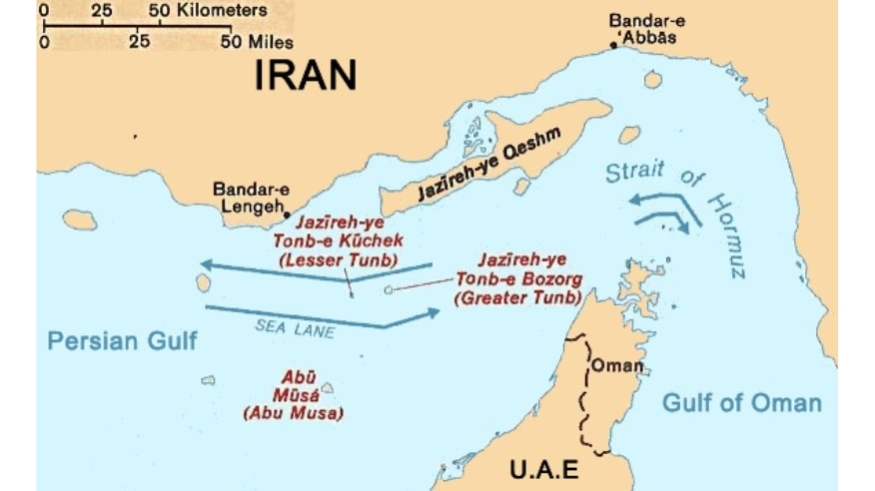
The ongoing crisis in West Asia involving Iran, Israel and the United States has rapidly evolved beyond regional security issue into a global economic concern. Due to the prolonged intense conflict, the stability of one of the world’s most critical energy producing region is under grave catastrophe. West Asia accounts for a substantial share of global oil and gas supplies besides the strategic chokepoint of the Strait of Hormuz which serves as lifelines for international energy trade. Disruptions in this region has severely impinged on fuel prices, supply chains and economic stability worldwide. Moreover, it has further professed to the world the concept of control of chokepoints to dominate the trade and energy routes.
India’s Bridge Over Troubled Waters
The global order today is no longer defined by the grand alliances of the past but persistent localized resilience. The 40 minutes telephonic conversation on 14 April 2026 between PM Narendra Modi and President Donald Trump serves as a stark reminder of India’s singular position in this new landscape. With the ‘Islamabad Peace Talks’ currently crumbling and the US naval blockade tightening around Iranian ports, India remains one of the few who are in direct contact with both Trump administration and leadership in Iran.
For India, this isn't just diplomacy, but rather it’s an existential hedge. The closure of the Strait of Hormuz since early March 2026 has sent Brent Crude skyrocketing toward $150 forcing India into a high speed pivot. To insulate our economy from any energy collapse, the Indian Government is aggressively diversifying its basket absorbing discounted Russian crude while simultaneously negotiating a ‘Green Channel’ with Washington for supplies from the US Strategic Petroleum Reserve.
The Architecture of the Stalemate
The current conflict is a complex mosaic of economic warfare and political survival. While the headlines focus on missiles, the true battle is the global supply chain which is elucidated as under: -
(a) The Rare Earths Quid Pro Quo- A hidden driver of US aggression is the strategy to deny oil to China leveraging both the collapse of Venezuelan exports and the Middle East squeeze. In return, US also seeks a leverage over China’s monopoly on the Rare Earth Minerals, a classic quid pro quo in an era where trade is used as a weapon.
(b) The Enrichment Gap- The distance between ‘victory’ and ‘surrender’ is measured in years. While Trump demands a 20 year moratorium on Iranian nuclear enrichment, Tehran offers only five years. Diplomats now suggest a ‘win-win’ middle ground of 8 to12 years coupled with the release of frozen assets which might be the only exit ramp that saves face for both sides.
(c) The Pakistani Proxy- While some in India view Islamabad’s role as the ‘go-between’ with skepticism, the reality is actually more transactional. Pakistan is acting as the messenger but the scripts are written by ‘Uncle Sam’, highlighting the desperate need for a neutral ground to exchange drafts.
(d) The Impeachment Clock- US domestic politics looms large over the Oval Office. The House of Representatives are currently debating articles of impeachment. Thus, the threat of losing both Houses in Nov 2026, Trump needs a ‘decisive win’ to repair his image. His rhetoric may sound very fiery but the underlying drive for a deal is increasingly getting serious.
The Next 10 Days: A Slow Grind
We may not witness a ‘Big Bang’ explosion leading into a World War but it’s a grinding erosion of the international system which cannot be ignored for long. The next 10 days will likely be defined by three critical shifts as under: -
(a) The Brinkmanship Peak- Expect Iran to test the US ‘Reverse Blockade’ by attempting high profile ‘protected tanker escorts’ forcing a direct maritime confrontation.
(b) Financial Bifurcation- The Iranian ‘Toll Booth’ will accelerate the transition to a parallel financial eco-system. The use of the Petroyuan and Crypto settlements will move from the fringes to the centre, thereby, permanently circumventing the US Dollar.
(c) Market Adaptation- Oil prices will likely fluctuate between $120 and $150. Traders are no longer looking for stability but they are pricing in ‘permanent uncertainty’.
Predictive Analysis
"Power is no longer measured with quantum of missiles fired but by resilience and the ability to absorb economic shocks without social collapse”.
The most probable outcome will be an ‘Uneasy Equilibrium’. A full-scale invasion will turn costly for Trump administration which is already facing domestic legal peril. Let’s then look for a sudden end April announcement of a ‘Framework of Assurance’ sounding as a multi stage deal where Iran accepts a decade long enrichment freeze in exchange for immediate humanitarian corridors and asset liquidity. While this may stop the anticipated ‘hot war’, however, the damage to the rule based order is permanent. The world has learnt that geography is a destiny and the era of the global ‘energy commons’ has officially ended.
Evolving India's role as a mediator, if the US domestic political situation worsens before the November elections, needs a deep analysis. In the rising global uncertainty and envisaged US actions, India must craft a medium and a long term strategy to safeguard its national interests. President Trump has already beckoned that his next target could be Cuba while showing interest in other global shipping choke points like Strait of Malacca as well. With US stranglehold increasing on China using oil as a weapon and NATO disconnecting from US, will this further escalate into a possibility of China taking this as an opportunity to capture Taiwan?
The recent global developments necessitate India to consider strengthening its influence over Strait of Malacca. Impetus is required towards solidifying Naval capabilities, developing security infrastructure in Andaman & Nicobar Islands as also rejuvenate surveillance capabilities over Strait of Malacca. India should continue the diplomatic outreach with Israel to sensitize them on retaining a stranglehold on Pakistan’s nuclear capabilities as it may ultimately affect Israel through an Islamic bomb.
India has maintained its strategic autonomy following the principle of ‘Vasudhaiva Kutumbakam’ and is emerging as a global trusted power. All Indians, therefore, must rise above the divisive sensation based on caste, community, region and religion and instead must stand together as one identity that is ‘Indian First.’
Author: - Views expressed are author's personal.
Lt Gen Abhay Krishna, Retd
Lt Gen Abhay Krishna (retd, PVSM, UYSM, AVSM, SM(G), VSM, - is a former Army Commander of South Western, Eastern and Central Army Commands.



The Strait of Hormuz crisis is far bigger than a regional dispute. It reflects a wider contest over power, deterrence, energy security, and the future global order. Even if shipping resumes, the old strategic normal has changed. Iran has shown how asymmetric leverage can shake markets, while the US and Israel have learnt that military strength alone cannot ensure lasting political outcomes. For India, this is a moment to act with strategic autonomy—protect national interests, secure energy flows, engage all sides, and support stability without becoming part of any camp.
An enlightening article by Gen Abhay Krishna,former Army Cdr of SW,Cetral & Eastren Armies dwelling on the current world crisis due US & Iran War & it's far reaching effects on world trade.Though blocking of strait of Hormuz is consequential to US action for which Trump is under pressure at home & out side.However Iran should not be granted liberty to levy tax on its passage for world trade unlike suez as it is natural water way. As far as Strait of Malacca,as amply brought out by thr writer , India must establish appropriate strong Naval presence in Andoman Area . Presence in Andoman area. Compliments for such a nice exposition of world's current dilemma.
Well articulated thoughts from a person with decades of experience in handling strategic issues at national and international level. Article on pertinent issue which impinges all currently. Well crafted predictive analysis. India's role well brought out. Compliments.
Crisp and to the point. Need another article focuses on Impact for India and steps to counter
The article is a sharp, insightful and timely analysis linking global turmoil with India’s strategic rise. Especially powerful is the message of unity and India First in changing times.
Respected sir Very meaningful and thoughtfully you pen down ...this will be an eye opener for many of us ...request you to please write such article for all of us...
Lt. Gen. Krishna, in particular, is well-known for his sharp strategic insights, often focusing on national security, the complexities of the Line of Actual Control (LAC), and military modernization. His writing tends to cut through the noise with the kind of "boots-on-the-ground" authority that only decades of command can provide.
Sir, Very nicely articulated, capturing the essence of the current conflict & its various contours.Absolutely critical for India to derive the requisite lessons to ensure it's energy security esp if this conflict prolongs or for any future disruptions.Strait of Malacca & Andaman & Nicobar islands assume huge significance if a threat develops on our Northern bdrs, anytime in future.India has emerged as a credible nation from this conflict due to it's deft diplomacy & strategic neutrality whereas Pakistan is increasingly appearing like a stooge or messenger of US.Israel ofcourse needs to guard against rallying of Islamic nations under a nuclear Pakistan.America's courting of Pakistan is transitional as it currently meets Trump's geo-political & economic interests and it could be dumped by a different dispensation or by Trump himself. Thanks for sharing Sir, quite insightful as always. Regards Atul Mishra
this article has covered all aspect and long term impact on global system of usa and Iran war