












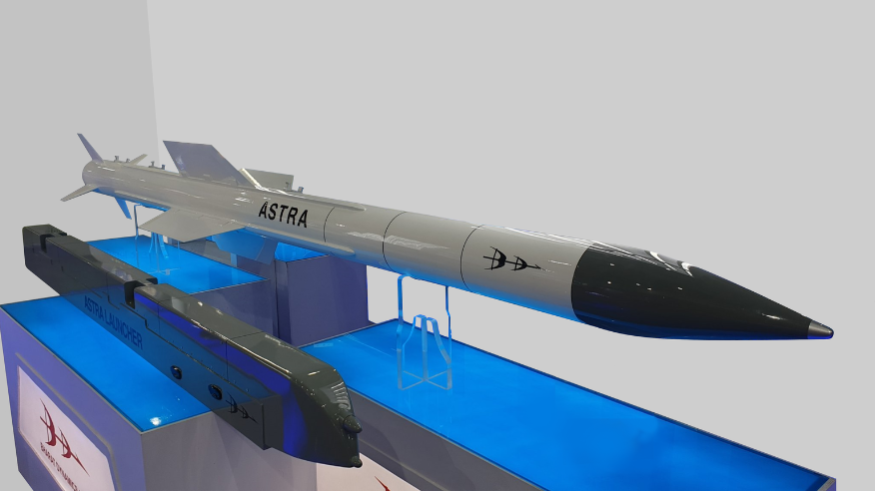
The Astra Mk-1 Deal

The Indian Air Force is close to finalising a procurement deal for 400 Astra Mk-1 air-to-air missiles. Developed by DRDO, the missile has an operational range of approximately 110 kilometres and is already integrated with the Su-30MKI fleet. Integration with the MiG-29K, Tejas Mk-1, and Rafale fighter jets is currently underway. The missile is manufactured by Bharat Dynamics Limited.
The Astra Mk-2 and Mk-3 variants are under development, offering greater flexibility for mission-specific requirements. The Mk-2 is expected to have a range of 140–200 km, while the Mk-3 could reach 300–350 km.
A key feature of the Astra missile is its No-Escape Zone, the region within which a target cannot evade interception. The Astra complements the Russian Vympel R-77 missile, which has a range of around 80 km. The Astra Mk-1 carries a 15 kg pre-fragmented high-explosive warhead triggered by a radio proximity fuse.
Development of Astra began with a pre-feasibility study in 1990 and was first showcased at Aero India 1998. Initially described as resembling an elongated Matra Super 530D, the project was formally sanctioned in 2004 with a budget of ₹955 crore. Early versions had a range of 25–40 km and were intended for integration with HAL Tejas. The first test took place in May 2003.
The missile underwent significant redesigns in 2006 and again around 2013 to address control issues and performance deficiencies at high altitudes. Modifications included new wing configurations, improved propulsion, and reworked control and guidance systems. These changes reduced the missile’s weight by approximately 130 kg compared to earlier versions.
Extensive testing followed, including ground trials, captive trials on the Su-30MKI, and multiple flight tests between 2014 and 2017. The missile demonstrated high manoeuvrability, up to 30g, and successfully engaged targets across varied scenarios, including long-range and high-speed engagements, as well as salvo launches.
After some setbacks, including a failed user trial in December 2016, subsequent tests proved successful. By September 2017, developmental trials were completed, followed by successful user trials in 2019, including a target hit at 90 km.
On May 31, 2022, the Ministry of Defence signed a ₹2,971 crore contract with Bharat Dynamics Limited for the supply of Astra Mk-1 missiles to the Indian Air Force and Navy.
More recently, the missile has continued to prove its capability. On August 23, 2023, Astra Mk-1 was successfully test-fired from HAL Tejas. On March 12, 2025, it was launched from the LCA AF Mk1 prototype. On July 11, 2025, DRDO and the IAF successfully conducted a flight test of Astra equipped with an indigenous Radio Frequency (RF) seeker from a Su-30MKI platform off the coast of Odisha.




Comments