












Stoner Legacy Continues: From SCAR to AR

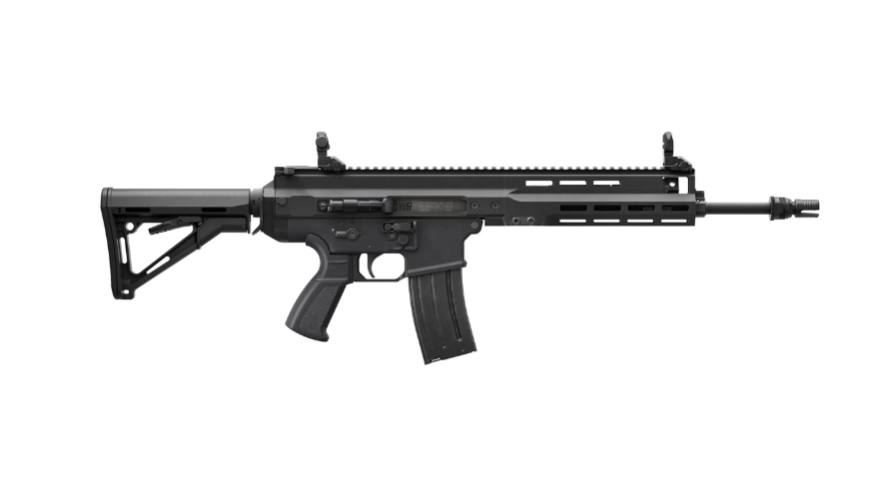
Belgian firearms company FN Herstal launched its new assault rifle, named ARKA, on June 2. By simply looking at the rifle, one can say that even FN is transitioning from its SCAR rifle to the AR-15 platform. Interestingly, the ARKA was earlier named the FN SCAR Mk-3. The rifle is chambered in 5.56×45 mm NATO and uses the short-stroke piston mechanism found in the FN SCAR-L Mk-2 rifle, which is chambered for the same round.
The ARKA features a T-shaped charging handle, forward assist, and a fully ambidextrous magazine release. It comes with a standard 14.5-inch barrel paired with either a short or long M-LOK handguard, or an 11.25-inch CQC barrel with a short M-LOK handguard. FN Herstal will offer this rifle for the UK's Project Grayburn programme to replace the bullpup SA80A3 rifle.
Eugene Stoner designed the AR-15 rifle in the late 1950s and early 1960s. It was chambered in the 5.56×45 mm round. The rifle was lightweight and allowed soldiers to carry more ammunition. The AR-15 design later evolved into the M16 and M4, which became the standard-issue rifles of the US military.
Even today, many countries are adopting rifles based on the AR-15 platform. The platform allows soldiers to carry more magazines compared to rifles chambered in 7.62×51 mm NATO. Even former Warsaw Pact countries are increasingly adopting rifles based on the AR-15 platform instead of those chambered in traditional Warsaw Pact calibres.
Today, companies such as Colt, Beretta, Sako, Heckler & Koch, SSS Defence, Lewis Machine & Tool (LMT), and now FN Herstal are designing rifles based on the AR-15 platform. The ARKA rifle from FN Herstal will not only participate in the Project Grayburn tender but will also compete with the American company Sig Sauer, which has secured a contract with Romania.
The growing adoption of AR-15-based rifles indicates that Europe continues to rely on the 5.56×45 mm NATO cartridge, while the United States is transitioning to the 6.8×51 mm round, also known as .277 Fury. While the newer cartridge is heavier and offers a greater range, the trade-off is that soldiers can carry fewer rounds compared to the lighter 5.56 mm NATO ammunition.
Arjun Dev Singh
Arjun Dev Singh has a deep interest in defence, security, and strategic affairs. With a strong analytical lens and a passion for military and geopolitical developments, Arjun strives to bring clarity and context to complex national and international issues.




Comments