











Indian Army’s Rudrarakshak Project

Static security has always been manpower-intensive. Long hours, predictable patterns, and human fatigue often accompany the guarding of some of the most sensitive locations in the country. In terrorism-affected regions, these vulnerabilities are precisely what adversaries exploit.
As threats become faster, smarter, and more psychological in nature, the limitations of purely human-dependent security have become increasingly evident.
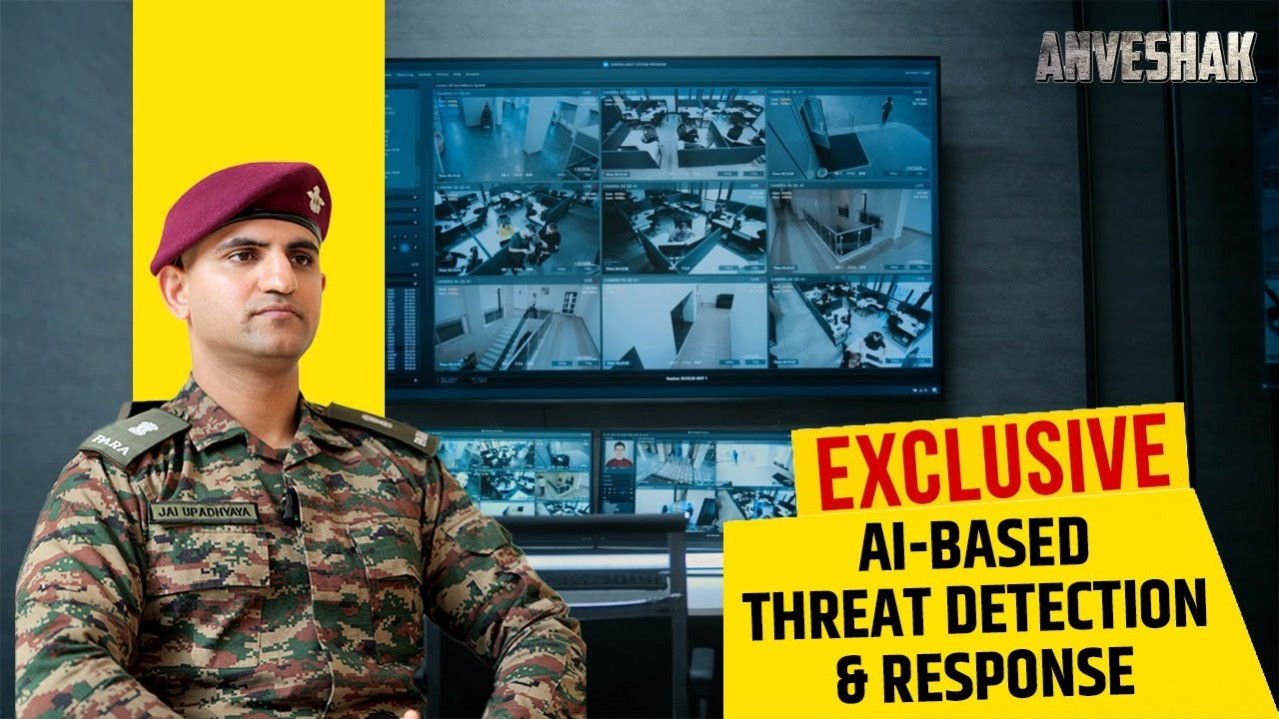
Major Jai Upadhyay, an Indian Army officer with deep experience in AI and drones, believed the solution lay in shifting from reactive defence to proactive domination. By integrating AI, autonomous drones, sensors, and surveillance into a single command architecture, he helped reimagine how sensitive areas are monitored and defended.
Major Jai Upadhyay explains:
“The Army is now entering the age of modernisation. With this decade being the decade of transformation and the last year being the year of technology absorption, many new technologies are emerging in surveillance and monitoring systems. There was a requirement to integrate these with drones and AI to make them even more effective. That is how this concept was developed.”
The Rudrarakshak project aims to provide the Army the ability to monitor and conduct surveillance 24×7 using automation, AI, and drone systems.
Major Jai Upadhyay emphasises that the system has been designed to remain as simple as possible because simplicity increases survivability in field conditions.
The first component is AI-based computer vision. In simple terms, cameras installed in the system can recognise and differentiate between a human being, an animal, and a vehicle. This provides the first level of confirmation if any person or potential threat is moving towards a protected area.
Second, the system incorporates several high-grade sensors that further assist in detection.
The next stage is the command system, which acts as the nervous centre. All camera inputs are routed to this location, allowing commanders and watch officers to assess the nature of the threat.
If required, the third phase of the system is activated — an autonomous drone. It does not require a pilot. It remains on a continuously charging platform so that it is always ready to respond, just like any soldier of the Indian Army.
If a threat needs to be addressed, the system is capable of both lethal and non-lethal action.
Overall, the system achieves three key objectives:
First, it significantly reduces the manpower required for routine security duties.
Second, it enables continuous 24×7 monitoring.
And third, it ensures a rapid response capability.
Major Jai Upadhyay highlights an important point:
“It is not the war of the future. It is the war of now. Warfare today is about man and machine operating together. When I say capability, I refer to technical capability — AI, robotics, niche technologies, directed-energy weapons. These are no longer futuristic concepts from movies. They are becoming part of modern warfare today.”
Watch the full episode: https://www.youtube.com/watch?v=1OvvIFD0KZI
Chakra Desk
Chakra News is a specialised digital media platform committed to in-depth coverage of India’s defence, national security, geopolitics, and critical technologies.



Comments