







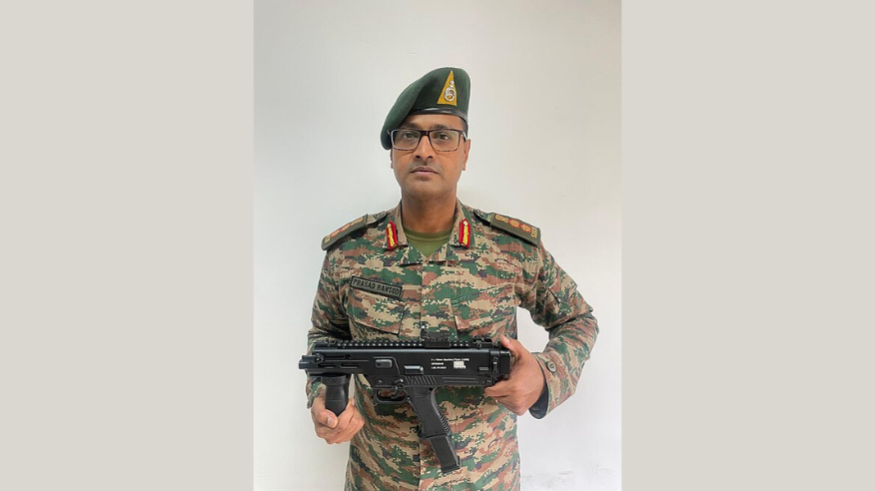
SA WEAPON SYSTEM DEVELOPMENT HISTORICAL PERSPECTIVE AND BACKGROUND IN INDIA COLONEL PRASAD A BANSOD, VSM

Abstract
This article examines the historical trajectory of firearms and gunpowder in India, tracing their evolution from 13th-century rocket prototypes like the Tir-i-Hawai to the sophisticated artillery and small arms produced by the Mughals, Marathas, and Sikhs. Moving into the modern era, the paper analyses procurement trends from 1900 to the present, evaluating current market dynamics and the projected growth of the small arms sector. The study concludes that achieving true self-reliance under the "Make in India" initiative requires a state-of-the-art R&D and manufacturing ecosystem. By balancing user aspirations with economical, world-class production and establishing a synergised developmental roadmap between designers and manufacturers, India can secure its national interests while successfully competing in the global arms market.
Col Prasad A Bansod, VSM, holds the Chair of Excellence for Small Arms Weapon System at CENJOWS Introduction The firearms and gun powder find mention in Indian historical context from 13th century in various forms right from “Tir -i- Hawai”, 1 a rocket of Chinese and Mongol origin part of fireworks welcoming Hulegu’s envoy to Delhi in 1289, similar to ones fired on festivals to hand held firearms like Match/Wheel/Flint lock weapons to predecessors of modern artillery popularised by Mughals and British. In fact, the advent of gunpowder and firearms of various types turned the tide in favour of empires that exploited them early and turned against those who were reluctant to embrace the new tech and still relied on conventional cavalry and infantry. The First Indian War of Independence (1857) was also started over the controversy involving the ‘Pattern 1853 Enfield rifle-musket’ and its animal fat-greased cartridge. ‘Gunpowder Empires’ quickly rose to prominence and changed world history as we know it today. It is also well known that before the British conquest of India and eventual disarmament after the 1857 mutiny, many Indian powers like Sikhs, Rajputs, Marathas, Mughals and others were producing high quality Artillery and firearms with the help of European expertise. This article will outline the historical perspective of firearms in India from the 13th century till present time, including the British influence. Details of procurement of the last century, from 1900 to the present time, will be presented along with the current and projected market size. Various agencies involved with SA designing and manufacturing will be covered in subsequent articles.
Small Arms: The Definition and Purpose
Small Arms (SA) can be defined as man-portable, relatively flat trajectory, largely shoulder-controlled weapons, in calibres up to 12.7 mm (.50 inch),3 used primarily to incapacitate or suppress the enemy with bullets or fragments. Canons take over after 12.7mm go up to 50mm. While the weapon has received legendary status, it is the ammunition that provides the results. SA only exist to fire the projectile. The primary objective of military SA is to exert control over a person, either by death, incapacitation or suppression.
United Nations Definition
The United Nations for control purpose clubs both ‘SA’ and ‘Light weapons’, as these are often used in close conjunction. For this instrument, “SA and light weapons4 will mean any man-portable lethal weapon that expels or launches, is designed to expel or launch, or may be readily converted to expel or launch a shot, bullet or projectile by the action of an explosive, excluding antique SA and light weapons or their replicas. Antique SA and light weapons and their replicas will be defined in accordance with domestic law. In no case will antique SA and light weapons include those manufactured after 1899: (a) ‘SA’ are, broadly speaking, weapons designed for individual use. They include, inter alia, revolvers and self-loading pistols, rifles and carbines, sub-machine guns, assault rifles and light machine guns; (b) ‘Light weapons’ are, broadly speaking, “weapons designed for use by two or three persons serving as a crew, although some may be carried and used by a single person. They include, inter alia, heavy machine guns, hand-held under-barrel and mounted grenade launchers, portable anti-aircraft guns, portable anti-tank guns, recoilless rifles, portable launchers of anti-tank missile and rocket systems, portable launchers of anti-aircraft missile systems, and mortars of a calibre of less than 100 millimetres”.
Brief Account of Gunpowder/Firearms in India
It is generally believed that Gunpowder accidently discovered by the Chinese around the 9th century and eventually arrived in India around the 13th century. A brief account on travel of Gunpowder and firearms there on can be can be divided into three phases, as written by Anirudh Deshpande.
• Phase One. This phase saw the introduction of gunpowder to the Indians. By the mid-14th century, many states/kingdoms had established their own manufacturing of the same, called ‘Barud Khanas.’ During the next two centuries, we see a change in the application towards the use of firearms and even artillery in its earliest form. It is, however, a sombre reality that this revolutionary concept of gunpowder didn’t find much traction with major Indian rulers and powers back then.
• Phase Two. Here one can see a distinct imprint of the Mughals and their innovative use of Gunpowder specially in Artillery and flintlock firearms. The Mughals revolutionised warfare as they invested in this technology, adequately demonstrated by their success in the pitched battles of Panipat (1526), Khanwa (1527), Chausa (1539) and Kanauj (1540), wherein they defeated much larger armies. This phase roughly started with Mughal emperor Babur’s exploits, wherein he used Gunpowder and artillery to their optimum and laid the foundation of the Mughal empire in India after defeating Ibrahim Lodhi.
• Phase Three. The phase is marked by improvement in the mobility of artillery and sees the downfalls of the Mughals and the Marathas. From 1600 till 1750s, the firepower in the Indian subcontinent saw almost no improvement and was no match against the mobile canons of the Europeans. This led to the expansion of the colonial powers, mainly Britain, through the East India Company (EIC).
• Phase Four. The fourth phase roughly covers 75 years till first war of Indian Independence in 1857, after which British rule was established in India. We see a renewed interest of Indian powers like Marathas, Sikhs, etc in adopting the latest technology, especially artillery alike the Europeans. From 1858 onwards, after the 4 establishment of British rule from the EIC, the British realised that the firearms industry in India must be controlled.
The British Influence and Military Deindustrialisation of India
In the online article ‘Guns and the British Empire,’ historian Priya Satia narrates that gunpowder and firearms were the fundamental foundations on which the entire British industrial revolution was based.6 It was not only used to establish the ‘Raj’ but also created a huge Military- Industrial complex (MIC). Britain’s Midlands (Birmingham) rose to become a leading manufacturing centre owing to overflowing orders as it fed the industrial revolution due to requirements for war efforts, manufacturing millions of ‘Indian Pattern Muskets’. The British hypocrisy ensure that under the false garb of ‘knowledge sharing’ British government actively protected its domestic gun industry which received patronage, funding and support where as those in India were systemically shut down thus creating complete dependence on British It was misnomer that the Western technology was considered superior, Priya Satia reveals that that 18th-century Indian arms (from Mysore, Awadh, and the Marathas) were often a cut above the British ones in range, velocity, and finish. To control Indians from manufacturing state of the art firearms and to promote British ones, the EIC blocked Indian access to technical knowledge, thereby systematically dismantling Indian factories, eventually killing local manufacturing. The British stifled Indian industry; they were quick to ‘borrow’ Indian innovations. For example, the British, however, stole Indian technology like the ‘Congreve rockets,’ primarily based on Tipu Sultan’s rockets used against them.
Brief history of Ordnance Factories
During the last quarter of the 18th century, the EIC felt the requirement of raising firearms/artillery manufacturing capacity in India, primarily to feed the ever-increasing colonial ambitions and economic interests. In 1775, the Ordnance Board was raised at Fort William, Kolkata. Thus, marking the official British ordnance manufacturing in India. Initially, a Gunpowder manufacturing plant was established on the banks of the Hooghly River in a small town called Ishapore, where in 1904 a rifle factory was erected. This was followed by the establishment of the Gun Carriage Agency at Cossipore, which later became the Gun Foundry Cossipore in 1830. It was raised under Lt. Col. Glass. It is now known as Gun & Shell Factory, Cossipore. 18 ordnance factories existed pre- independence, and 23 factories were raised post-independence.
Before the private industries entered the defence manufacturing scene in India, the majority of the defence contracts were awarded to the erstwhile OFB, which produced everything from weapons, SA, tanks, artillery, ammunition and even troop comfort consumables. The primary consumers for the OFB were the Armed Forces, CAPFs and Armed Police of various states. The Board had a monopoly over the defence contracts. The private industry during this period was in a support role as tier -II suppliers to the major factories, which played the role of ‘Lead Integrators’; suppling the final product. However, user feedback indicated concerns regarding the quality as supplied by the OFBs, which was evident in multiple CAG reports which severely criticised the Ordnance Factory Board (OFB) for poor manufacturing, production shortfalls, and poor-quality control, which have led to a critical deficiency in ammunition and accidents for the Indian Army.
To revamp defence production, enhance efficiency and grant a greater autonomy, in June 2021, the govt decided to corporatise all (41) units of the Ordnance Factories. The erstwhile structure would give way to seven new Defence Public Sector undertakings, namely as under: ADVANCED WEAPONS AND EQUIPMENT INDIA LIMITED (AWEIL), MUNITIONS INDIA LIMITED (MIL), ARMOURED VEHICLES NIGAM LIMITED (AVNL), GLIDERS INDIA LIMITED (GIL), Century of Procurement and Production INDIA OPTEL LIMITED (IOL), OFB TROOP COMFORTS LIMITED (TCL), YANTRA INDIA LIMITED (YIL)
Century of Procurement and Production
Let’s take a look at a century (1900-2025) of SA production and procurement in India. Two scenarios have shaped the modernisation of arms and equipment- the 1962 Sino-Indian War and the 2008 Mumbai Terror Attacks. This timeline is important to understand the state of current production & procurement. Aaron Karp and Rajesh Rajagopalan.9 In their report state that various agencies and organisations have varied armament requirements and procurement policies, which will have a mix of contemporary /legacy systems and also state-of-the-art armaments mostly procured through imports to keep up with the latest. This approach has led to a modern but heterogeneous combination of weapons of all types. As a result of SA procurement moving from central control to states and agencies since the 1990s, this trend has intensified
Three Waves of Indian SA Development and Procurement
This section elaborates on the broad manufacturing vision and also throws some light on indigenisation efforts, especially in terms of products like the INSAS family of weapons, transfer and absorption of ToT from foreign OEMs and some attempts even to reverse engineer. Wave two, three and four, as mentioned in the succeeding paras are of immense importance as these shaped out the SA philosophy for the foreseeable future. Government 7 SA procurement for various users as authorised falls into four waves, classified by production, procurement wars/operations and the necessity to modernise thereon:10
• Wave one (1900 to 1963). During this stage, British modelled weaponry was manufactured by Indian Ordnance Factories (IOF). The SA’s most favoured were the Lee-Enfield rifle and the Webley revolver. SMALL MAGAZINE LEE ENFIELD (SMLE) WEBLEY REVOLVER Source: Compiled by Author from various sources
• Wave Two (1964 to 2007). The learnings from the Sino- Indian war formed the basis of our thinking shift with more semi-automatic and automatic firearms and an emphasis on locally produced foreign models with a focus on indigenous tech. This was dominated by Self- Loading Rifle (SLR), Indian SA System (INSAS), Sterling sub-machine gun (SMG), and the 9 mm Pistol Auto.
In the 1990’s, India Army was equipped with SLR rifles, and the serial production of Initial variants of the INSAS rifle had just commenced. However, there was an urgent requirement for a weapon for CI/CT ops in J& K, as the situation was deteriorating. As a stop gap measure10,000 AK-47 rifles were procured for the Rashtriya Rifles from Romania.11 The AK-47 is a short, handy weapon (with a barrel length of 415 mm and folding butt capability which can fire in bursts at short distances with relative accuracy. The Terminal ballistics were adequate for incapacitation in CI/CT ops, and the weapon is controllable (unlike the SLR) in burst fire mode also. During this period, in 2002, we also saw the procurement and induction of the Israeli-made Tavor rifle (quality 3074) for the Special Forces for INR 880 million.12
• Wave Three (2008 to present). The 2008 Mumbai terrorist Attacks were a wake-up call for the Indian security establishment. The Mumbai Terror attacks triggered a series of reforms (largely driven by state Police forces and CAPFs) Incl raising of ATS in almost all states. The equipping of forces and up gradation of CAPFs led to a new wave of quick COTS purchases. The period saw the rapid mushrooming of anti-terror units both at the federal and state levels. The Federal Anti – Terror Force NSG established five more hubs at Kolkata, Hyderabad, Chennai, Mumbai and Ahmedabad, and a Task Force in Jammu, and a new Hub was announced at Ayodhya. Almost all state police forces saw the rise of Anti-terror units/ Special units to tackle the security situation. There was pressure to arm these new units; a decision was taken to equip these units with armaments imported in place of domestic purchases. The weapon holding became more diverse in types due to specific service requirements of different agencies and department making the heterogeneous mix. The erstwhile OFB (Now AWIEL) lost its monopoly and has now been relegated to a vendor who has to compete with other manufacturers for govt contract.
• Wave four (2008- 2025). The single most critical part of this phase was the years 2015- 2017, when the allotment of Arms Production licence was awarded to private players/entities, which has now changed the complete Indian SA landscape. The IOF lost its monopoly on govt sales and was relegated to a vendor. The Armed Forces, too, realising the limitations of 5.56 mm (INSAS amn) coupled with the already 9 plagued INSAS program, decided to change its standard rifle calibre to 7.62x 51/39 mm. It was decided to buy modular weapons with modern accessories through the FTP route in the backdrop of Op Urgencies.
Existing Domestic Market
Total official Indian inventories are estimated to contain 5.6 million SA. Approximately 2.6 million of these belong to the military, 1.3 million to paramilitary agencies, and 1.7 million to police.13 The increasing size of the Armed Forces, MHA forces, and enhancement in the Armed 10 State Police Forces has amplifies the requirement of SA within the country. This includes both initial bulk procurement and recurrent retail procurement, including spares/accessories and ammunition. Bulk procurement, like the change of calibres in respect of the Indian Army, brought about a change in the basic weapon system from 7.62mm SLR to 5.56 mm INSAS Family. This resulted in mass production of weapons systems, components/accessories, ammunition involving DPSUs and pvt industry, providing adequate opportunities even to MSMEs to contribute towards nation building.
Indian Armed Forces are the largest consumers of SA in the country, including their reserve elements. Different states in India have their respective State Police Forces, a certain percentage of which are Armed Police, that are authorised to bear arms. These also form a sizable number for SA in the country. The estimated total of these, as per 201116, are approx. 1,17,00,000. With a majority of these (approx. 100,000) being the vintage .303 Lee Enfield rifle & variants.
With the total SA market size of approximately 63,32,000 SA in India, the procurement model is generally based on a 15-20-year life expectancy of an average firearm, although prudent maintenance practices and conservational approach extends average the life of firearms beyond 20 years in most cases. With the above practices in mind, for recurrent yearly procurement, a realistic attrition percentage of 1-2% (against a global CAGR of 4.5%) should be benchmarked to estimate the annual market size. The annual requirement just to meet domestic requirements turns out to be approximately 60,000 SAs per year. This pattern precludes the cyclic major turn overs (15-20 years) wherein the basic weapons systems are procured in bulk. If an average benchmark price of a Carbine/ Assault rifle can be estimated 12 at Rs 80,000/-, then the annual SA market for domestic requirement itself stands at Rs 450 - 500,00,00,000 ($ 4.5-5 Billion).
Export Potential
The global SA market will experience a CAGR of 4.17% to 4.5% growth until 2027, mainly due to the modernisation and replacement of ageing military and police inventories. It refers to a stable market for 4-5% of the inventory on account of ageing and technological advancement.17 SA manufactured by India has export potential to other countries in South East Asia, the Middle East, Africa and Latin America. Exports can also include raw materials, spares/Jigs-fixtures, or logistics related to SA. In these places, the largest contender is China, which can be overcome by Indian manufacturing standards and competitive costing.
Indian products have a huge market potential in the markets, as suggested by the IBID report. Govts push towards ‘Atamannirbhar’, and the various schemes to incentivise Indian Defence manufacturers should usher in a new era of exports. Various programs like procurement/sale on ‘Line of credit’ and quality assurance will help enable Indian products to reach global consumers. Details of such requirements and govt assistance will be covered in detail in subsequent articles in this series.
Conclusion
SA are the symbolic epitome of national security and have been used to project power. To ensure the self-reliance of our country in the field of small arms, it is imperative to ensure that user aspirations are met in the best possible way. It is equally important to ensure that the R&D and manufacturing setup is state-of-the-art, capable of producing world-class small arms at an economical cost, with an aim not only to meet national security requirements but also to target international markets. A vital step in this direction is to prepare a small arms developmental plan with major milestones clearly marked and optimised with our future aspirations, as well as ensure a synergised approach between the user, designer and manufacturer. The aspects when carefully balanced can truly fructify “Make in India”.
This article appeared on 27 February, released by CENJOWS. reproduced with permission.
Chakra Desk
Chakra News is a specialised digital media platform committed to in-depth coverage of India’s defence, national security, geopolitics, and critical technologies.


Comments