












Pakistan’s Emerging ICBM Ambitions

For the second time in as many years, the United States has flagged Pakistan’s potential development of Inter-Continental Ballistic Missiles (ICBMs) as a future threat. In 2025, U.S. strategic assessments first hinted that Islamabad’s advancing missile program could eventually extend beyond South Asia. Now, in 2026, that concern has been reiterated more explicitly: if current trends continue, Pakistan could develop missile systems capable of striking targets far beyond its traditional regional focus. It is not an immediate threat, but it is a trajectory worth examining.
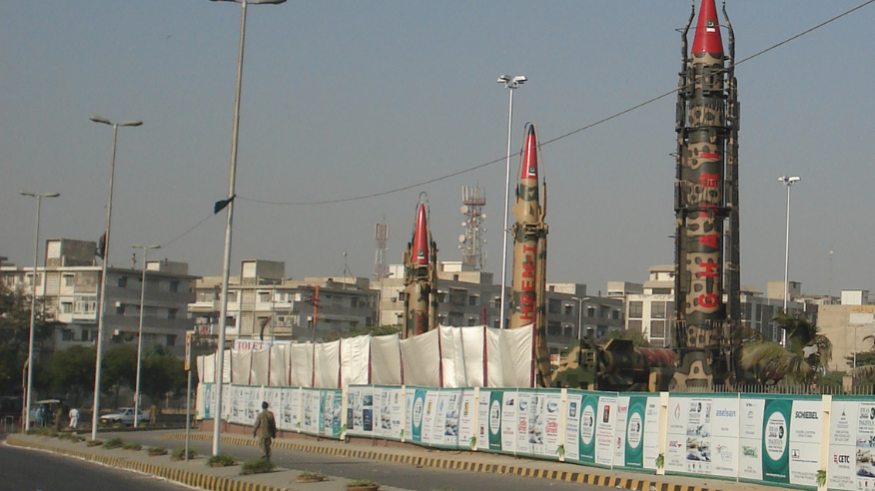
Historically, Pakistan’s missile program has been shaped almost entirely by its rivalry with India. Systems like the Ghauri, Shaheen-I and Shaheen-II were designed with ranges to cater to Indian targets. The newest addition, the Shaheen-III, is Pakistan’s longest-range publicly known missile. With an estimated range of around 2,750 km, the Shaheen-III was specifically designed to target India’s Andaman and Nicobar Islands, thereby closing perceived strategic gaps.
To reach the US mainland, Pakistan would need a missile with a range of 10,000 kms (East coast) to 13,000 kms (West coast). Such a platform would place Pakistan alongside the 8 countries which have ICBMS: the United States, Russia, China, India, North Korea, France, Israel and the United Kingdom.
But moving from 2,750 to 13,000 kms will not be easy. It will require massive advancements in propulsion technology.
So how does Pakistan aim to accomplish this?
Well, analysts have often pointed to the Shaheen-III as a potential technological foundation for longer-range systems. To evolve it into an ICBM-class system, Pakistan would likely need to develop multi-stage rocket systems (ICBMs generally have 3 stages). It would also need to drastically enhance accuracy to target intercontinental distances.
The repeated mentions in US think tank assessments suggest a shift in how Washington views Pakistan’s strategic trajectory. Pakistan’s steady improvements in missile design and materials could enable future breakthroughs. In the case of North Korea, it rapidly progressed from medium-range systems to ICBMs within a decade. Such a progression shows that Pakistan is capable enough to do the same.
But despite these technological capabilities, Pakistan faces its own set of challenges with respect to the ICBM program. Pakistan’s economy is crumbling. ICBM development requires millions of dollars’ worth of R&D. The possible threat of international sanctions would further put their economy under pressure and make a bad situation worse. The biggest and most important point that goes overlooked is the lack of strategic necessity. There is currently no direct military rationale for targeting the U.S. In contrast to countries like North Korea, Pakistan does not face existential threats from the United States that would justify such a capability.
For now, Pakistan’s missile program remains anchored in South Asia. But as history has shown, missile technology can evolve quickly under the right conditions.
Ayaan Ahmad
Research Analyst in Chakra News. Ex NDA with 4 years of experience in Defence and Geopolitics. Have an affinity for writing and finding stories from data.




Comments