










IRIS Dena Sunk by US Submarine

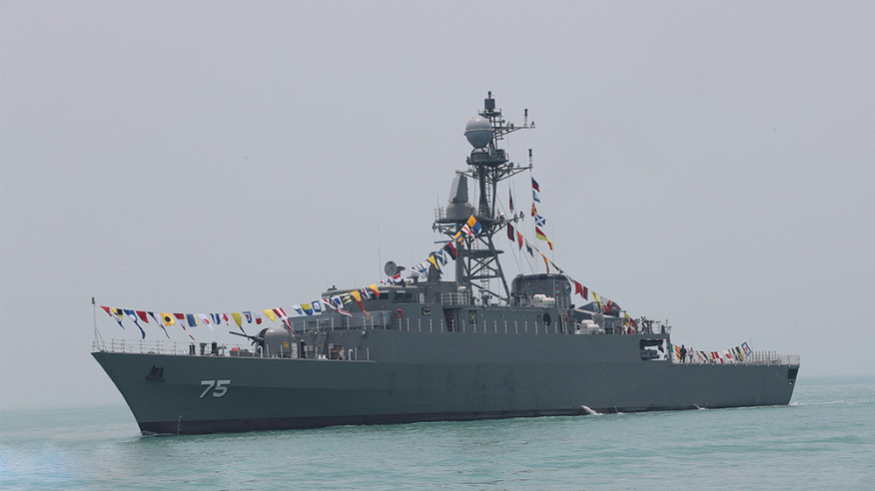
On March 4, the Iran-US war reached a dangerous new phase in the Indian Ocean. The Iranian frigate IRIS Dena was sunk by a US Navy submarine using a Mk-48 torpedo, just 14 nautical miles south of Sri Lanka. The strike signals a major escalation at sea and raises serious questions about regional security and global shipping.
To discuss the wider implications of this attack and the peculiarities of submarine warfare, Chakra News spoke with veteran submariner Commodore Anil Jai Singh.
Commodore Anil Jai Singh told Chakra News that “the two countries are in conflict. They may not have formally declared war, nobody formally declares war anymore, but the countries are clearly in conflict. Here were the two protagonists who faced off. It may have been south of Galle in Sri Lanka, but the fact is that it was a very juicy target for the US Navy to prosecute, particularly for an SSN. So, this ship was quite a sitting duck, actually. And if two countries are in conflict, anywhere anybody sees the other side’s ship, the rules of engagement are very clear. You hit it. So there’s nothing unusual about what happened.”
An important insight was also offered by Commodore Anil Jai Singh: “Any warship going to sea should be fully armed, irrespective of whether it's going for a treaty review, an exercise, or whatever it might be.” Speaking about the IRIS Dena, he said, “It’s a modern frigate, modern corvette. It had anti-submarine warfare equipment, it had torpedoes, and it had sonar. There’s no reason why it should not have been armed. If you put the shoe on the other foot, and suppose this ship had picked up a submarine, say the submarine was on the surface, I’m sure the ship would have attacked that submarine.”
Speaking about the role of submarines, Commodore Anil Jai Singh said, “As far as submarines are concerned, the US Navy has more than 40 nuclear attack submarines, what are called SSNs. SSNs are probably the most powerful and lethal platforms in any navy today. Only five navies operate SSNs, and the US has more than 40 of them. So obviously, if there is an area of tension, it is inevitable that there would be SSNs there.”
He added that the presence of American carrier groups would almost certainly mean submarine deployments as well. “If the US has deployed two aircraft carrier battle groups in the region, the USS Gerald Ford group and the USS Abraham Lincoln, then definitely there would be SSNs patrolling in that area. SSNs have a dual role. They complement a carrier battle group because they have speed, weaponry, lethality, concealment and stealth. Even when operating independently, they are extremely powerful platforms. They can achieve very high speeds, intercept ships at long ranges, carry land-attack missiles with a range of about 750 kilometres, and deploy heavy-weight torpedoes. So Iran would have been aware that SSNs are operating everywhere around them.”
When asked about India’s anti-submarine warfare (ASW) capability, Commodore Anil Jai Singh said, “India has been focusing a lot over the last two decades on improving its anti-submarine warfare capability. Today, every major frigate and destroyer is equipped with towed array sonars, hull-mounted sonars, ASW rocket launchers, and heavyweight and lightweight torpedoes. Almost every class of ship has them: the Delhi class, Kolkata class, Surat class, Shivalik class, Brahmaputra class. These are very effective for open ocean deployments as part of carrier battle groups or separate search and attack units.”
He noted that many of these ships are equipped with helicopters capable of anti-submarine operations. “Most of them have a heavy helicopter on board. That helicopter has anti-submarine and anti-surface warfare capability. So from an ASW perspective, in terms of sheer hardware, we are reasonably well placed. We do need more helicopters, and we know they are coming slowly.”
From a coastal defence perspective, he pointed to the induction of shallow-water ASW vessels. “These 16 ASW shallow water craft that are being commissioned will strengthen coastal security. INS Anjadeep was commissioned just a couple of days ago. These vessels will form a very effective littoral security layer, particularly against neighbours who are expanding their submarine capability.”
He described these vessels as a useful addition to India’s maritime defence. “These ASW shallow water craft are small, around 800 to 900 tonnes, and can operate in very shallow waters. They are equipped with towed array sonars, torpedoes and hull-mounted sonar systems.”
India’s airborne surveillance also plays a key role. “Then we have the Boeing P-8I long-range maritime patrol aircraft. These deploy sonar buoys, torpedoes and work closely with helicopters. So from an ASW perspective, we are doing reasonably well.”
In conclusion, Commodore Anil Jai Singh said India must balance multiple maritime threats. “We have to balance all our requirements. We need strong anti-missile capability and anti-surface capability as well. But for some time there was a degree of neglect in the ASW dimension, which is now being addressed quite rapidly.”
He also highlighted the growing submarine threat in the region. “Pakistan is acquiring eight submarines from China. In the restricted waters of the Arabian Sea, Pakistan will eventually operate 11 submarines: three French boats and eight Type 039s.”
Watch the full podcast: https://www.youtube.com/watch?v=CpPosxfKm2U&t=206s
Chakra Desk
Chakra News is a specialised digital media platform committed to in-depth coverage of India’s defence, national security, geopolitics, and critical technologies.



Comments