











Five Ways in which Anduril Fury is going to redefine warfare

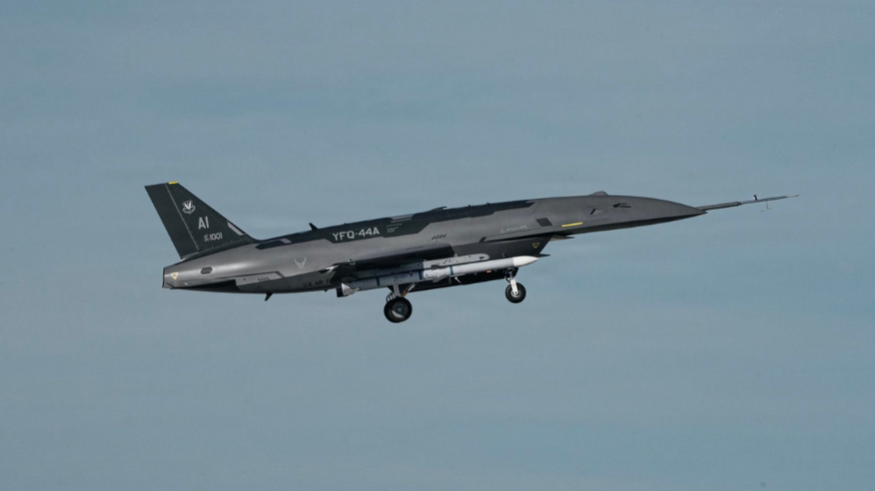
US defence technology firm Anduril’s new semi-autonomous jet-powered unmanned combat aerial vehicle (UCAV), dubbed “Fury”, promises to transform air warfare. The UCAV was developed in just 566 days— from concept to execution. It achieved its first semi-autonomous flight on October 31, 2025, just 556 days after the firm was selected for the program. The Fury was designated the YQ-44A on 3 March 2025 by the US Air Force. It is part of the US Air Force's Collaborative Combat Aircraft program. Y stands for Prototype status (this prefix will be dropped once the aircraft enters production), F for Fighter mission, and Q stands for Uncrewed/Unmanned system.
Here are five ways it will change air warfare
1. Keeps the pilots safe
Pilots fly the YFQ-44A from a safe distance. This means the UCAV can undertake hazardous missions like suppression of enemy air defences at the start of aerial campaigns.
2. Acts like a loyal wingman
The Anduril Fury can fly alongside the manned aircraft, what is known as the loyal wingman concept. The Fury can be controlled by in-service combat jets like the F-15, F-22, F-16 and the F-35.
3. Can act like a digital kamikaze
The Fury can execute high-risk manoeuvres—like flying into enemy airspace to get an adversary's radars to reveal their positions. These positions can be attacked and destroyed.
4. Can switch software in flight
Software-defined control or adaptive flight control, allows unmanned aircraft to transition between different algorithms without landing. This could prove critical for drones to switch between dynamic mission requirements. On 26 February, the YFQ-44A flew with two different mission autonomy software suites, made by two different vendors, on the same aircraft, on the same flight. The aircraft took off and autonomously approached a designated point where Shield AI’s mission autonomy software stack, Hivemind, was activated to complete a series of test cards. Following completion of Hivemind tests, Anduril was able to seamlessly switch to Anduril’s Lattice for Mission Autonomy stack to complete the same test points before returning safely to land.
5. Perform air combat
The Anduril YFQ-44 will go in for weapons tests in the next few months. It will carry both air-to-air and air-to-ground weapons. On 23 February, the YFQ-44 was carrying an AIM-120 AMRAAM missile, indicating the start of weapons testing trials.
Where are India’s Furies?
General Atomics YFQ-42A ‘Dark Merlin’, Northrop Grumman's YFQ-48A ‘Talon Blue’, and Boeing's MQ-28 Ghost Bat, are platforms in direct competition with the Fury. On January 8, the US Marine Corps awarded a contract to the XQ-58 Valkyrie as its CCA platofrm. Türkiye has its Kizilelma drone, which became the first drone in the world to fire an air-to-air missile on 30 November 2025.
But where are India’s Anduril Furies? India got off the blocks seven years ago with the CATS Warrior programme, which began in 2019. The first CCA platform is still a year away from flight testing. The Combat Air Teaming System (CATS) programme, began in 2019 as a Public Private Partnership (PPP) between HAL and private startup NewSpace Research and Technologies (NRT). A CATS prototype was displayed at Aero India 2025. The CATS Warrior employs two HAL PTAE-W engines derived from the PTAE-7 engine developed by the Aero Engine Research and Development Centre. In January 2025, HAL successfully conducted the first engine ground run of the full-scale demonstrator, a key step toward flight. While ground trials and taxiing are currently underway, the maiden flight of the Warrior is scheduled for 2027.
Arjun Dev Singh
Arjun Dev Singh has a deep interest in defence, security, and strategic affairs. With a strong analytical lens and a passion for military and geopolitical developments, Arjun strives to bring clarity and context to complex national and international issues.



Comments