






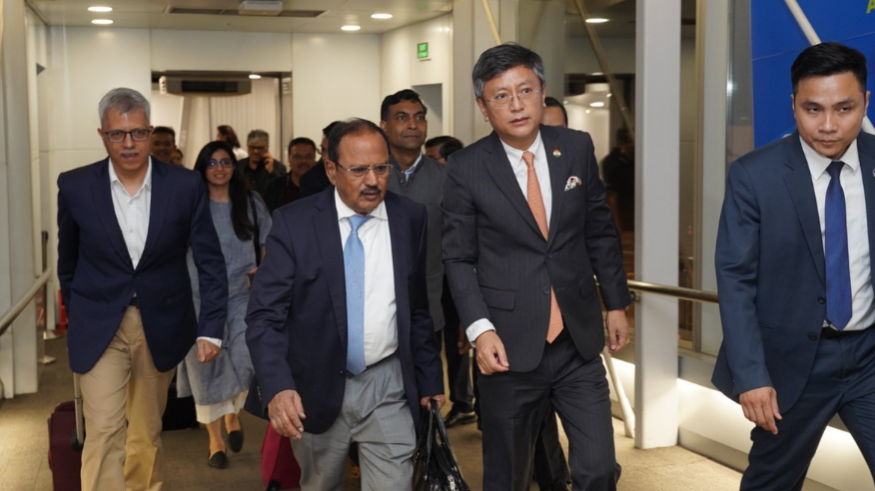
What was NSA Ajit Doval doing in Vietnam?

India’s National Security Advisor arrived in Hanoi on November 1 for a high-level visit aimed at strengthening the two countries’ strategic partnership. But with defence cooperation, maritime security and the wider Indo-Pacific in play, the significance of his visit extends beyond diplomatic niceties.
Vietnamese official media has framed the visit around implementing existing commitments and strengthening defence, security and technological cooperation. Regional strategic coverage, meanwhile, places the engagement against the backdrop of China’s growing influence in the Indo-Pacific and Vietnam’s efforts to diversify its security partnerships. The central question is whether India and Vietnam can translate their strategic convergence into deeper operational cooperation.
On November 2, Doval met Vietnam’s Deputy Prime Minister and Defence Minister, General Phan Van Giang. Both sides reviewed ongoing defence cooperation and agreed to deepen engagement. Doval also held talks with Public Security Minister General Luong Tam Quang on security cooperation, including cybersecurity, counter-terrorism, law enforcement and emerging technologies. He also met Foreign Minister Le Hoai Trung.
The visit follows a significant development in May 2026, when Prime Minister Narendra Modi and Vietnamese President To Lam elevated bilateral relations to an Enhanced Comprehensive Strategic Partnership. Their defence cooperation is guided by a Joint Vision Statement towards 2030.
The groundwork is already substantial. India transferred the missile corvette INS Kirpan to Vietnam in 2023 and supplied 12 high-speed guard boats under a $100 million line of credit. In May 2026, India also confirmed that an agreement to supply Vietnam with BrahMos missiles had been signed, although its financial terms remain undisclosed.
Last month, the two countries held their fourth Security Dialogue in New Delhi, reviewing cooperation in maritime security, cybersecurity, counter-terrorism, economic security and emerging technologies.
The geopolitical context matters. Vietnam faces maritime disputes with China in the South China Sea, while India seeks a stronger presence in Southeast Asia through its Act East Policy. Both support freedom of navigation and respect for international law. Deeper defence ties could strengthen Vietnam’s security options and expand India’s strategic footprint.
However, neither country has described this partnership as a formal anti-China alliance. Vietnam continues to pursue strategic autonomy.
Doval’s visit, therefore, is about more than weapons or military exchanges. The real test is whether India and Vietnam can turn shared interests into sustained defence-industrial, technological and security cooperation.
Chakra Desk
Chakra News is a specialised digital media platform committed to in-depth coverage of India’s defence, national security, geopolitics, and critical technologies.


Comments