







Trump Welcomes Mecca Agreement: Does India Need To Worry?

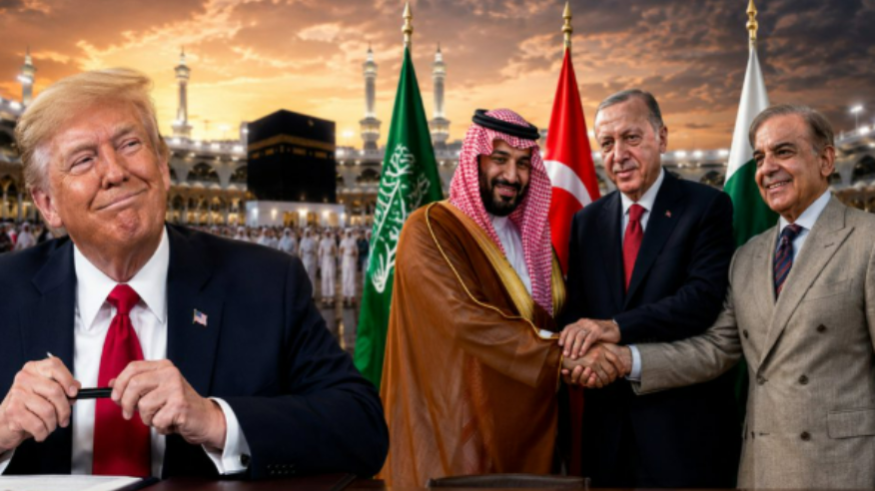
US President Donald Trump welcomed the 'Mecca Joint Defence Agreement' between Saudi Arabia, Türkiye and Pakistan, lending the recently signed pact strategic weight. Trump called the agreement a “BIG, BOLD AND IMPORTANT FIRST STEP”, saying the agreement demonstrated that the Middle East was “coming together”.
Although a clause of the agreement provides for collective defence, calling the pact a form of an ''Islamic NATO'' is premature. The pact, despite strong political rhetoric, lacks a formal structure and commitments, and the full text remains unrevealed, raising ambiguity. Although these countries possess complementary forms of strategic weight, they vary significantly in their individual strategic objectives. For Pakistan, it is focused on an India-centric approach and India’s growing strategic relationship with Saudi Arabia further complicates the situation.
The significance of Trump's statement, however, lies less in the rhetoric surrounding an “Islamic NATO” and more in what it reveals about the changing security architecture of the region. For Saudi Arabia, the pact reflects a search for greater strategic insurance at a time when the security environment around the Gulf is becoming increasingly uncertain due to the United States' conflict with Iran. Türkiye brings a growing defence industrial base and military capabilities, while Pakistan contributes a large conventional military establishment as well as a nuclear deterrent.
Trump's endorsement is significant because it suggests that Washington is not certainly opposed to regional security arrangements developing outside a conventional US-led framework. Trump is known for squandering the United States’ credibility, as a consequence of which, countries are building respective insurance policies. Yet, rather than treating the pact as a challenge to traditional American influence, Trump appears to view greater regional burden-sharing as a positive development.
For India, this development requires neither alarm nor complacency. New Delhi has indicated that it is examining the agreement from the perspective of national security and regional stability. The immediate temptation would be to view the pact primarily through the India-Pakistan lens. That would, however, risk overlooking its wider significance.
The answer for India, should be deeper engagement with countries rather than reactive alignment. Saudi Arabia has become an important economic, energy and strategic partner for New Delhi, while India has simultaneously developed strong defence and strategic relations with Türkiye's wider regional competitors and with key Indo Pacific partners. The challenge will be to preserve these relationships without allowing the emergence of new security groupings to narrow India's strategic choices.
The Mecca Agreement may not yet be a NATO equivalent and calling it an “Islamic NATO” is an exaggeration, while the pact is yet at a nascent stage. Trump's endorsement of the pact shows that the regional security landscape of West Asia is being reshaped through new partnerships that increasingly connect the Gulf, Türkiye and South Asia.
For India, the lesson is simple and straightforward. The strategic map to India's west is no longer separate from the strategic map to its northwest. New Delhi will have to watch not only what these three countries do together, but also what their emerging alignment means for India's access, influence and security interests across the wider Indian Ocean and West Asian region.
Savio Rodrigues
Savio Rodrigues is a Research Analyst at Escape Velocity MediaWorks Pvt Ltd and writes for Chakra News on Defence, Geopolitics, National Security. He holds a Master’s degree in International Relations from the University of Mumbai.



Comments