






India’s Most Controversial Army Chief

The Sandeep Unnithan Show
Feat Probal Dasgupta
Author, Historian, Columnist, and Military Veteran
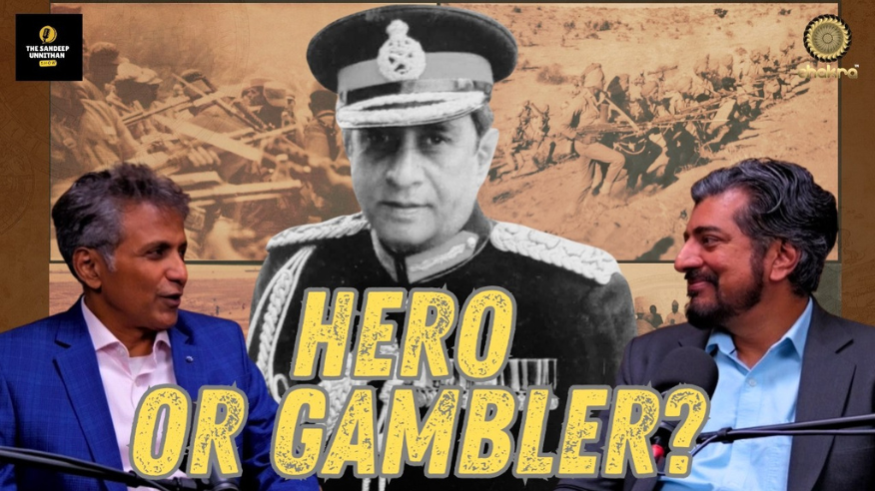
Sandeep Unnithan: Hello and welcome to the Sandeep Unnithan Show, your weekly dose of defence, geopolitics and much more. Today I'm joined by Probal Dasgupta, author, historian, columnist and of course a military veteran, distinguished military veteran. He's out with a new biography of one of India's most charismatic, cerebral, and, of course, most controversial army chiefs, General Sundarji. His new book is called General Brasstacks, the Sundarji story. Prabal, welcome to my show.
Probal Dasgupta: Thank you, Sandeep. Pleasure to be here.
Sandeep Unnithan: Thank you for coming, Prabal. General Brasstacks, one of the most beloved and, I would say, controversial army chiefs. Krishnaswamy Sundarji, what drove you to write a biography? I think it's the only biography of General Sundarji.
Probal Dasgupta: Yes, it is the only definitive biography. I don't recall that he wrote his memoirs, which were about the early part of his life, which helped me draw source material information about what he was thinking when he was 1920-21, but that apart, there is no full-fledged biography of him that was there before this book came out.
Sandeep Unnithan: Magnificent work, I must say that the kind of work that you've put into this bringing this book together Probal is that I was just when I went through it I just realized that here is one of the Indian army chiefs that we've really not studied a lot about and the sweep of the book leads you to believe that LAC with China, LOC with Pakistan, Blue Star Operation, Chequerboard, Hammerhead tried it. All this in 820 days of tenure. I would have thought. that he had a tenure of five or 10 years.
Probal Dasgupta: Yes, it seemed like.
Sandeep Unnithan: Incredibly eventful tenure. Did he actually make all of this happen? How do you see him as an army chief as a strategist? Was this something that he had planned all along to engage in all of this, multi- front war, or was it something that he was just caught in those circumstances of the 1980s?
Probal Dasgupta: So I'll also answer your first question as well, why him? I thought he was a child of destiny he was child of destiny interesting yes because I think all along and if you if you see the period post-independence India to the 80s four five decades as you mentioned he has been a part of most of these almost like having a ringside view from the partition days to Gandhi's death to post independence new India which is still carrying his colonial legacy.
Sandeep Unnithan: Some pre- liberalization India 47 to 61.
Probal Dasgupta: Yes, and then the 60s and 70s again. He was not fully involved in the 71 war, but he was in the 33 corps in Siliguri. 65 years there at the start of the war 80s was his period when he was completely at the centre of it all. So all along, he had it. If I were to plot his life, it would be along the trajectory of post-India’s independence history of 40 years, and I would think that it's using the window or the story of the protagonist to map India's history in certain ways. In those four or five tumultuous decades culminating in the 1980s, that is why I wrote this book; it started, sometimes things start with a plan. I wouldn't be kidding myself, saying that everything is according to how you plan things. Also, it is a product of conversations and circumstances and ideas that develop over a period of time. One of the things that I recollect is that somebody had come forward asking me to write a book on Sam Manekshaw. He'll be surprised but not surprised as well because in our ecosystem, we like to flock to the same horse, and I said, look, Sam Manekshaw has been done. Everyone has written that there was a film being made then.
Sandeep Unnithan: A biopic.
Probal Dasgupta: Then and now, it's been made. So I said everything has been done, some people know much, much more than what I would ever know. I don't think I can really regurgitate some; I would only be doing that, which I didn't want to do. That set me thinking, alongside I remember growing up in the 1980s, discussing with my father about what was going on at the Golden Temple, and we all know what we were doing when Mrs Gandhi was shot. We all know, we all remember in our mind's eye, in our personal histories, that look, we were doing this when Golden Temple happened. We would read newspapers, and at the centre of it all, while growing up in the 1980s, was General Sundarji. I said, well, certainly not Sam Manekshaw, the great general he was. It's been written about. I was thinking of Sundarji, and I realised that there's no book on him. Given the fact that these were events of the 1980s that we grew up with. And we're still wrestling with the consequences. And here was an opportunity to dive deeper into all of those things, and sort of understand what the motive was, who was involved, and how things happened a little more with a project in mind and a purpose, so that gave me a purpose as well. And the revealing thing was that, as it happens with the books that you work on and you would have seen your book as well, that you start by telling yourself, well, I know what has happened in the 1980s. I remember telling my publisher that I think the book is largely going to be focused there. I need to figure out what I can do to pull together any part of the life that he lived before the 1980s. And lo and behold, I discovered so many things right from 19. So, some of the story started to be written by itself. As I discovered events, as I researched, I found that what I said earlier, he was on the right side of history, like a Destiny's Child watching everything happen from the 1940s right up to partition, and he was the last chief who was commissioned pre-independence.
Sandeep Unnithan: Well, 46.
Probal Dasgupta: 46.
Sandeep Unnithan: Interesting, and he's also a deeply controversial chief. If you can look at what his critics would say about him, and I tend to agree with them at times, is that General Sundarji was theoretically brilliant, larger than life chief. I mean, there's possibly no chief post-independence that we've produced who could imagine warfare on the scale that he did, air-land battles going down to the nuclear question, which I'm going to ask you subsequently, but all his operations when they hit the ground, when the rubber hit the road, as they say.
Probal Dasgupta: Yes.
Sandeep Unnithan: They were disasters. Brasstacks nearly triggered a war with Pakistan. Blue Star was the Western Army Commander. We're still grappling with the consequences of the army going into the Golden Temple. Operation Pawan was a disastrous deployment in Sri Lanka. How did you reconcile with this when you were putting this book together? You still believe that his legacy is contested. He is controversial in a lot of ways. He was a political general, if you could call him that.
Probal Dasgupta: So that's a question that I started with, and some of the things that I kind of sourced through my research and understood better led me to certain viewpoints around some of these controversies and events. Well, I think one of the things, if I were to answer the question, answer this question in a particular manner, I would think that all the sources that I went to and spoke with, either had good things to say about him, or were critical of him. If I were to speak with General Kalkat, he would have a certain opinion about him. General Kalkat was the first commander in Sri Lanka. General Shamsher Singh Mehta had a certain opinion. Then there were certain people who were critical of him as well.
Sandeep Unnithan: You want to name them?
Probal Dasgupta: I would think that, let's say, Sri Lanka, for instance. I spoke with General Ved Malik. He was very balanced about his opinion on General Sundarji, and he believed that there's and he's written about it as he's written a blur general VP Malik has written, and he said there were times when he took calls which didn't work out the way, and they were instinctive, impulsive decisions and they were so he was impatient impulsive instinctive which kind of did not work out the way they should have and he would know well because he was the one who was at in that room when decision to go to Pawan Sri Lanka was made General VP Malik was there and some people have been critical in their writings as well I have I've actually named them in the book as well General VK (Tubby) Nayar was one. General P N Hoon was one person I've heard it from, personally,
Sandeep Unnithan: Deeply critical of.
Probal Dasgupta: He was deeply critical, as well as General VK (Tubby) Nayar was critical about him. So there are people who have been General Nanavatty again, very balanced about how he saw Sundarji as somebody who spoke a language that was far ahead of his times and therefore, he was not understood very well by a lot of people around him. So, there are several variations, but all said and done, one of the things I found was that either there were people who revered him or reviled him, either debated him or completely supported him. There he was, but he left a profound impact in every which way in all of these events that we spoke about. The one thing that I would say is that throughout his life, there was no moment that was devoid of action, devoid of drama, in this theatre that he kind of straddled right through. You spoke about 820 days. I think, if you add the Western army commander role, it will probably be.
Sandeep Unnithan: A little more.
Probal Dasgupta: A little more going up to a thousand days.
Sandeep Unnithan: Did he script all of these theatres that you spoke of, or was he again drawn into these circumstances?
Probal Dasgupta: So, if I were to look at that kind of thing, it can lead us to understanding why he was doing this. Blue star.
Sandeep Unnithan: Let's start with Blue Star.
Probal Dasgupta: Blue star. Yes.
Sandeep Unnithan: He was a Western army commander.
Probal Dasgupta: He was a Western army commander.
Sandeep Unnithan: You have a very powerful seek movement that's gone and entrenched itself in the holiest Sikh shrine, and it's an army operation. He makes that, according to your book, he makes the calculation that we will overwhelm them.
Probal Dasgupta: I think his assumption of the adversary’s capabilities was wrong. Second, so there was one, and I think he was. If I were to take a few steps back, he had developed his personality on the premise of being aggressive, being decisive at times, reckless, but impatient nevertheless, so all of these qualities ensured that he was not somebody who was going to wait; there was another plan, as far as the blue star, as far as Punjab was concerned, which was to surround the Golden Temple and lay siege. He was also, if I were to sort of be on his side, to be fair to him, he had acted on the face of the intelligence that was available to him at that time. So when I spoke with General Bulbul Brar, his view was that he had got intelligence that on the 9th of June, Khalistan was going to be announced, which meant that they would need to act quickly.
Sandeep Unnithan: pre-empt the announcement.
Probal Dasgupta: Yes. Apart from Amritsar, other gurudwaras in Punjab were at that time occupied by Bhindranwale supporters, which haven't come into light as much as Blue Star, because those were not as high-profile, but there were issues, and they had feared that Bhindranwale supporters would march from different villages across Punjab, and he had been made into a dragon which couldn't have been controlled by the political. It was a political creation, and the D dragon was swallowing up everybody, and nobody could do much then, and it was like an inevitable circumstance that was laid at the door of the army, that you do this. Well, in hindsight, we could say that it was a wrong call. The other option was to lay siege. Would that have been better? Which I understand from my speaking with sources, given that Khalistan was to be announced, it could have led to a much, much more difficult and complex situation. I know it's a little bit of a digression, but if you look at 1971, it's very different. I mean, I'm not comparing the two at all. But in 1971, the initial plan was to surround Dhaka. It was as the operations happened, and we know how General Sagat and others operated. So then they lead. They went into Dhaka and captured the city. So that was a call that they had taken, that this is what we would do. Now, if I had not succeeded, we would have probably thought of 1971 differently. So, in hindsight, as I said, there are two very different campaigns, so we can't compare, but I'm just talking about the mindset that when you have a situation, and you could either lay siege and take the other option, which General Vaidya had recommended, General Sundarji thought.
Sandeep Unnithan: Laying siege, but General Vaidya was the Army Chief at that time.
Probal Dasgupta: Was the Army Chief. So, where I follow General Sundarji was of disturbing the protocol, jumping General Vaidya and establishing a direct link with the Prime Minister, which Shiv Kunal Verma has also been critical of. He's again a very severe critic of his actions, so that is how I see Blue Star. Blue Star was an outcome of several deficiencies of the state system of the government, the inability of the law and order system to rein him in, he was moving around in Bombay and Delhi with guns and swords, and His supporters were everywhere. He had also heard that a DIG of the Punjab police had been killed on the steps of the Golden Temple. His body lay there for 4 hours. Nobody could pick up his body. That was the kind of influence that Bhindranwale had, the kind of domination that he had, and some people were standing around his body. the police did not have the gumption to go in and take out his fallen so body and so I think it was it was a set of circumstances that brought the situation to such a pass could be faulted for certain things, but I think the larger blame which I have indicated is at the door of the state the ineptitude with which the entire thing was happening
Sandeep Unnithan: So, he survived that fiasco that was Blue Star, which led to Mrs Gandhi's assassination and riots across the country.
Probal Dasgupta: And General Vaidya's.
Sandeep Unnithan: And of course General Vaidya, the only former chief to have been assassinated. How did he become chief? Then, on the 1st of February 1986, is when 40 years ago, he became the army chief. How did that happen? How did he manage to evade this controversy and become Chief?
Probal Dasgupta: He comes in, I think what had happened also was that Mrs Gandhi had died, and now it's a little disassociated with this, but General Sundarji had established a good line. He was there in the army headquarters earlier as well, so he had endeared himself to the new breed of politicians that had come up, which included Rajiv Gandhi and Arun Singh.
Sandeep Unnithan: The Beatles generation.
Probal Dasgupta: Yes, the Beatles generation, and they spoke technology, General Sundarji spoke technology, they spoke about high-tech computers. And I'll just give you a little anecdote. I was speaking with someone, and he was a young officer then. He said I was working; I was in the army headquarters working on a plan, and General Sundarji came in and briefed everybody that you should be having it on a computer screen; he spoke about computers. He spoke about war games and computers in 1982-84.
Sandeep Unnithan: When he was Vice Chief, or?
Probal Dasgupta: When he was Vice Chief, yes, so which was never imagined then, that nobody had known how to operate, then why is it even necessary?
Sandeep Unnithan: So, it's what you're saying that it was a meeting of two like-minded people. You have a young prime minister, 42 years old, talking about computers and an Army Chief, the first one again talking about computers.
Probal Dasgupta: Yes.
Sandeep Unnithan: In that sense, he had aligned himself with the political class.
Probal Dasgupta: Yes, and he had conducted an exercise called Exercise Dig Vijay 1981, in which we spoke about how he moved the tanks. They saw in him somebody who was modernising the Indian army. Here was a set of politicians who were seen as the modernisers' generation. Here was an army chief who was seen as a modernising army general. I think that was what tilted the scales in his favour.
Sandeep Unnithan: That's why General Kaul didn't make the cut.
Probal Dasgupta: Yes. The other view is that General Sundarji was ahead even otherwise. He had a tenure as Deputy Chief, as Vice Chief and then as Western Army Commander. So, he was tipped. The other thing is that General Sundarji was in line of seniority. General Vaidya had made it to the Chief. Superseded General Sinha, who had created a lot of controversy. So, the other explanation for this is also that the government didn't want to make another sort of a decision, which was which would account for a super session.
Sandeep Unnithan: So, he was anyway going to be chief, and he was seniority-wise.
Probal Dasgupta: Yes, he was, but I started the question on the premise of how there was a change in the leadership because Golden Temple had happened, which could have been a difficult time for him to make it difficult for him to really take.
Sandeep Unnithan: And soon after he becomes chief, he almost immediately plunges the Indian armed forces into the biggest exercise, not in India but in the world. Explain to us, Brasstacks. What was the Brasstacks all about? That's also in the title of your book. Why is it such a significant operation even four decades later? I don't think we have come anywhere close to the scale of the Brasstacks.
Probal Dasgupta: No. So, so again, Brasstacks was thought of as an all-services exercise. It was one of the first times that all the services were used, but it was basically General Sundarji's baby, as Admiral Tahiliani, in one of the sessions, mentions that this is General Sundarji's baby, so let him go ahead and plan Brasstacks happened because again, it's the political leadership and the military leadership were in alignment with each other, so Rajiv Gandhi called the three chiefs asks them if India had this kind of massive preparation of all three services. They said no. He said, we should have that and I think one of the things, as you said, it's never happened before or after, I would call it the first time a whole of nation approach had been undertaken to move mobilize the armed forces also, to which is not very well known is to mobilize logistics the ministry of transport the ministry of roadways, railways all of them.
Sandeep Unnithan: They were pretty upset. Madhavrao was not very happy with what was happening.
Probal Dasgupta: But I think they had a plan, and they had a plan, and they needed all of these logistic support. all of these other ministries to be supportive of what India was trying to do, which I think is immense. , creating that, and you spoke about that being the largest exercise. It was four times bigger than a NATO exercise; it was the largest ever exercise that had taken place after the Second World War. 400 000.
Sandeep Unnithan: 400,000 soldiers moving all across.
Probal Dasgupta: Yes. And it was, it is, again, anything that Sundarji did, which is what I sometimes have felt that has happened, is any action, any decision that he has taken had had its political implications and consequences which were far outside just the military impact, and Brasstacks was one.
Sandeep Unnithan: There's also that there's a view here that says that the Brasstacks was actually a giant diversionary operation?
Probal Dasgupta: Yes.
Sandeep Unnithan: And the actual objectives of Brasstacks were in the north, to capture parts of the POK. How true is that?
Probal Dasgupta: So, there are two parts to this. One is the thought that the Brasstacks was a smoke screen to really launch into Operation Trident to the north, which was to rest the areas in POK Gilgit Skardu, which by using tanks, by using reserve troops to land beyond the lines.
Sandeep Unnithan: Beyond the LOC?
Probal Dasgupta: Beyond the LOC into Pakistan, but that was not in isolation; it was with Brasstacks, and I'll come to why that was so. Because Brasstacks was meant to stretch the Pakistani deployment. Pakistan was conducting them at that time.
Sandeep Unnithan: Flying Horse?
Probal Dasgupta: Flying Horse and Safe Shikhar.
Probal Dasgupta: So, one was army reserve north and army reserve south. They had got the inkling that the Indian exercise was on. The interesting part was that it was the one time when the hotline between the DGMOs had collapsed, which had set off the cat amongst the pigeons. Look, when this happens, what is it we are planning? So the idea to be put into Pakistani minds was that India was, and Sundarji had adopted an approach wherein it would hold the Pakistanis in Punjab, and this is coming from his learnings in 1971, that the DCB warfare and the other things meant, and the Pakistanis are a very strong Amritsar axis. So, he would hold them there, and he would launch the strike core across the desert into Rajasthan, into Pakistan and dismantle the fledgling Kahuta.
Sandeep Unnithan: The nuclear reactor.
Probal Dasgupta: The nuclear plant facility, which Abdul Qadeer Khan established through his shenanigans, and he was developing by stealing the nuclear technology. So, all of that was also a part of this, that we stretched them at two places. Coming back to Trident. So, the idea was to stretch Pakistan down south to Rajasthan or Punjab and leave that space for Indian operations to be launched and rest in two or three areas from POK.
Sandeep Unnithan: In the northern areas?
Probal Dasgupta: In the northern areas, Gilgit and Skardu are amongst them. The idea was to use tanks and paratroopers to go inside Pakistan in POK and get that, but it was eventually shelved because of logistical overreach, as the plan could not find fruition. I believe the Prime Minister was not in complete agreement with that, which is what I've heard from sources, but there is a lot more to that than what is out there in the domain, given the fact that India also planned to. Sundarji planned to use the deployment, and we had 400,000 troops there. The idea was not just to be in the deserts alone. The idea was to make Pakistan deploy, commit and then get ourselves to do a quick operation. That is one of the interpretations. I mean, these are things that always throw up possibilities and interpretations.
Sandeep Unnithan: What ifs.
Probal Dasgupta: That's what if, so that was a what if. The other thing which has been debated far more is whether Sundarji had plans to actually attack Pakistan, drive into Pakistan, strike them and dismantle the Kahuta facility. There are two opinions on this. Many people have felt that it was not, and Sundarji planned to develop an aggressive posture and do the exercise as it was planned. There were four parts to it, and this was part four. Part one was on computers, as it started, and so the idea was to do that. But, the other view is that which is what western analysts and others, and I've, if you read Devin Hagerty and some of the others who've been writing about Sundarji. I think the view there is that General Sundarji would have moved the troops to the extent that it would provoke a first strike from Pakistan, which would enable him, given the excuse, to drive deeper into Pakistan. which I believe is possibly closer to the truth in my opinion I don't think there is a strong there is an opinion that oh no, he was not really well he was not, but that would have he was he was sharp, he was astute, he knew that if it provoked Pakistan into committing that mistake that would give him the excuse to go deeper into Pakistan, and that he was ready with force deployment, he was ready to do that. Analysts in the West have believed that India was in a position to actually close such a campaign quickly by moving through the deserts, and given that we had had this kind of a deployment, Pakistan was on shaky ground. It had not developed its nuclear facility then, which actually tells us why Pakistan was kind of panicky, because General Zia-ul-Haq, then president of Pakistan, flew down to India to broker peace.
Sandeep Unnithan: Famous match in Jaipur.
Probal Dasgupta: Yes, it got the Pakistani president to fly down. So, they were quite scared of that. Many years later, in the 1990s, the Pakistanis sitting across Sundarji at a forum in the US admitted that this was something that we were not aware of. It did spook them to the extent that the president had to fly into India, so this spooked them into considering the desert operation a possible plan. The Trident thing was another thing that spooked them. They called the Indian diplomat of the high commission, SK Singh, who was there. They called him at midnight, and they said What are you doing? So, they were very much rattled by, and they had known of General Sundarji because he remembered he was in the US. So, Pakistani generals were very much aware at that time. They have always been close to the US military thinking. So they knew this man was quite aggressive in his approach.
Sandeep Unnithan: So, he was a US-trained general in that sense. I mean, one hears that his inspiration for what he did with the Indian military in the 80s was the US airline battle concept, NATO's airline battle concept. How true is this? And was he very heavily influenced by the US strategic thinking at that time?
Probal Dasgupta: Yes, I would think so. So one of the Things that happened when he went to Fort Living for his command and general staff course was that the Americans were very impressed by the way he spoke and the way he thought. So his thinking was shaped by how the Americans were dealing with the global situation, then with the Russians, with the Soviets, theoretically and their approach to Vietnamese resistance in the 60s. He was also regarded by the US as someone who could command a NATO army, which is rare. I haven't known of a general Indian General who had been given that sort of honour, but I think the Americans were quite overruled by General Sundarji. They also inducted him into the Hall of Fame later.
Sandeep Unnithan: Is he the only Indian General?
Probal Dasgupta: I think, arguably, he is probably the only one. I don't know of anybody else who would have been inducted into the Hall of Fame. He has been the only one, unless there is somebody else. I do not know of anybody else, so that is the mindset that he came with. So, he came into India, and he was part of the defence reforms committee in the 1970s restructuring committee post 1971. His thing was his whole thinking of speed mobilisation
Sandeep Unnithan: Mechanisation.
Probal Dasgupta: Mechanisation was driven by the fact that he'd seen the Americans do that. So, his thing was to integrate the various components, and he thought of man and machine as one that could be integrated into one battery.
Sandeep Unnithan: He pushed a lot of reform, as I mean from your book, the fact that you had the Army Aviation Corps.
Probal Dasgupta: So all of this was shaped by when you talk about American thinking. On one side is this helicopter. On one side is a decisiveness to the point of taking charge, doing things the American way, which led to blunders, disasters, which led to mistakes, which also led to a large-scale transformation of the Indian army, which led to coming off on besting the conventional adversaries like China and Pakistan because he was a grand strategist. He knew that this was what I would do. This is how I would do it. So, I think that again, if you go back to the Americans, the grand strategist that Vietnam had no exit plan for, go to Sundarji again, he comes from Fort Leavenworth. He thinks that way, he's a transformative machine technology,
Sandeep Unnithan: Man-machine interface.
Probal Dasgupta: Yes, interface firepower. All of that, but again, you go into the low-intensity conflict, and there was a blunder. Sri Lanka was a big blunder.
Sandeep Unnithan: Sri Lanka was immediately after the Brasstacks. So, the Indian Army gets pulled back from the Brasstacks. The political leadership kind of worries that this could lead us into conflict. Then, you have two quick controversies in quick succession. You have Bofors, which just broke out in ' 86. The story broke in the Swedish media and was then picked up by Chitra Subramaniam. Then, in ' 87, you have Sri Lanka. So are these all interlinked?
Probal Dasgupta: So, what happened was Sumdorong Chu came in between against the Chinese. So you have, the sequence was there a low, and there was a high, there was a low. So that's how it went. Both actually started from the time that he was a deputy chief, and he had an oversight into the kind of choices that were made, the guns that were in the containment push, and the French gun.
Sandeep Unnithan: He was in favour of the French gun.
Probal Dasgupta: French gun. Yes. So, he initially saw the Sofma, but the gun tracking radars had been developed and had
Sandeep Unnithan: The AN/TPQs were supplied to the Pakistanis.
Probal Dasgupta: So, he changed his mind there. Bofors, when he finally chose the gun, and I'm sorry I'm digressing, but I'll come back to this thing. The Bofors happened at different points in his time at the Army Headquarters. He was a Deputy Chief, and he went out to various countries on a tour, and sort of and he saw all of these different guns. The Austrian gun was on the top of the list, but it had issues with its barrel mobility. The Sofma gun I told you about, they had developed.
Sandeep Unnithan: It didn't have the shoot and scoot capability.
Probal Dasgupta: Shorten squad capability was also something that they had had in mind, and there was a British gun, which was the fourth and then Bofors. Bofors and the other two were in contention. The Sofma gun was number one, but by the time he took over, he had the guns evaluated for two to three years, and then Bofors was the one that he chose. There was a controversy over Bofors, and these things, to your question, these things happened because the Prime Minister, the General, all of them, the Defence Leadership, the Army Leadership primarily, and here was the political leadership. I think they were also in a hurry to resolve things. Some worked in their favour, some did not. So, for instance, coming back to buffers, there were two parts to it. One is the gun and the deal. So Sundarji always maintained that I chose the right gun. Whether it was the right deal depended on the process followed. The process followed involved stakeholders. Some people knew it was a controversy because people said some people were on parole, and or people took kickback agents, and kickbacks happened. Win Chaddha was there, and a lot of things happened. So in fact, in Delhi, it was Olaf Palme and Rajiv Gandhi on a morning walk when they decided to let's touch the deal and let's go ahead. So, Sundarji’s stand before the parliamentary committee, and also earlier when he wrote a letter to S.K. Bhatnagar, who was a secretary of defence then, suggests that if there was a controversy, ask Bofors to reveal the names of the beneficiaries of the kickbacks. That was not done. The letter did not reach the Prime Minister, one. Second, when the Prime Minister heard that Sundarji had been talking about this, he was visibly irritated and annoyed. So, Sundarji's stand was quite clear, I thought, in both that look he said the gun was good. Because people started to it became a political sort of issue where people started talking about the gun and the efficacy of the gun. General Sundarji believed that the gun was fine. It's the deal, and he had a stand on the deal, which Chitra Subramaniam alludes to as well, that General Sundarji was not somebody who could be criticised for this, and I thought that was true, that he was not somebody because I think his stand was very clear that I chose the gun for its, and the gun was always good. It had become a political football. People understood it differently. It was how the kickbacks were paid. So buff happened because again, it was also like I said, it was an outcome of circumstances in 1979 and 80, India had started the acquisition process. Why so? Because the Soviets had come to Afghanistan. And the Soviets needed India's support, and they were ready to Bofors, of course, these guns were, but the Soviets had laid out a lot of weapons and armament at a reasonable sort of rate, and the acquisition was fast-paced and in the early 80s, especially after it had been.
Sandeep Unnithan: India bought a lot of Soviet stuff in the 80s, especially during Rajiv Gandhi’s term.
Probal Dasgupta: And General Sundarji was not a big fan of Soviet equipment in the sense that he professed going towards America more again, going back to his time in the US, but he thought the US would become the unilateral world power, and the Soviet Union had collapsed in ' 89, but in the early 80s, the acquisition process had started. India had started to acquire Soviet weapons. India had also started to look at these guns. So buffers came at a time when again General Sundarji was the chief. So, things started to happen, and then, as I said, the government of the day wanted things to close.
Sandeep Unnithan: A hawkish general who advocated no first use. That's something I haven't heard about General Sundarji, but hold your thought, we'll talk about that in the next episode.
Watch the full episode: https://www.youtube.com/watch?v=YuOm76tVVOI.
Chakra Desk
Chakra News is a specialised digital media platform committed to in-depth coverage of India’s defence, national security, geopolitics, and critical technologies.


Comments