









96% Dip in Terror Incidents since 2016 Surgical Strikes

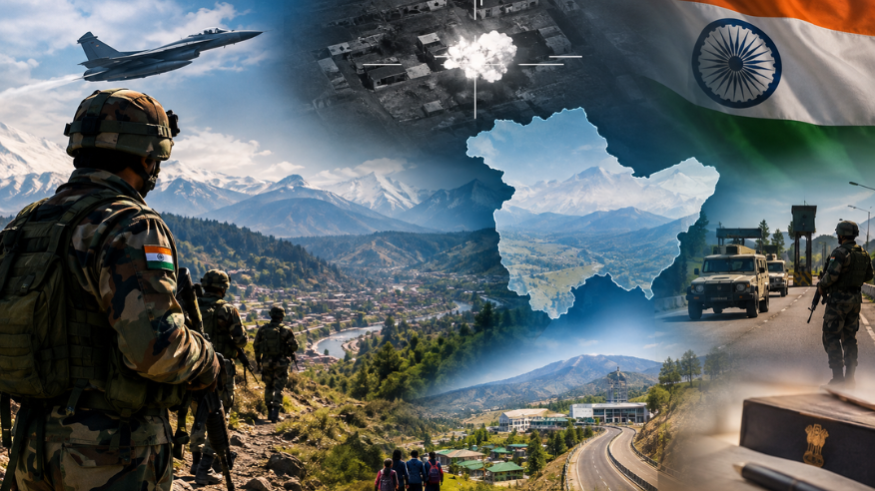
On September 28-29, 2016, the Indian Army carried out targeted surgical strikes on terrorist launch pads across the Line of Control (LoC) in Pakistan-occupied Jammu and Kashmir (PoJK). The operation was launched as a direct military response to the Uri terror attack earlier that month, in which 19 Indian soldiers lost their lives.
In this past decade, Pakistan-sponsored terrorism in Jammu and Kashmir has declined sharply by 96%. In 2016, Jammu and Kashmir recorded 332 terrorist-initiated incidents, according to data from the Home Ministry. The number fell to 46 in 2023, 28 in 2024 and 12 in 2025. Civilian deaths also fell from 55 in 2018 to 28 in 2025, while security force fatalities declined from 91 to 16. In the first five months of 2026, Jammu and Kashmir recorded no civilian deaths in terror-related violence, according to data compiled by the South Asia Terrorism Portal (SATP).
The decline becomes even clearer when compared with the earlier years of terrorism in Jammu and Kashmir. In 1996, more than 1,300 civilians were killed. In 2002, the civilian death toll was over 1,000. By 2010, it had fallen to 47. The violence has not disappeared and major attacks have continued, including the Pahalgam attack in 2025. But the scale of sustained violence seen during the 1990s and early 2000s has reduced significantly.
The most visible change is seen after India's military response to major terror attacks. The turning point came in September 2016, after the Uri attack. The Indian Army conducted surgical strikes against terrorist launch pads across the Line of Control. India publicly acknowledged the operation. This marked a shift in approach, signalling that a major terrorist attack would be followed by conventional military action across the LoC.
This changed India's approach towards cross-border terrorism. In response to the Pulwama attack in February 2019, the Indian Air Force carried out an air strike against a Jaish-e-Mohammed training facility at Balakot in Pakistan. The operation went beyond the Line of Control and demonstrated that India's response was no longer restricted to targets immediately across the LoC.
Operation Sindoor in 2025 marked another stage in this evolution. Following the Pahalgam terror attack on April 22nd, India struck terrorist infrastructure in Pakistan and Pakistan-occupied Jammu and Kashmir. The operation involved precision weapons, drones, intelligence and air defence capabilities. India struck 9 targets in 22 minutes across the border, including key Jaish-e-Mohammed and Lashkar-e-Taiba facilities at Bahawalpur and Muridke.
The three operations show the evolution of India's use of hard power. In 2016, India crossed the Line of Control to strike terrorist launch pads. In 2019, it used air power against a terrorist facility inside Pakistan. In 2025, the response involved a wider combination of precision weapons, drones, intelligence and air defence.
The security approach also changed after the abrogation of Article 370 in August 2019 and the reorganisation of the former state of Jammu and Kashmir into two Union Territories of Jammu & Kashmir and Ladakh respectively. Subsequently, India tightened security measures while continuing anti-terror operations and development measures.
India included development and economic opportunities within its response framework. In Jammu and Kashmir, the government has linked security with roads, connectivity, employment, tourism and welfare. Long term stability requires more than security operations. It also requires functioning institutions and economic opportunities that can reduce the space for terrorist recruitment and influence among the youth.
The response moved beyond dealing with individual attacks. It has focused on strengthening the security grid, preventing infiltration, disrupting terrorist networks and financing, and reducing the space available for recruitment and support. Development and employment have also become part of the wider effort to restore normalcy in affected areas.
The security grid in Jammu and Kashmir has become tighter over the years. Intelligence sharing between agencies has increased, while security forces have strengthened checkpoints, area domination and cordon and search operations. Border surveillance and anti-infiltration measures have also been expanded. The focus has been on identifying threats earlier and preventing terrorist networks from establishing themselves.
There has been focus on the wider ecosystem around terrorism. This includes action against terrorist supporters, financing networks and properties linked to terrorist organisations. The National Investigation Agency has expanded its presence and investigative capabilities. The objective is not only to eliminate terrorists after an attack but also to disrupt the networks that allow them to operate.
India has simultaneously worked to internationalise the issue of terrorism financing and Pakistan based-terrorist groups. New Delhi has raised cross border terrorism at the United Nations and other international forums. India has also pushed for action against terrorist financing. The 2022 ‘No Money for Terror’ conference in New Delhi brought together representatives from 78 countries and 16 international organisations.
The Pahalgam attack demonstrated that Pakistan-based terrorist groups can still inflict significant casualties. Nonetheless, the numbers show a substantial reduction in the scale of violence compared with earlier periods. At present, India is is witnessing one of its most peaceful periods in roughly four decades. The larger story of the past decade is therefore not only how India responded after attacks, but how it changed the wider system used to prevent and counter terrorism.
Watch the full video: https://www.youtube.com/watch?v=zLgHwa2bhTU
Savio Rodrigues
Savio Rodrigues is a Research Analyst at Escape Velocity MediaWorks Pvt Ltd and writes for Chakra News on Defence, Geopolitics, National Security. He holds a Master’s degree in International Relations from the University of Mumbai.



Comments