












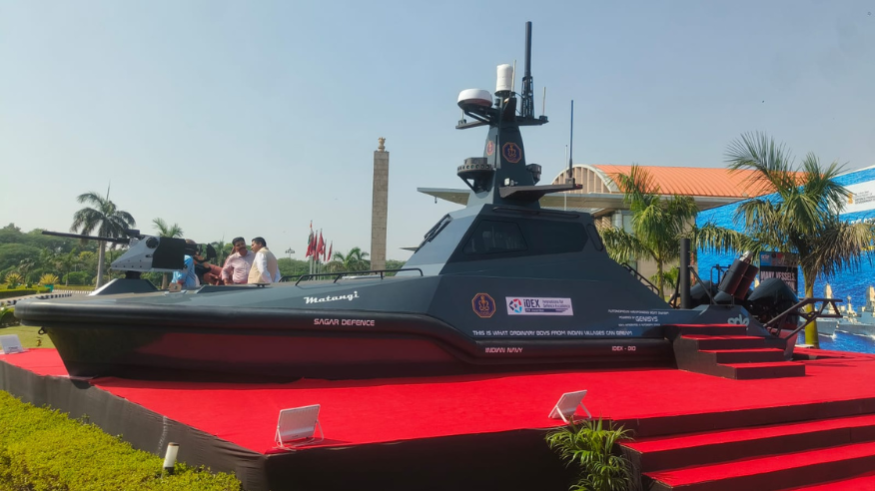
Sagar Defence Unveils 'Matangi' Indigenous Autonomous USV at Swavlamban 2026

Sagar Defence Engineering Limited's 'Matangi', an indigenous Autonomous Unmanned Marine Surface Vehicle (USV), was among the key unmanned maritime systems showcased at the Indian Navy’s Swavlamban 2026 in New Delhi on October 26.
Matangi completed a voyage of around 1,600 km in November 2024 from Mumbai to Tuticorin without a crew on board. The vessel used an indigenous navigation and collision avoidance system during the journey.
The vehicle has been developed under the Innovations for Defence Excellence (iDEX) framework. It is designed around autonomous maritime operations and the use of unmanned systems in coordinated missions. The company also highlighted the vehicle’s potential role in maritime swarming, where multiple unmanned platforms can work together as a network.
The unveiling comes as the Indian Navy increases its focus on autonomous systems for surveillance, maritime security and other naval missions. Swavlamban has emerged as an important platform for connecting the Navy with Indian startups, MSMEs and defence companies working on such technologies.
Autonomous surface vessels can operate without a crew physically present on board. Depending on their configuration, they can carry sensors, communication equipment and other mission payloads. This allows them to undertake tasks in areas where keeping personnel on board may not be necessary.
The company has also been developing armed unmanned surface vessels for the Indian armed forces. Sagar Defence had begun supplying 12 armed USVs to the Indian Navy under an iDEX SPRINT contract. These include its Matangi craft and are intended for surveillance and other operations. The boats have been reported to carry remote-controlled weapon stations, electro-optical systems and navigation equipment.
The latest unveiling therefore comes as the company expands from demonstrating autonomous navigation to developing a wider range of unmanned maritime capabilities.
The importance of such systems has grown with the changing maritime security environment. Navies are increasingly looking at unmanned platforms for persistent surveillance, intelligence gathering and operations in high-risk areas. Autonomous vessels can also operate for longer periods without exposing a crew to the same risks as conventional manned platforms.
For India, the development also fits into the Navy’s wider effort to increase indigenous content in its equipment. The iDEX framework allows startups and smaller companies to work on specific military requirements with support from the defence ecosystem.
Sagar Defence has recently expanded its role in the naval sector. In September, the company received a licence to design, build, integrate, test, assemble and supply specified warships, submarines and related naval systems for the Indian Navy. The company had earlier focused primarily on unmanned surface and underwater systems.
The company’s latest USV is therefore part of a broader shift in India’s naval technology ecosystem. The Navy is looking beyond traditional platforms and increasingly exploring autonomous systems that can combine sensors, communications and decision-making with unmanned operations.
Swavlamban 2026 has provided a platform for these technologies to move from development and trials towards wider military applications.
Savio Rodrigues
Savio Rodrigues is a Research Analyst at Escape Velocity MediaWorks Pvt Ltd and writes for Chakra News on Defence, Geopolitics, National Security. He holds a Master’s degree in International Relations from the University of Mumbai.




Comments