


Major Reshuffle in the Indian Defence Establishment
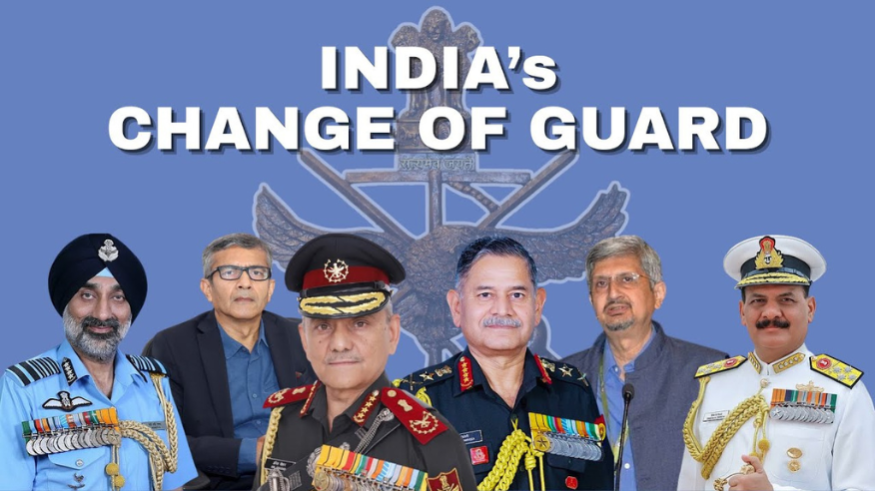
India’s defence establishment is on the cusp of a historic leadership transition, with an unprecedented reshuffle set to take place in May 2026. Almost the entire upper echelon of the defence and national security apparatus will change over in 30 days.
Chief of Defence Staff General Anil Chauhan, PVSM, UYSM, AVSM, SM VSM, retires on May 30, along with General Upendra Dwivedi, PVSM, AVSM, Chief of the Army Staff, Admiral Dinesh Kumar Tripathi, PVSM, AVSM, NM, Chief of the Naval Staff and DRDO Chairman Dr Samir V. Kamath.
Air Chief Marshal Amar Preet Singh, PVSM, AVSM and Defence Secretary Rajesh Kumar Singh will retire on October 30. This will be the first time in recent history that such a large changeover has happened. Dr Kamath and General Chauhan will have served for almost four years. Both were given extensions last year to ensure stability and continuity in major, ongoing and long-term structural reforms, including defence indigenisation, theatre command reforms and long-term capability development.
General Chauhan is the second CDS after General Bipin Rawat, PVSM UYSM, AVSM, YSM, SM VSM, who served at the post for two years before his tragic death in a helicopter crash. General Chauhan was appointed to the post after the government Amended Service Rules in 2022 to allow serving or recently retired 3-star or 4-star officers under the age of 62 at the time of appointment to be considered for the post of CDS.
How will the next service chiefs be chosen? While the Appointments Committee of the Cabinet (ACC) ultimately decides on promotions based on merit and seniority, top hierarchy roles for future leadership often come from the pool of Vice Chiefs and operational commanders. As for the DRDO chairman, the ACC typically appoints a distinguished scientist from the organisation. The intimation regarding the replacements of these appointments is expected to be given in April 2026.
Whenever such events happen, this not only signals a shift in administrative hierarchy but also strategic implications. As the new cohort of leaders will take the reins of the second largest military in the world, they will collectively influence defence policy, joint operational doctrines, capability development and India’s long-term defence posture.
A major reform expected this year is the creation of joint theatre commands where components of all three services will fight under a theatre commander drawn from one of the three services. The plan is to replace 17 single-service commands with three functional commands — a northern theatre command facing China, a western theatre command focused on Pakistan and a maritime theatre command covering the oceans and maritime security.
Reports suggest these theatre commands will be operationalised by May 2026, before General Anil Chauhan, Chief of Defence Staff, retires. That would make 2026 one of the watershed years in Indian defence reforms.
Watch: https://www.youtube.com/watch?v=PS0EsesnDp0&t=65s
Ayaan Ahmad
Research Analyst in Chakra News. Ex NDA with 4 years of experience in Defence and Geopolitics. Have an affinity for writing and finding stories from data.



Comments