


Indian Army’s Own Technology Initiatives: A Never Acknowledged Truth
There is so much being spoken today on technology today, that the entire strategic military balance of the Nation, seems to be tethered to this single capability. Several seminars and discussions on how to give better technical wherewithal to the Armed Forces, and development of an indigenous defence industrial ecosystem, are all debated regularly, and discussed vociferously on electronic and social media platforms.
There is one community of technologists who are sitting quietly and doing what they are supposed to be doing, the military technologists who have defined several key initiatives, which have made remarkable difference to conduct of operations, not only in the recent Operation SINDOOR, but also in several conflict situations in the recent past. They are the Army’s communicators who have been spearheading cutting edge technology induction into the Army’s efforts in securing our borders to dealing with internal conflicts and disaster situations. Let us look at the technology they used in the recent conflicts.
The networks the Armed Forces used were all encrypted and secure networks following the most modern architectural framework with no connections to any external public networks. These operational networks are fully monitored every second, at multiple locations and centrally, with even the smallest vulnerability detected proactively and plugged or segregated. Tri Services integration is ensured through seamless exchange of information and intelligence, all of which is available to decision makers at the point they need.
The network has multiple redundancies catering for challenges which could be triggered through multi-domain operations, considering the fact that communication networks are the primary targets of any of the conflicts. One recent example was the jamming of satellite communication systems extensively reported during the initial phases of the Russia Ukraine conflict. And the entire networks were fully manned and operated by the combatants from the Corps of Signals of the Indian Army. These networks are still not fully ready, the Project Network for Spectrum, still not yet fully completed. (More on this later).
Another major enabler for the Armed Forces was the SAMBHAV secure Army
Smartphone which is a singular secure platform used over public networks anywhere in the world. This unique system, the IPR for which rests with the Indian Army, is a technology marvel truly indigenous, with participation from a host of professional organisations like the IIT Madras, SETS Chennai, CDOT New Delhi, India's major TSPs and an Indian private sector GIS platform, all brought together under a very vibrant team located at New Delhi. This development was an effort of several years of dealing with challenges on tackling path breaking technology, and more importantly, on cumbersome procedures.
Army in fact, has its own mobile cellular systems in operation, fully owned and operated by combatants in India's Northern Command, though it’s based on outdated technology today, and is awaiting replacement.
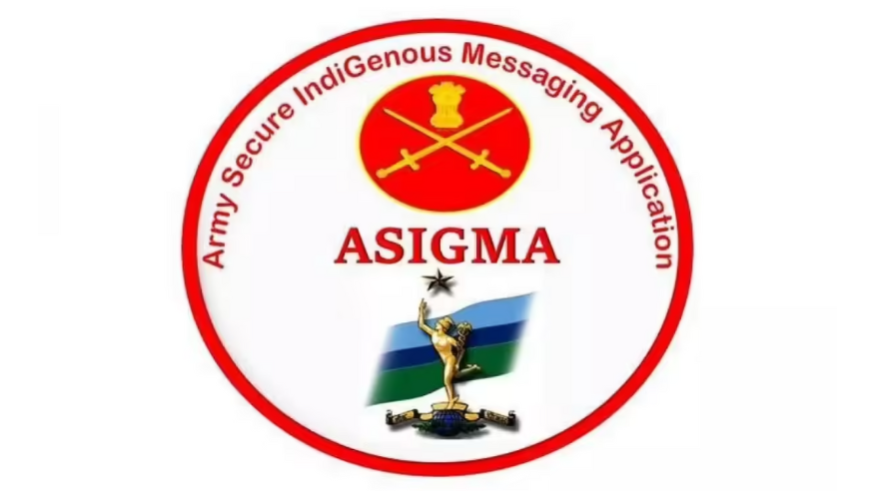
Yet another major technology used extensively was the ASIGMA secure messaging system which is a fully indigenous product, developed by officers and men at the Military College of Telecommunications Engineering (MCTE) and launched by the Army in 2021. This platform developed fully inhouse, replaced a decade old Army Wide Area Network (AWAN) platform developed by one of India's leading software conglomerates. The cost of development and fielding of the entire system was less than five percent of the indicative cost given by the same vendor for upgradation of AWAN. The ASIGMA platform over the recent times, has been extended for Tri Services usage and was used extensively during operations.
The Military has absorbed emerging technologies at a rapid pace, with a 5G testbed fully functional at the MCTE. It has a mobile component too, which can facilitate training for future communication scenarios and for drone operations. India's first Quantum lab was established at MCTE in December 2021, and several key projects on AI, basically for supporting combat operations, with live data streaming from the field, attempted for the first time by MCTE. Way back in 2012, India's first tele-medicine trials over a Software Defined Radio (SDR) platform was carried out during the Amarnath Yatra. In fact, that was the first time the Amarnath Yatra communication was converted to a complete optical fibre-based system, with live streaming demonstrated over multiple streams.
As the Nation wakes up to the reality of wide usage of space-based communications, the Army has been using satellite systems since the early 1970s. Today, an entire array of satellite communications systems are available, reaching out to every part of our Nation including the island territories. An exclusive satellite communication exercise (Exercise SKYLIGHT) was conducted by the Army, for validating the entire concept in 2022.
The technology enabled combat communicators of the Indian Army, have also been the pioneers in several other pathbreaking technologies. The failure of one of the most ambitious of Indian Army’s initiatives on digitising the tactical battle space in early 2000s under a project by name of SAATHI/BETA, would have given our nation, a global lead in the domain, however, the project failed to find acceptance owing to multiple challenges. This project was conceived and steered by passionate group of Army officers, with a private company and IISc Bengaluru, supporting the initiative.
To keep up with emerging trends and to ensure being ahead of the technology curve, a new unit was envisaged and created by Corps of Signals in 2024, aptly called the Signals Technology Evaluation and Adaptation Group (STEAG). Behind every weapon system in use in the Armed forces today, there is a lot of technology associated, from passing on critical information feeds to storage, predictive analysis to precision guidance, all have technology enabled combatants of Indian Army, a large majority of them from Corps of Signals, associated. They are a true reflection of the competence, valour, and professionalism of the Indian Armed Forces.

Lt Gen M Unnikrishnan Nair PVSM,AVSM, SM (retd)
Lt Gen M Unnikrishnan Nair (retd) is India’s former National Cyber Security Coordinator and ex-Signal Officer in Chief. A decorated veteran with 40 years of service, he played a key role in defence cyber, telecom security, and global cyber diplomacy, and served in top operational, intelligence, and technological roles.



Comments