










PRC’s Untested Military Might

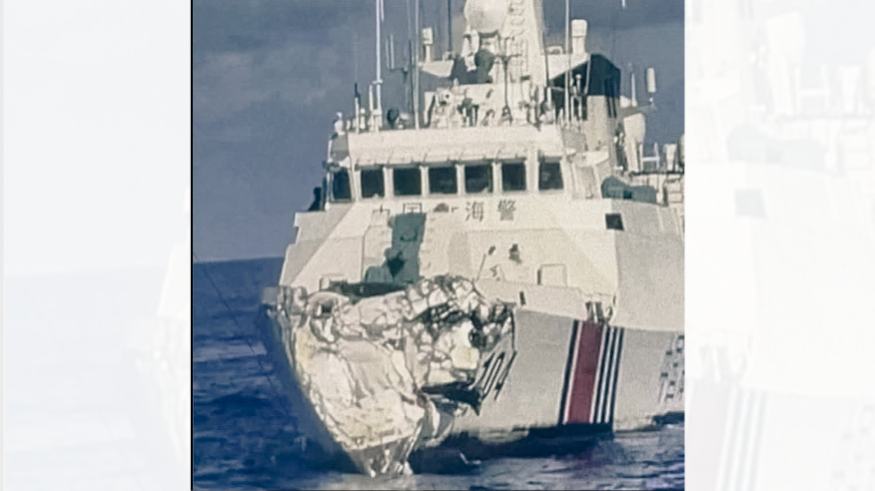
The collision of two Chinese vessels near Scarborough Shoal on August 11, 2025—caught in a chaotic pursuit of a Philippine humanitarian mission—was more than a maritime mishap. It was a revealing glimpse into the deeper structural fragility of People’s Republic of China’s (PRC) naval force, a fleet often showcased as the centrepiece of Beijing’s global rise. The world watched as a Chinese navy destroyer rammed into a Chinese coast guard (CCG) cutter, not during a war, but in a peacetime contest of aggression. This incident, jarring in its brazenness, casts long shadows over the true readiness of PRC’s People’s Liberation Army Navy (PLAN), which, despite its vast expansion, remains conspicuously untested in real combat.
Modern military power is not solely determined by technology proficiency or numerical strength. It is primarily an issue of command-and-control coherence under stress—of the intangible traits that determine military effectiveness: training, discipline, decentralised initiative, and institutional resilience. PRC has, in the past twenty years, invested substantial resources into the advancement of its military capabilities. The navy has now achieved the distinction of being the largest in the world in terms of hull count. It manages sophisticated destroyers, nuclear-powered submarines, and is manufacturing aircraft carriers at an unprecedented rate in the post-Cold War period. Nevertheless, the crew, including the sailors, officers, and commanders, largely lack combat experience. The last time PRC experienced sustained combat was in 1979, during its ill-fated border war with Vietnam. Since that time, its military has engaged in simulations, showcased their presence in Tiananmen Square, and executed meticulously orchestrated drills, yet they have never faced a genuine trial by fire.
This intrinsic deficiency of battle-hardened experience renders PRC’s military growth fragile. The recent Scarborough incident exemplifies this fragility. Military manoeuvres, particularly in confined spaces, need an exceptional level of accuracy, communication, and mutual confidence. The catastrophic failure of coordination between the two branches of PRC’s maritime apparatus—navy and coast guard—indicates more than a mere lapse in judgement. It suggests inadequacies in doctrine, command structure, and live-scenario training. The PLAN, despite its resources and scale, seems to be executing a function it has not yet mastered in practice.
There is a paradox at the heart of PRC’s military posture. On the one hand, it insists on projecting an image of invulnerability, showcasing new carrier battlegroups, hypersonic missile tests, and far-sea deployments from the Indian Ocean to the Arctic. On the other hand, it is politically and structurally averse to the kind of decentralization that combat effectiveness demands. Xi Jinping’s military reforms have consolidated control tightly within the Central Military Commission, emphasizing loyalty to the Chinese Communist Party (CCP) above operational adaptability. This has created a command culture that punishes initiative and rewards obedience—an efficient model for maintaining political control, but a poor one for real-time decision-making in dynamic combat environments.
The problem is not limited to surface operations. Even in the realm of PRC’s most sensitive assets—its nuclear-powered submarines—there are signs of systemic weakness. In 2024, a Zhou-class submarine sank under mysterious circumstances while docked in a shipyard. Speculation ranged from a reactor failure to human error, but the lack of transparency made it impossible to assess the causes. Once again, political control trumped operational clarity. And once again, a key component of PRC’s deterrent force proved more fragile than Beijing would like the world to believe.
It is important not to underestimate PRC’s capacity for adaptation. The history of modern militaries is filled with examples of inexperienced forces evolving rapidly under pressure. However, war is not a proving ground that nations should seek lightly, and no serious strategist should view untestedness as a neutral quality. In the absence of combat, the next best indicator of a force’s readiness is its conduct in high-stress, near-combat conditions. That is why the Scarborough Shoal collision matters. In that moment—of confusion, aggression, and self-inflicted damage—PLAN revealed more about its true state than any official white paper or naval parade could conceal.
The world must pay attention. As PRC continues to test the boundaries of the status quo in the South China Sea, Taiwan Strait, and beyond, it is not enough to tally ship counts or missile inventories. A more sober analysis must ask: how will these forces perform when the fog of war descends? How will PRC’s untested commanders respond to unpredictable threats? And most urgently, how might this inexperience—combined with overconfidence—lead to escalation through miscalculation?
In the end, the collision was not merely between two ships. It was between the image of a rising superpower and the reality of its internal contradictions. The gap between ambition and experience remains wide. Whether PRC can close it without stumbling into conflict may be the defining strategic question of our time.
Anubhav Shankar Goswami
Anubhav Shankar Goswami is a Doctoral Candidate of Politics and International Relations at the School of Humanities, Arts and Social Science, Murdoch University, Perth. His doctoral research is based on the field of nuclear strategy with a particular focus on nuclear brinkmanship. Anubhav is the author of the book, ‘Deterrence from Depth: SSBNs in India’s Nuclear Strategy’.


Comments