












India Seeks Joint Production of Javelin Anti-Tank Missiles with USA

The Javelin Anti-Tank Missile may soon become a Made in India product.
According to reports, India has submitted a letter of request to the US government for the joint production of the Javelin anti-tank missile. A top defence source confirmed that India has shown interest and submitted a formal proposal to US authorities, aligning with the “Make in India” initiative of the NDA government.
What We Know
“The Javelin will ensure operational readiness and reduce dependence on foreign support. The talks are in an advanced stage,” said an official familiar with the matter. According to the official, in light of growing urgency to replenish weaponry, India has engaged with the United States for the procurement of Javelin missiles through the emergency procurement route.
Given India’s strategic imperatives and the evolving threats from both Pakistan and China, the Javelin presents a strong case for boosting India's anti-tank warfare capabilities, the official added.
Javelin Anti-Tank Missile
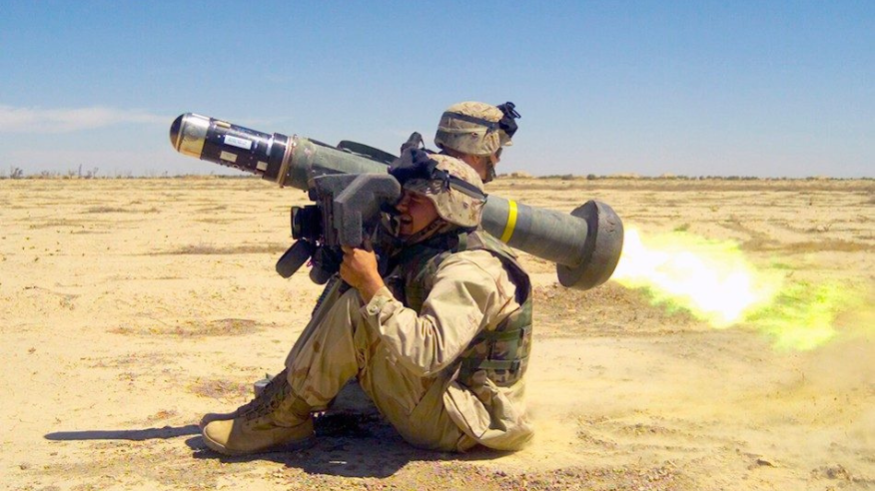
The Javelin missile is produced by a joint venture between Lockheed Martin (Orlando) and Raytheon (Tucson), and has been in service since 1996. It is a third-generation anti-tank guided missile (ATGM), man-portable and operable by a single soldier.
The system’s Command Launch Unit (CLU) enables surveillance and targeting. The Javelin can be deployed from multiple platforms and is operational day or night, in all weather conditions. It can engage targets at a range of up to 2.5 km, with a maximum range of around 4 km. Its “fire-and-forget” technology allows the operator to take cover immediately after launch. The missile’s top-attack mode targets armoured vehicles from above—where armour is typically weakest.
The Javelin comprises several key components:
Command Launch Unit (CLU): Provides three viewing modes—day, wide field, and narrow field thermal imaging. It can also function as a standalone thermal sight.
Day Field of View: Offers 4x magnification for daylight operations and twilight scanning when thermal imaging is less effective.
Wide Field of View: Used at night, it offers thermal imaging with 4x magnification, detecting infrared signatures of concealed vehicles and personnel.
Lightweight CLU: An improved version over Block I—70% smaller, 40% lighter, and 50% longer battery life. Features include a high-definition display, long-wave IR camera, five-megapixel colour camera, GPS locator, laser range finder, and heading sensor.
Launch Tube Assembly: A disposable casing housing the missile, protecting it from harsh conditions. Built-in electronics and a locking hinge make missile loading and unloading seamless.
Development History
In 1983, the US Army initiated the Advanced Anti-Tank Weapon System – Medium (AAWS-M) program. By 1986, proof-of-principle contracts were awarded to Hughes, Ford Aerospace, and Texas Instruments. In 1989, a joint venture between Martin Marietta and Texas Instruments (now Lockheed Martin and Raytheon) won the contract. Designated FGM-148, the missile was test-fired in 1991, and the launcher followed in 1993. Low-rate production was approved in 1994, and the Javelin entered service in 1996, replacing the M47 Dragon.
The Javelin proved effective during the Iraq War, destroying Iraqi T-55 tanks. In Afghanistan, it was used in counter-insurgency missions with minimal collateral damage. During the Syrian Civil War’s al-Shaddadi offensive, a Javelin was used to neutralise a suicide car bomb. In Ukraine, Javelins have played a significant role against Russian T-series tanks.
Influence on Global Systems
The Javelin, known for its portability and fire-and-forget capability, has inspired several countries—including China (HJ-12), South Korea (Raybolt), Israel (Spike and its NLOS variants), Iran (Almas), and India (MPATGM)—to develop their own lightweight, easy-to-operate anti-tank guided missile systems; notably, India had earlier shortlisted the Javelin alongside Israel’s Spike, eventually procuring a limited number of the latter.
Currently, the Indian Army operates second-generation wire-guided systems like the French Milan-2T and Soviet Konkurs, both of which need replacement. The Javelin offers a significant capability upgrade. In the future, it could be integrated with vehicles like Mahindra’s ALSV, the QRFV, and the Kalyani M4—all currently in service.India has NAG anti-tank missile which play the same role of both the Javelin and Spike NLOS.The NAG has been test fired from NAMICA (NAG Missile Carrier) and the Rudra MK-4 attack helicopter.Indian Army has inducted NAMICA MK-1 version and MK-2 version is in development and in January 2025 its field evaluation trials has been completed and the development of its missile carrier has been started.The standard version of NAG has a range from 500 metres to 4km while the Stand-off Anti-Tank Guided Missile (SANT) can hit the targets up to 15 to 20 kilometres away.The NAG missile is a great example of Aatamnirbhar Bharat.
India could adopt both MPATGM and Javelin systems or design a common launcher capable of firing both. An air-launched and naval variant—co-developed with the US—would further enhance capabilities, as seen in Israel's Spike NLOS.
Joint production of the Javelin would not only support operational needs but also provide critical know-how to accelerate MPATGM development, including future variants with longer range and improved precision.
Arjun Dev Singh
Arjun Dev Singh has a deep interest in defence, security, and strategic affairs. With a strong analytical lens and a passion for military and geopolitical developments, Arjun strives to bring clarity and context to complex national and international issues.



Comments