







India and US defence ties in the shadow of Trump

For over two decades, the India–US relationship was hailed as the most important strategic partnership of the 21st century. Two nations that were united by shared democratic values, economic cooperation, and converging geopolitical interests. Burgeoning defence ties were meant to be the strongest pillar of this partnership. Yet, within months of President Donald Trump’s return to the White House, the partnership appears to be a thing of the past.
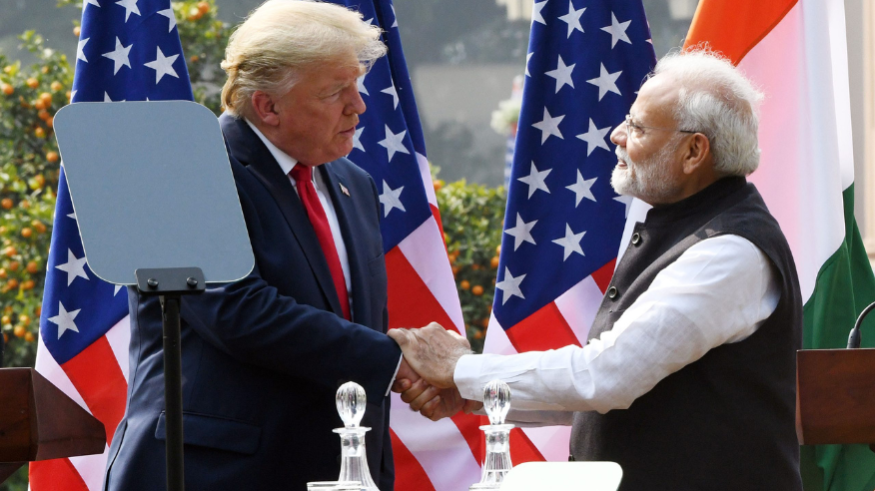
Just six months ago in February 2025, US President Donald Trump had declared in a joint news conference with Prime Minister Narendra Modi “Starting this year, we’ll be increasing military sales to India by many billions of dollars,” Trump told a joint news conference with Modi.
But Trump’s tariff tantrums, repeated attempts at intervening in the India-Pakistan relationship, and trolling and targeting of India have unsettled policymakers in New Delhi.
Now as the trade deal between India and USA hangs in the limbo and a United States Defence Policy Team set to visit India, the question remains what lies ahead for the ties between the world’s oldest democracy and the world’s largest democracy?
Trade Turbulence, Defence Continuity
Despite Trump’s tariff strike and a steady stream of rage tweets on X, Indian officials maintain that defence procurement remains unaffected. Contracts for US-origin equipment like the Apache and Chinook helicopters, P-8I maritime patrol aircraft, and MQ-9 drones continue to be executed, while negotiations for GE engines for Tejas Mk-1A fighters are still ongoing. Earlier in August 2025, the Defence Ministry dismissed reports suggesting India had paused defence purchases from Washington, terming them “false and fabricated.”
However, there is a palpable “trust deficit” at least in public perceptions in India. At the moment there are nearly 20 defence agreements binding the two nations. These agreements are the result of 25 years of efforts from both sides. But these gains could be lost with current political rhetoric in the US unsettling confidence at the operational level.
A 10-Year Defence Framework
In July 2025, Defence Minister Rajnath Singh and US Defence Secretary Pete Hegseth agreed to sign a 10-year framework to expand military cooperation. A statement from the Pentagon noted “considerable progress” in defence industrial cooperation. The Indian Defence Minister urged expedited delivery of GE F404 engines to power the Tejas fighters and pushed for an early conclusion of the proposed HAL–GE Aerospace deal for co-producing F414 engines in India.
This is a major pain point in India. Delays in F404 supplies have already caused Hindustan Aeronautics Ltd. (HAL) to miss deadlines for delivering Tejas Mk-1A aircraft to the Indian Air Force, with just 2 out of 99 engines delivered four years after a deal was signed. With the HAL-GE deal, New Delhi hoped joint production of F414 engines would provide both autonomy and reliability.
The 10 year framework also envisions greater collaboration in training, logistics, interoperability, defence supply chains, and joint exercises, alongside initiatives like the Autonomous Systems Industry Alliance (ASIA) for drones and unmanned systems.
Defence Projects in the Pipeline
The United States of India is the world’s leading defence equipment manufacturer while India
is the world’s largest weapons importer. According to the US Congressional Research Service, New Delhi will spend over $200bn in the next 120 years in defence modernisation. This is a prospect that leaves US manufacturers salivating. Even with all the political rhetoric and tarrif turbulence, the India–US defence agenda remains crowded:
P-8I Maritime Patrol Aircraft: India and US in talk for purchase of six more aircraft to bolster naval domain awareness.
Stryker Infantry Combat Vehicles: India is evaluating variants with amphibious capability, potentially integrated with Javelin anti-tank missiles. Washington has proposed making India a global manufacturing hub for the Stryker.
Javelin ATGMs: Talks are underway for co-production with Bharat Dynamics Limited in partnership with Raytheon and Lockheed Martin.
114 Multi-Role Fighter Jets: The largest defence tender in play, requiring foreign firms to shift production to India under ‘Make in India’. Boeing and Lockheed Martin are among the bidders.
C-130J Aircraft: Lockheed Martin and Tata Advanced Systems have offered to produce 80 aircraft domestically, building on the 12 already in IAF service.
Apache & Chinook Helicopters: India operates about 22 Boeing AH-64E Apache attack helicopters. The Indian Army received 3 Apache helicopters under a separate deal in July 2025, with the remaining three expected later.
MQ-9B Drones: India finalised a deal in 2024 to purchase 31 SeaGuardian and SkyGuardian drones after prolonged negotiations.
The Pentagon has also flagged future possibilities in undersea warfare systems, fifth-generation fighters, space cooperation, and air defence technologies.
COMPACT and Strategic Goals
When Trump and Modi met in February 2025, they unveiled the COMPACT framework — Catalysing Opportunities for Military Partnership, Accelerated Commerce and Technology. This seeks to integrate defence industrial bases, expand co-production, and link security cooperation with trade and energy. Trump even promised to eventually offer F-35 stealth fighters to India, framing defence sales as central to a broader economic package that includes Indian imports of US oil and gas.
Yet, a lot needs to be said and done before all this comes to fruition. US tariffs will hit Indian exports, at a time when Trump has been particularly indulgent with China, Russia and even Pakistan. Trump also attempted to rehyphenate India and Pakistan and offered time and again to mediate between the two: this is anathema to New Delhi. Its no wonder that India would want to put future defence deals on the backburner until “tempers cool.”
Moreover, India’s insistence on local manufacturing under Make in India contradicts Trump’s stand asking American firms to build in the US./ negotiations slower and more complex.
The Future
So far, defence cooperation has proven resilient. But for the partnership to fulfil its 21st-century promise, it must overcome cycles of political turbulence and needs commitment and action from both sides.
The US must consider and address Indian sensitivities and offer freely to India the technologies and access that it has in the past provided to actors like Turkey and Pakistan. In return it will find a partner with a long memory, stability, the world’s fastest growing economy and the human resources that come with it. For India, the present crisis is an opportunity for reform. India must do more to open itself to the world and deepen its bond with the US. This however cannot come at the cost of the Indian people.
The coming months will reveal whether the strategic logic of the partnership can outlast Trump’s transactional impulses.
Deepak Bhadana
Over the past decade, Deepak Bhadana has built expertise in multimedia storytelling, with a focus on military conflicts, insurgencies, international relations, the defence industry, and occasionally, wildlife and environmental issues.


Comments