









How the US Squeezed Thai F-16s

Thailand and Cambodia edged dangerously close to full-scale war in mid‑2025, as long-standing disputes over poorly demarcated tracts along their roughly 800‑km shared border spiralled into deadly confrontation. A fatal skirmish on 28 May 2025 in the so‑called "Emerald Triangle" reignited hostilities. Both Cambodian and Thai troops blamed each other, resulting in the death of a Cambodian soldier and a breakdown in diplomatic trust. Subsequent attempts to de-escalate failed, with tensions intensifying through border checkpoint closures and mutual diplomatic expulsions.
Violence fully erupted on 24 July 2025, with sustained clashes near strategic cultural sites such as Preah Vihear and Ta Muen Thom. Heavy weaponry—including BM‑21 Grad rocket launchers and airstrikes from Thailand’s F‑16 jets—was deployed along multiple sectors, causing civilian casualties and mass displacement.
Both sides brought out significant firepower: Cambodia deployed the Russian-made Grad Multi-Barrel Rocket Launching system (MBRL), while Thailand utilised American Lockheed Martin F-16A/B fighters and Swedish JAS-39 Gripen jets. Each side claimed to have inflicted damage on the other—Thailand said it destroyed a Cambodian Grad launcher, while Cambodia claimed to have shot down a Thai F-16.
International Reactions
When the fighting broke out, the US Embassy in Thailand urged American citizens to follow local advisories, as Thai authorities began evacuating people from conflict zones on Thursday, 24 July 2025.
Chinese Foreign Ministry spokesperson Guo Jiakun expressed “deep concern” over the escalating tensions between its Southeast Asian neighbours, urging both sides to prioritise long-term regional stability. He stated that China would “continue to play a constructive role in promoting peace and dialogue.”
Malaysian Prime Minister Anwar Ibrahim, also ASEAN’s current chair, said he would personally engage both sides in negotiations. “I’ve sent messages to both prime ministers and look forward to speaking with them later today or tonight,” he said, urging them to stand down and enter negotiations, calling the situation “worrying.”
On Friday, 25 July 2025, Thailand’s Ministry of Foreign Affairs said in a social media post that it “fully agrees” with the negotiation proposal. However, the statement added that “Cambodian forces have continued their indiscriminate attacks on Thai territory,” arguing that “any ceasefire must be based on appropriate on-the-ground conditions” and accusing Cambodia of lacking good faith.
US Intervention and the Malaysian Talks
US President Donald Trump intervened directly, warning both countries of possible trade sanctions if they failed to agree to ceasefire talks. On Sunday, 27 July 2025, Trump called Thai Acting Prime Minister Phumtham Wechayachai to push for negotiations.
Following Trump’s call, Thai and Cambodian foreign ministries resumed communication. Bangkok laid out its terms: the meeting must be between the two prime ministers and held in a neutral venue. “We proposed Malaysia because we want this to be a regional matter,” a Thai official said. Another Thai source added, “The U.S. really pushed for the meeting. We want a peaceful solution, so we had to show good faith.”
Thailand had earlier rejected offers from China and Malaysia to mediate. Cambodia, however, had accepted Malaysia’s initial offer. According to Lim Menghour, a Cambodian government official, it was only after Trump’s pressure that Thailand agreed to move ahead. He added that Cambodia kept diplomatic channels open with China, reflecting its close ties with Beijing. “We exchanged regular communication,” Menghour noted.
Eventually, Malaysia brokered a truce on 28 July 2025, bringing an end to five days of intense fighting. However, the ceasefire talks are still ongoing in Kuala Lumpur as efforts continue to de-escalate the situation.
F-16s: A Hidden Pressure Point?
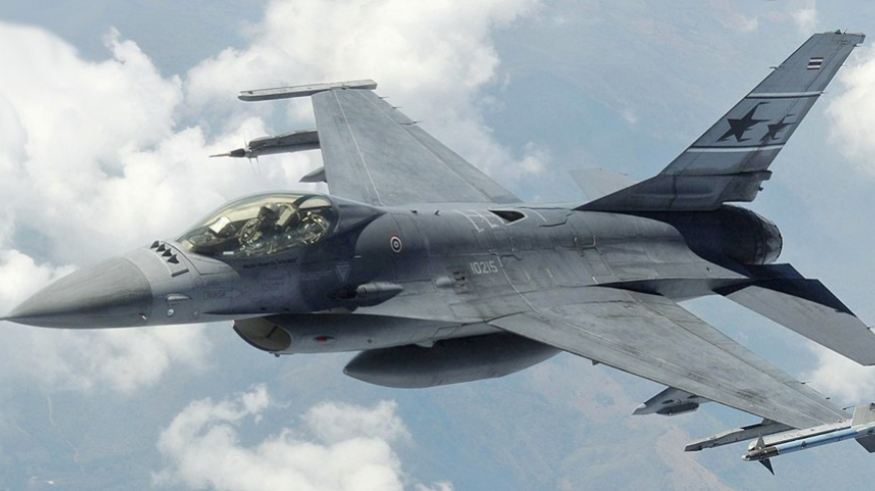
Could Thailand’s fleet of American-made F-16s have been the reason behind the US pushing for a ceasefire? The Royal Thai Air Force operates 54 F-16A/B fighter jets—aircraft that remain dependent on US support for parts, maintenance, and software.
Designed by Lockheed Martin, the F-16 can carry a wide range of air-to-air and air-to-ground missiles. It has a top speed of Mach 2.05 (2,526 km/h), a combat radius of 550 km, and a ferry range of 4,220 km with drop tanks. With a service ceiling of 50,000 feet and a rate of climb of 254 m/s, the F-16 remains a potent multirole fighter. It is powered by the General Electric F110 engine and features fly-by-wire controls and a bubble canopy for enhanced visibility.
The US has a history of retaining end-use monitoring and override mechanisms on advanced weapon systems it exports. In this case, Washington could have made it clear that if Thailand didn’t cooperate, it might face operational restrictions on its F-16 fleet during the conflict.
Gripens and American Engines: Another Leverage Point
Coinciding with the crisis, on Tuesday, 5 August 2025, Thailand approved the purchase of four additional Saab Gripen E/F fighters, adding to its existing fleet of 12. These aircraft are powered by the General Electric F414 engines—the same American company that produces the F110 for the F-16s and the F404 for the older Gripens.
The Gripen E features advanced sensors for situational awareness, a canard-delta wing design for agility, and can operate from shorter runways. While it is more cost-effective and easier to maintain than the F-16, it has a smaller payload and a more limited global user base—currently only Sweden, South Africa, Czech Republic, and Thailand.
The deal, worth 22.8 billion baht (approx. USD 635 million), is part of Thailand’s broader effort to modernise its air force. Deliveries are expected by 2028. But with the engines sourced from a US firm, even this Swedish aircraft comes with potential American strings attached.
F-35s for India: More Strings Attached?
Meanwhile, the United States has been actively pushing to sell its fifth-generation F-35 fighter jets to India. However, the proposal has faced resistance in New Delhi due to concerns over operational sovereignty. Like the Thai F-16s, F-35s come with significant American control over software, systems, and maintenance. In theory, Washington could render the aircraft inoperable during a conflict that runs counter to US strategic interests—such as a war involving Pakistan or China. For Indian defence planners, such external dependency is unacceptable and runs counter to the country’s doctrine of strategic autonomy.
Arjun Dev Singh
Arjun Dev Singh has a deep interest in defence, security, and strategic affairs. With a strong analytical lens and a passion for military and geopolitical developments, Arjun strives to bring clarity and context to complex national and international issues.


Comments