












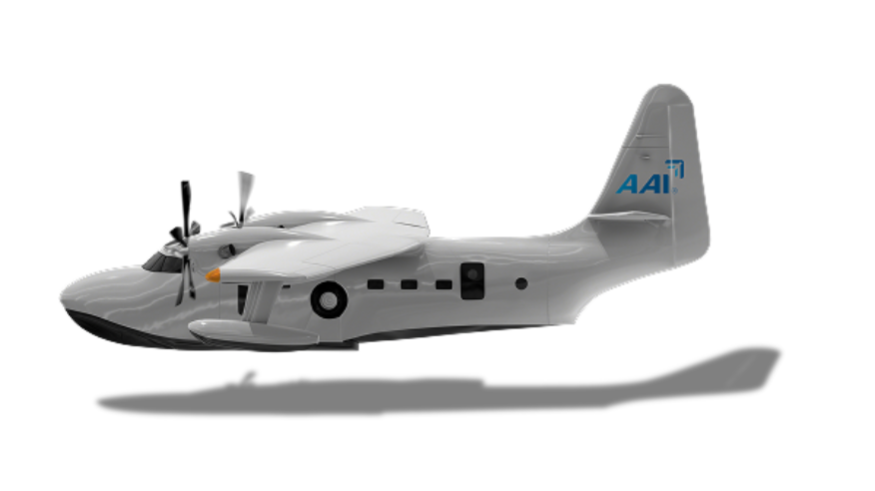
Amphibian Aerospace Industries and Apogee Aerospace to collaborate on Albatross 2.0 aircraft

Amphibian Aerospace Industries (AAI), a subsidiary of Amphibian Aircraft Holdings (AAH), and Apogee Aerospace Pvt Ltd have announced a collaboration to establish amphibious aviation capabilities in India, anchored by the Albatross 2.0 amphibious aircraft. The announcement was made at an event held at The Oberoi, New Delhi. Under the collaboration, Apogee Aerospace has been designated as AAI’s exclusive authorised representative partner for the Indian subcontinent in the restricted category, covering defence and government requirements.
The event was attended by Wing Commander MVN Sai (Retd), Chairman and Managing Director of Apogee Aerospace; Vice Admiral Shekhar Sinha PVSM, AVSM, NM & Bar, ADC (Retd); Mr Khoa Hoang, Founder and Executive Chairman of Amphibian Aerospace Industries; Mr Gopi Reddy, President and CEO of Amphibian Aerospace Industries; Mr Sanjay Singh, Chief Strategic Advisor of Amphibian Aerospace Industries; and Air Marshal B N Gokhale PVSM, AVSM (Retd), all of whom delivered keynote addresses. Defence Secretary Shri Rajesh Kumar Singh was scheduled to attend but was unable to reach the venue and instead conveyed his message through a video address.
In their keynote addresses, the speakers highlighted India’s long-standing requirement for amphibious aircraft. Mr Sanjay Singh pointed out that India has historically been viewed as a predominantly land-based, flat country in two dimensions, which has resulted in amphibious aircraft not being inducted despite the opportunity existing since Independence. Vice Admiral Shekhar Sinha shared his experience of flying amphibious aircraft such as the Russian Beriev Be-200, describing the Albatross 2.0 as a very stable aircraft to fly, while also emphasising the importance of adequate infrastructure for maintenance. He noted that the ShinMaywa US-2 faced certain issues, which is why the Indian Navy did not proceed with its induction.
Wing Commander MVN Sai highlighted that India would be the first and only country to operate the Albatross 2.0. He underlined India’s strategic position in the Indian Ocean Region, with two clearly defined seaboards spanning nearly 3,000 km on either side, and noted that 72 per cent of India’s trade moves through southern sea routes, making the security of sea lines of communication critical. Defence Secretary Rakesh Kumar Singh wished both companies success with the Albatross 2.0 platform. Mr Khoa Hoang stated that the Albatross 2.0 is certified by both the FAA and EASA and is a 19-seater aircraft, with the capability to be configured for up to 28 seats in the Registered Passenger Transport (RPT) sector.
As part of the collaboration, Apogee Aerospace has placed an order for 15 Albatross 2.0 aircraft, representing an approximate programme value of ₹3,500 crore. The company will also invest ₹500 crore to establish facilities in India, including tail section manufacturing, maintenance and overhaul, and training and simulation infrastructure. The collaboration is also targeting the Indian Navy’s RFI for four amphibious aircraft on wet lease. In addition to defence requirements, the Albatross 2.0 will also be offered for civil aviation applications.
Following the keynote addresses, the speakers responded to questions from the media. A Chakra correspondent asked whether the Albatross 2.0 could be used as a drone-hunter, given the use of drones during Operation Sindoor, and whether a special operations variant of the aircraft was being considered. Wing Commander MVN Sai (Retd) stated that such capabilities would depend on specific military requirements. Mr Khoa Hoang added that a special operations variant could be considered, noting that amphibious capability offers flexibility where conventional land-based aircraft may be constrained. Air Marshal B N Gokhale (Retd) further stated that the Albatross 2.0 could be used for insertion and extraction missions for the Indian Navy’s MARCOS, citing past operations against Somali pirates where, instead of helicopters, an aircraft like the Albatross 2.0 could land near a vessel to extract commandos after an operation.




Comments