
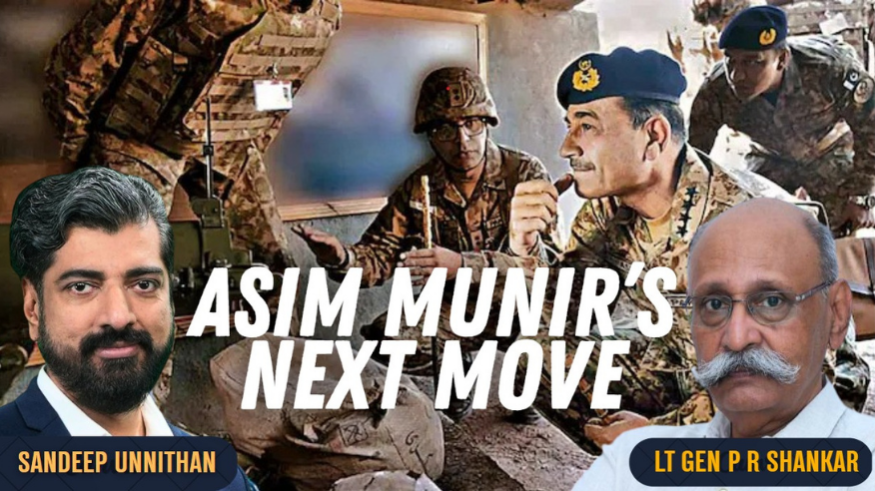








"Pakistan's military is now a religious military": Former Singaporean Diplomat
Former Singaporean Diplomat Bilahari Kausikan has said Pakistan's military has changed from a largely professional and secular force into what he described as a "religious military". He also said the military remains the only institution holding Pakistan together, but is itself part of the country's problems. Bilahari is a Singaporean diplomat of Indian origin and former chairman of the Middle East Institute at the National University of Singapore and has served as Singapore’s ambassador to Russia, permanent representative to the United Nations and permanent secretary at the Ministry of Foreign Affairs.
Speaking on the podcast Why Should We Care About the Indo-Pacific? Kausikan said Pakistan had been “teetering on the brink of failure” for years. He said the country had not fallen apart partly because it is a nuclear weapons state and argued that its military remains its “only fairly coherent institution”.
"The only thing holding it together precariously is the military," Kausikan said. He contrasted the present military with the force Pakistan had in its early decades, describing it as a "professional secular force more or less" through the 1960s and 1970s.
Kausikan's remarks also point to the growing Islamic identity of Pakistan's military. The process became more pronounced during the rule of General Zia-ul-Haq, who took power in 1977 and pushed Islam into several areas of state and military life. Islamic ideology became more prominent in military training and institutional culture, while the armed forces developed closer links with religious groups. This marked a shift from the more secular and professional character that had defined the Pakistan military in its early decades.
The religious influence within the military has remained a subject of debate among scholars and analysts. Kausikan's reference to soldiers growing beards was made in this context. "When an army allows its soldiers to grow beards, it is in trouble", he said. He used it to illustrate what he sees as the visible change in the military's religious character. His larger argument is that the institution that once served as a relatively secular national force has itself undergone an ideological transformation, even as it remains the main institution holding Pakistan's fragmented political system together.
Kausikan's comments came while discussing Pakistan's political and institutional problems. He said the country's military is the institution holding Pakistan together as well as part of the problem. He also questioned Pakistan's original national rationale, saying that once Bangladesh separated from Pakistan, the idea of Pakistan as the homeland of Muslims of South Asia had lost much of its original basis.
The former diplomat also criticised Pakistan's recent diplomatic outreach. He said Islamabad had been skilful in using geopolitical opportunities to make itself relevant to the United States, Saudi Arabia and other countries, including through the Mecca Agreement and efforts to mediate between Iran and the US. He argued, however, that such diplomatic activities do not address Pakistan's internal problems.
Kausikan had made similar comments in July, when he described Pakistan as a state “on the brink of failure”. He said its deeper problems included economic mismanagement and allowing jihadist movements to get out of hand. He has also said previously that Pakistan's military was “a big part of the problem”.
Savio Rodrigues
Savio Rodrigues is a Research Analyst at Escape Velocity MediaWorks Pvt Ltd and writes for Chakra News on Defence, Geopolitics, National Security. He holds a Master’s degree in International Relations from the University of Mumbai.


Comments