












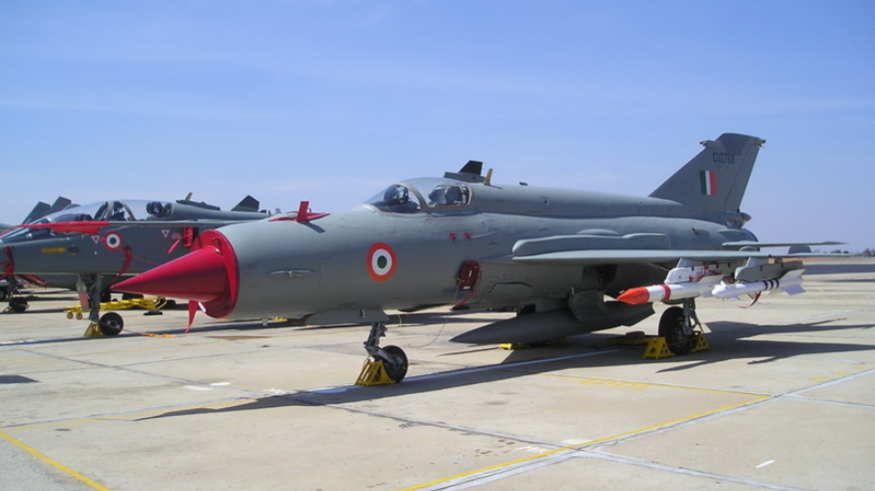
Last flight of the MIG-21

Curtains are set to fall on an era for the Indian Air Force. In September 2025, the IAF will retire the last of its Mig-21 Bison fighter jets. These legacy jets belong to the last two remaining squadrons of Mig-21 Bison. On June 28,2024 the last two remaining squadrons of the Mig-21 Bison had been relocated to the Nal desert fighter base near Bikaner from their home base in Suratgarh in Rajasthan. There the warbirds will take one final flight into the sunset.
The Backbone of the IAF
The Mig-21s in the early 2000s comprised a vast chunk of the Indian Air Force fleet, much like the Su-30mki is today. The first Mig 21s landed in India in early 1963. 3 years later, in 1966, the first Indian made Mig-21 flew took flight from the Nashik facility of HAL (Hindustan Aeronautics Limited).
But those were a far cry from the Migs that we are familiar with today. India’s current Mig-21s are the upgraded Mig-21 Bison or Mig-21 Bis upgrades. For 6 decades they served India through highs and lows and through 3 wars, trading blows with aircraft like the F86 Sabre, the F104 Starfighter and even 4th Generation fighters like the F16.
In that time more than 11,000 MiG-21s, its derivatives and copies, served in as many as 50 air forces all over the globe. This was the world’s most produced supersonic jet fighter ever and arguably the longest-serving fighter jet.
This is truly the end of an era! For its part the Indian Air Force is preparing to bid its own farewel to a favoured warbird
The World’s Fourth Largest Air Power
The IAF today, stands at 33 squadrons. With the phasing out of Mig-21, this will drop to 31 squadron against a sanctioned strength of 42 squadrons for a two front war against China and Pakistan. The Mig-21 is not the only aircraft which needs to be replaced; there’s the SEPECAT Jaguar (6 squadrons), Dassault Mirage-2000 (3 squadrons), and the MiG-29 (3 squadrons). For the foreseeable future, the IAF will rely on the Su-30mki (13 squadrons), Dassault Rafale (2 squadrons) and LCA (Light Combat Aircraft) Mk-1. But are they enough?
The Air Chief Marshal Amarpreet Singh himself highlighted the predicament of the Indian Air Force. “The IAF needs the production of around 35 to 40 fighter jets per year to replace the aging fleet,” he stated.
The most likely replacement for the MiG-21 is India’s homegrown LCA Tejas. The LCA Tejas Mk-1A which is a light , inexpensive and multi-role capable aircraft. India had hoped that a steady assembly line of the LCA will fill its ranks. This however did not happen.
The LCA uses the American-made General Electric F404 jet engine and with supply chain issues, delays in the delivery of these engines hampered the production of LCA Tejas Mk-1A. At Aero India 2025, IAF Chief expressed his lack of confidence to HAL officials regarding the delivery of Tejas Mk-1A. (IAF Chief quote against HAL).
Thankfully, General Electric finally started the long awaited delivery of F404 engines in 2025.
Then there was India’s hunt for a Multi-Role Fighter Aircraft.
The MRFA programme sought the acquisition of 114 advanced fighter jets, at a cost of about $20 billion. This program would bolster India's defense capabilities and address potential threats from regional rivals. At the same time, it would also aid the development of an indigenous ecosystem as these jets would be built in India under the Make in India initiative.
But at the moment, the MRFA programme seems to be going nowhere. There is no information regarding the MRFA (Multi-Role Fighter Aircraft) tender.
An Unlikely Icon
The MiG-21 is a Soviet-era supersonic fighter aircraft designed by the Mikoyan-Gurevich design bureau. It features a delta wing and was originally intended for the role of an interceptor. In 1963, India became the first export customer of the MiG-21, which also became the IAF’s first supersonic jet—transforming the nation’s air combat capabilities. Lightweight and capable of achieving Mach 2 despite its relatively low-powered afterburning turbojet, the MiG-21 was comparable to contemporaries like the American Lockheed Martin F-104 Starfighter, Northrop Grumman F-5 Freedom Fighter, and the French Dassault Mirage III.
The MiG-21 was powered by Tumansky’s R-25 turbojet engine, which replaced the earlier R-13 variant. The R-25 is a two-spool, axial-flow turbojet featuring a new compressor with increased overall pressure ratio and airflow, a variable two-stage afterburner, and greater use of titanium components.
The IAF operated three main variants of the MiG-21: the MiG-21FL, which saw action in the 1965 and 1971 wars; the MiG-21M; and the MiG-21 Bison—both of which were upgraded versions equipped with improved radar systems and weaponry. The MiG-21 Bison remains in service with the IAF to this day.
The Warbird’s Combat Record
The Mig-21 landed in India in 1963, months after India faced the loss of 1962.
In the 1965 War, when Indian Gnats took on the Pakistani F86 sabres and the F104 Starfighter, the MiGs were still finding their own place in the IAF.
It was during the 1971 War, that the Migs came into their own. They intercepted the best that the Pakistan Air Force could offer, achieved air-superiority over the skies of East Pakistan, pummeled enemy ground defences and with a couple of rockets fired at the Governor’s House in Dhaka forced Pakistan to sue for peace. Their ground attack missions were so successful that they earned their nickname as “Runway Busters”.
During the 1999 Kargil War, Mig-21s made history by conducting unprecedented feats of ground attack and reconnaissance on the world’s highest battlefields in the Himalayas. On August 10 1999 two Mig-21FLs of IAF intercepted and shot down a Pakistani Breguet 1150 Atlantic aircraft.
In Feb 2019, 56 years after their inception, IAF MiGs took on 4.5th Gen F16s and JF-17s as India carried out airstrikes in Pakistan’s Balakot. A Mig-21 Bis piloted by Wing Commander Abhinandan shot down a F-16 fighter jet of the Pakistan Air Force. Abhinandan became a national hero and was awarded Vir Chakra for gallantry.
Even in 2025, when India launched Op Sindoor, the last Mig-21 Bison squadron remained on operational alert ready for intercepting any incoming enemy.
“Flying Coffin” or Legacy Fighter?
6 decades of service took a toll on the MiG-21. In India alone, more than 170 Indian pilots and 40 civilians have been killed in 400 crashes since the 1970s. This earned them names like the Flying Coffin and Widow Maker. But is that justified?
It is worth noting that these aircraft served for over 6 decades. The Soviet Union which built the MiG 21 in the first place, retired them in the 1990s. But in India, this widow maker served a purpose. Over 840 fighter aircraft served a country that could not look to so-called “better options” that an unwilling West would provide. It was a small, modest and economical fighter that helped a cash strapped third world nation humble jets from the most advanced powers from the free world. India’s MiGs flew to protect the world’s largest democracy, until their very airframes gave up.
So while the world may mock an ageing widow maker, in September 2025 as the MiG-21 Bis takes off for a final flight. India will remember a warbird that served its purpose and did its duty.
Arjun Dev Singh
Arjun Dev Singh has a deep interest in defence, security, and strategic affairs. With a strong analytical lens and a passion for military and geopolitical developments, Arjun strives to bring clarity and context to complex national and international issues.




Comments